
Filter
474
Text search:
ending
tb
Featured
66
135
Language
Document type
219
114
59
40
21
10
6
2
1
1
1
Countries
32
16
15
14
14
14
13
11
11
10
9
9
9
8
8
8
8
8
7
7
6
5
5
4
4
4
4
3
3
3
2
2
2
2
2
1
1
1
1
1
1
1
1
1
1
1
1
1
1
1
1
1
1
1
1
1
1
1
1
1
1
1
1
1
1
1
1
1
Authors & Publishers
Publication Years
Category
189
26
24
19
12
12
2
1
Toolboxes
122
76
22
21
16
14
8
7
7
7
6
6
5
5
4
4
3
2
2
1
1
1

2nd edition. The 2018 Roadmap incorporates an additional critical population: adolescents. Despite making up 1 in 6 of the world’s people, adolescents have been largely overlooked as global momentum to address TB has grown. Spanning the ages of 10
...
The Roadmap towards ending TB among children and adolescents, third edition builds on the 2013 and 2018 versions. The 2023 version recognizes the progress made over the past five years and outlines
...
The WHO End TB Strategy aims to end the global TB epidemic by 2030, in alignment with Goal 3 of the United Nations (UN) Sustainable Development Goals (SDGs). Member States of the World Health Organi
...
World Health Organization. Country Office for Timor-Leste. (2020). National strategic plan for ending TB 2020--2024. World Health Organization. Country Office for Timor-Leste.
La nueva hoja de ruta para poner fin a la TB en la población infantil y adolescente tiene un amplio público destinatario y alentamos a los países a que la adapten en función de su contexto nacional. Se prevé que utilicen la hoja de ruta los enc
...
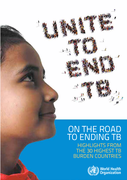
On the road to ending TB
Highlights from the 30 highest TB burden countries
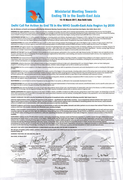
Ministrial Meeting Towards Ending TB in the South-East Asia, 15-16 March 2017, New Dehli India
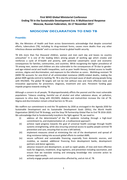
First WHO Global Ministerial Conference
Ending TB in the Sustainable Development Era: A Multisectoral Response
Moscow, Russian Federation, 16-17 November 2017
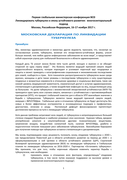
First WHO Global Ministerial Conference
Ending TB in the Sustainable Development Era: A Multisectoral Response
Moscow, Russian Federation, 16-17 November 2017
Первая глобальная
...

While there has been real progress in addressing the burden of disease in the WHO African region, the COVID-19 pandemic has highlighted the link between health, economics and security, as the region saw decades of progress threatened, including positive trends in decreasing inequality. In the Africa
...
The WHO South-East Asia (SEA) Region bears a high burden of tuberculosis (TB) and MDR-TB. In 2015, the Region accounted for nearly 200 000 or 35% of the global estimated new RR/MDR-TB c
...

The Millennium Development Goals (MDGs) showed
that global commitment and collective action
could significantly reduce the disease burdens of
three deadly communicable diseases: HIV/AIDS,
tuberculosis (TB) and malaria. The MDGs helped
focus eff
...
The aim of the people-centred framework is to help countries to develop fully prioritized and budgeted NSPs based on a culture of making full use of the available data, which are aligned with national planning cycles and which provide the basis for a robust national response that can accelerate prog
...

The importance of community and civil society engagement to end TB has been highlighted in various strategies and global commitments. The WHO End TB Strategy, aligned with the United Nations Sustain
...

The World Health Organization and the Global Fund to Fight AIDS, Tuberculosis and Malaria are part of a group of agencies working together to accelerate progress towards the health-related SDGs through the Global Action Plan for Healthy Lives and Well-being for All. Understanding patterns of inequal
...

In an era of constrained resources and tightening budgets, strategic prioritization in tuberculosis (TB) programming is more critical than ever. Countries must make informed decisions to allocate limited resources effectively - maximizing impact, pr
...
