
Filter
355
Featured
35
270
Language
Document type
304
19
11
6
4
2
2
2
1
1
1
1
1
Countries
22
7
6
4
3
2
2
2
2
2
2
2
1
1
1
1
1
1
1
1
1
1
1
1
1
1
1
1
Authors & Publishers
Publication Years
Category
13
12
12
4
4
3
1
Free and open access application that gives you direct access to key updates and reports on communicable disease threats of concern to the EU on your mobile device.
The application is free to use and can be accessed by anyone. ECDC partners can access additional reports by logging in with their ECD
...

WHO guidelines for clinical management of arboviral diseases: dengue, chikungunya, Zika and yellow fever
recommended
The new WHO guidelines provide clinical management recommendations for four of the most widespread arboviruses affecting humans: dengue, chikungunya, Zika, and yellow fever.
An integrated approach is vital, as these four diseases often present with similar symptoms, especially in the early stages
...

Toolkit regarding Zika Virus
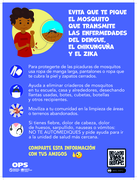
Para protegerte de las picaduras de moquitos usa ropa de manga larga, pantalones o ropa que te cubra la piel y zapatos cerrados
Arbovirus (arthropod-borne virus) is defined as any virus that is transmitted to humans and/or other vertebrates by certain species of blood-feeding arthropods, mostly insects (flies and mosquitoes) and arachnids (ticks). Arbovirus is a descriptive term based on transmission by vectors with particul
...
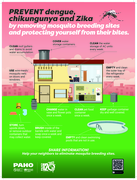
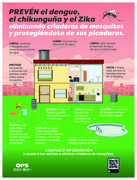
Prevention recommendations at home. PREVENT dengue, chikungunya and Zika by eliminating mosquito breeding sites and protecting yourself from mosquito bites.
Case definitions, clinical classification, and disease phases Dengue, Chikungunya, and Zika
recommended
A person who lives in or has traveled in the previous 14 days to areas with dengue transmission, and presents with acute fever that has typically lasted 2 to 7 days, and two or more of the following clinical manifestations: nausea or vomiting, exanthema, headache or retro-orbital pain, myalgia or ar
...
This document assembles these best practices and provides a resource for the proper management of equipment in the laboratory to ensure accurate, reliable and timely testing, and maintain a high level of laboratory performance. Improved equipment management also lowers repair costs, lengthens instru
...
Zika and dengue viruses remain significant public health threats. These viruses share the same Aedes (Stegomyia) mosquito vectors and geographic distributions but infections cannot be readily distinguished clinically and need to be differentiated from each other, and from other circulating arboviral
...
En la actualidad, las guías basadas en la evidencia constituyen una de las herramientas más útiles para mejorar la salud pública y la práctica clínica. Su finalidad es formular intervenciones con sólidas pruebas de eficacia, evitar riesgos innecesarios, utilizar los recursos de forma eficient
...

Version corregida. En la actualidad, las guías basadas en la evidencia constituyen una de las herramientas más útiles para mejorar la salud pública y la práctica clínica. Su finalidad es formular intervenciones con sólidas pruebas de eficacia, evitar riesgos innecesarios, utilizar los recurso
...
Risk communications
recommended
For public health emergencies, risk communication includes the range of communication capacities required through the preparedness, response and recovery phases of a serious public health event to encourage informed decision making, positive behaviour change and the maintenance of trust.
Risk commu
...
Evidence-based guidelines are one of the most useful tools for improving public health and clinical practice. Their purpose is to formulate interventions based on strong evidence of efficacy, avoid unnecessary risks, use resources efficiently, reduce clinical variability and, in essence, improve hea
...

2nd edition, June 2021
The strategy recommends that AU Member States should enhance, where feasible, existing COVID-19 surveillance to include:
Community-based surveillance to detect symptomatic cases early for treatment and to avert viral transmission;
Sentinel surveillance in high-risk populations to detect
...
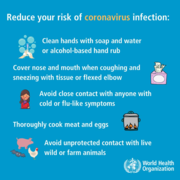
WHO’s standard recommendations for the general public to reduce exposure to and transmission of a range of illnesses are as follows, which include hand and respiratory hygiene, and safe food practices. You can download a range of posters directly at the website
