
Filter
488
Featured
31
17
Language
Document type
90
70
55
50
50
45
31
26
18
15
10
9
7
6
6
Countries
107
27
20
12
7
7
7
7
6
6
6
6
6
5
5
5
4
4
4
4
3
3
3
3
3
3
3
3
3
2
2
2
2
2
2
2
2
2
1
1
1
1
1
1
1
1
1
1
1
1
1
1
1
1
1
1
1
1
1
1
1
1
1
1
1
1
1
1
Authors & Publishers
Publication Years
Category
111
62
45
32
27
19
6
Las Directrices de la OMS sobre la malaria reúnen las recomendaciones más actualizadas de la Organización acerca de la malaria (o paludismo) en una plataforma en línea fácil de usar y de navegar.
La primera versión de las Directrices es una recopilación de las recomendaciones existentes de
...
Flugmedizin · Tropenmedizin · Reisemedizin - FTR 2024; 31(04): 165-206
DOI: 10.1055/a-2351-8414

Die gefährliche Infektionskrankheit "Malaria" tritt auf, wenn die dämmerungs- und nachtaktiven Anopheles-Mücken durch Ihre Stiche Malariaerreger sog. Plasmodien übertragen. Im Folgenden wird die Übertragung von Malaria durch Mücken erläutert und durch eine Grafik und Videoanimation veranschau
...
Die Weltgesundheitsorganisation (WHO) empfiehlt Reisenden in bestimmten Malariagebieten eine medikamentöse Vorsorgebehandlung und / oder die Mitnahme eines Notfallmedikamentes zur Einnahme bei Erkrankung Ihr Reiseziel.

Relapsing malaria caused by Plasmodium vivax parasites poses a significant challenge to global malaria elimination efforts. About one third of the population remains at risk of contracting P. vivax malaria, and 85% of P. vivax infections stem from reactivated latent parasites, leading to chronic ana
...

Meeting report, Kampala, Uganda,
7–8 November 2023
BMJ 2024 Mar 13:384:e077512. doi: 10.1136/bmj-2023-077512.
Co-infections in individuals with malaria are common, particularly in endemic areas, and can significantly impact disease severity and outcomes. Effective management requires prompt diagnosis of both malaria and any co-occurring infections,
...
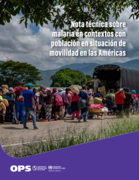
Este documento es una nota técnica con propuestas de intervenciones para la atención, la prevención y la vigilancia de la malaria en poblaciones migrantes y en comunidades de acogida, especialmente en países de Centroamérica, considerando el reciente incremento del número de personas que se mo
...

2nd edition. The purpose of this document is to present updated standardized protocols that P. falciparum-endemic countries can use to determine the prevalence of parasites with pfhrp2/3 gene deletions causing negative HRP2 RDT results among symptomatic falciparum patients. The findings should be us
...

The following appendices of the Guide for introducing a malaria vaccine containing key messages are available for country adaptation

Guide pour l’introduction du vaccin contre le paludisme dans les programmes nationaux de vaccination
Messages clés sur la vaccination antipaludique à adapter par les pays
Annexe 1. Informations sur le vaccin contre le paludisme destinées aux agents de santé (pour l’introduction du vacci
...

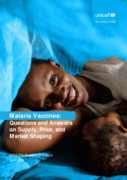
Two malaria vaccines are currently WHO prequalified and recommended1 for use to prevent
P. falciparum malaria in young children, the RTS,S/AS01 vaccine, currently manufactured by
GlaxoSmithKline (GSK), and the R21/Matrix-M vaccine, manufactured by Serum Institute of India
Pvt (SII)

Deux vaccins antipaludiques sont actuellement préqualifiés et recommandés par l'OMS1 pour prévenir
le paludisme à P. falciparum chez les jeunes enfants : le vaccin RTS,S/AS01, actuellement fabriqué par
GlaxoSmithKline (GSK), et le vaccin R21/Matrix-M, fabriqué par Serum Institute of India
...
Lancet Microbe 2024; 5: e519

Lancet 2024; 403: 533–44
R21/Matrix-M was well tolerated and offered high efficacy against clinical malaria in African children. This
low-cost, high-efficacy vaccine is already licensed by several African countries, and recently received a WHO policy
recommendation and prequalification, offerin
...

WHO position paper on malaria vaccines, Weekly Epidemiological Record 10 May 2024
The WHO susceptibility test kit has been extensively used for monitoring of insecticide resistance in disease vectors for many years. Over the years, users have reported issues with these kits and potential improvements to WHO in an ad-hoc manner. To systematically determine whether the reported iss
...

