
Filter
2663
Text search:
case
investigation
Featured
317
682
Language
2528
88
52
38
37
28
12
10
5
4
4
3
3
3
3
3
3
2
2
2
2
2
2
2
2
2
2
2
2
2
1
1
1
1
1
1
1
1
1
1
1
1
1
1
1
1
1
1
1
1
1
1
Document type
1355
493
393
185
121
41
38
24
4
3
3
3
Countries
134
108
84
67
64
60
59
54
48
44
44
43
40
40
39
39
36
32
30
30
30
24
24
23
23
22
21
21
21
20
19
19
19
17
17
16
16
13
13
13
13
13
12
12
12
11
11
11
10
10
9
8
8
7
7
7
6
6
6
6
6
6
6
5
5
4
4
4
4
4
4
4
4
4
4
4
3
3
3
3
3
3
3
3
3
3
2
2
2
2
2
2
2
2
2
2
2
2
2
2
2
2
1
1
1
1
1
1
1
1
1
1
1
1
1
1
1
1
1
1
1
1
1
1
1
Authors & Publishers
469
140
87
73
56
38
25
25
24
21
20
20
17
17
16
14
14
14
13
13
11
10
10
10
10
10
9
9
9
8
8
8
8
8
8
7
7
7
7
7
7
7
7
6
6
6
6
6
6
6
6
6
6
6
6
5
5
5
5
5
5
5
5
5
5
5
5
5
5
5
5
5
5
4
4
4
4
4
4
4
4
4
4
4
4
4
4
4
4
4
4
4
4
4
3
3
3
3
3
3
3
3
3
3
3
3
3
3
3
3
3
3
3
3
3
3
3
3
3
3
3
3
3
3
3
3
3
3
3
3
3
3
3
3
3
3
3
3
3
3
3
3
3
3
3
3
3
3
3
3
3
3
2
2
2
2
2
2
2
2
2
2
2
2
2
2
2
2
2
2
2
2
2
2
2
2
2
2
2
2
2
2
2
2
2
2
2
2
2
2
2
2
2
2
2
2
2
2
2
2
2
2
2
2
2
2
2
2
2
2
2
2
2
2
2
2
2
2
2
2
2
2
2
2
2
2
2
2
2
2
2
2
2
2
2
2
2
2
2
2
2
2
2
2
2
2
2
2
2
2
2
2
2
2
2
2
2
2
2
2
2
2
2
2
2
2
2
2
2
2
2
2
2
2
2
2
2
2
2
2
2
2
2
2
2
1
1
1
1
1
1
1
1
1
1
1
1
1
1
1
1
1
1
1
1
1
1
1
1
1
1
1
1
1
1
1
1
1
1
1
1
1
1
1
1
1
1
1
1
1
1
1
1
1
1
1
1
1
1
1
1
1
1
1
1
1
1
1
1
1
1
1
1
1
1
1
1
1
1
1
1
1
1
1
1
1
1
1
1
1
1
1
1
1
1
1
1
1
1
1
1
1
1
1
1
1
1
1
1
1
1
1
1
1
1
1
1
1
1
1
1
1
1
1
1
1
1
1
1
1
1
1
1
1
1
1
1
1
1
1
1
1
1
1
1
1
1
1
1
1
1
1
1
1
1
1
1
1
1
1
1
1
1
1
1
1
1
1
1
1
1
1
1
1
1
1
1
1
1
1
1
1
1
1
1
1
1
1
1
1
1
1
1
1
1
1
1
1
1
1
1
1
1
1
1
1
1
1
1
1
1
1
1
1
1
1
1
1
1
1
1
1
1
1
1
1
1
1
1
1
1
1
1
1
1
1
1
1
1
1
1
1
1
1
1
1
1
1
1
1
1
1
1
1
1
1
1
1
1
1
1
1
1
1
1
1
1
1
1
1
1
1
1
1
1
1
1
1
1
1
1
1
1
1
1
1
1
1
1
1
1
1
1
1
1
1
1
1
1
1
1
1
1
1
1
1
1
1
1
1
1
1
1
1
1
1
1
1
1
1
1
1
1
1
1
1
1
1
1
1
1
1
1
1
1
1
1
1
1
1
1
1
1
1
1
1
1
1
1
1
1
1
1
1
1
1
1
1
1
1
1
1
1
1
1
1
1
1
1
1
1
1
1
1
1
1
1
1
1
1
1
1
1
1
1
1
1
1
1
1
1
1
1
1
1
1
1
1
1
1
1
1
1
1
1
1
1
1
1
1
1
1
1
1
1
1
1
1
1
1
1
1
1
1
1
1
1
1
1
1
1
1
1
1
1
1
1
1
1
1
1
1
1
1
1
1
1
1
1
1
1
1
1
1
1
1
1
1
1
1
1
1
1
1
1
1
1
1
1
1
1
1
1
1
1
1
1
1
1
1
1
1
1
1
1
1
1
1
1
1
1
1
1
1
1
1
1
1
1
1
1
1
1
1
1
1
1
1
1
1
1
1
1
1
1
1
1
1
1
1
1
1
1
1
1
1
1
1
1
1
1
1
1
1
1
1
1
1
1
1
1
1
1
1
1
1
1
1
1
1
1
1
1
1
1
1
1
1
1
1
1
1
1
1
1
1
1
1
1
1
1
1
1
1
1
1
1
1
1
1
1
1
1
1
1
1
1
1
1
1
1
1
1
1
1
1
1
1
1
1
1
1
1
1
1
1
1
1
1
1
1
1
1
1
1
1
1
1
1
1
1
1
1
1
1
1
1
1
1
1
1
1
1
1
1
1
1
1
1
1
1
1
1
1
1
1
1
1
1
1
1
1
1
1
1
1
1
1
1
1
1
1
1
1
1
1
1
1
1
1
1
1
1
1
1
1
1
1
1
1
1
1
1
1
1
1
1
1
1
1
1
1
1
1
1
1
1
1
1
1
1
1
1
1
1
1
1
1
1
1
1
1
1
1
1
1
1
1
1
1
1
1
1
1
1
1
1
1
1
1
1
1
1
1
1
1
1
1
1
1
1
1
1
1
1
1
1
1
1
1
1
1
1
1
1
1
1
1
1
1
1
1
1
1
1
1
1
1
1
1
1
1
1
1
1
1
1
1
1
1
1
1
1
1
1
1
1
1
1
1
1
1
1
1
1
1
1
1
1
1
1
1
1
1
1
1
1
1
1
1
1
1
1
1
1
1
1
1
1
1
1
1
1
1
1
1
1
1
1
1
1
1
1
1
1
1
1
1
1
1
1
1
1
1
1
1
1
1
1
1
1
1
1
1
1
1
1
1
1
1
1
1
1
1
1
1
1
1
1
1
1
1
1
1
1
1
1
1
1
1
1
1
1
1
1
1
1
1
1
1
1
1
1
1
1
1
1
1
1
1
1
1
1
1
1
1
1
1
1
1
1
1
1
1
1
1
1
1
1
1
1
1
1
1
1
1
1
1
1
1
1
1
1
1
1
1
1
1
1
1
1
1
1
1
1
1
1
1
1
1
1
1
1
1
1
1
1
1
1
1
1
1
1
1
1
1
1
1
1
1
1
1
1
1
1
1
1
1
1
1
1
1
1
1
1
1
1
1
1
1
1
1
1
1
1
1
1
1
1
1
1
1
1
1
1
1
1
1
1
1
1
1
1
1
1
1
1
1
1
1
1
1
1
1
1
1
1
1
1
1
1
1
1
1
1
1
1
1
1
1
1
1
1
1
1
1
1
1
1
1
1
1
1
1
1
1
1
1
1
1
1
1
1
1
1
1
1
1
1
1
1
1
1
1
1
1
1
1
1
1
1
1
1
1
1
1
1
1
1
1
1
1
1
1
1
1
1
1
1
1
1
1
1
1
1
1
1
1
1
1
1
1
1
1
1
1
1
1
1
1
1
1
1
1
1
1
1
1
1
1
1
1
1
1
1
1
1
1
1
1
1
1
1
1
1
1
1
1
1
1
1
1
1
1
1
1
1
1
1
1
1
1
1
1
1
1
1
1
1
1
1
1
1
1
1
1
1
1
1
1
1
1
1
1
1
1
1
1
1
1
1
1
1
1
1
1
1
1
1
1
1
1
1
1
1
1
1
1
1
1
1
1
1
1
1
1
1
1
1
1
1
1
1
1
1
1
1
1
1
1
1
1
1
1
1
1
1
1
1
1
1
1
1
1
1
1
1
1
1
1
1
1
1
1
1
1
1
1
1
1
1
1
1
1
1
1
1
1
1
1
1
1
1
1
1
1
1
1
1
1
1
1
1
1
1
1
1
1
1
1
1
1
1
1
1
1
1
1
1
1
1
1
1
1
1
1
1
1
1
1
1
1
1
1
1
1
1
1
1
1
1
1
1
1
1
1
1
1
1
1
1
1
1
1
1
1
1
1
1
1
1
1
1
1
1
1
1
1
1
1
1
1
1
1
1
1
1
1
1
1
1
1
1
1
1
1
1
1
1
1
1
1
1
1
1
1
1
1
1
1
1
1
1
1
1
1
1
1
1
1
1
1
1
1
1
1
1
1
1
1
1
1
1
1
1
1
1
1
1
1
1
1
1
1
1
1
1
1
1
1
1
1
1
1
1
1
1
1
1
1
1
1
1
1
1
1
1
1
1
1
1
1
1
1
1
1
1
1
1
1
1
1
1
1
1
1
1
1
1
1
1
1
1
1
1
1
1
1
1
1
1
1
1
1
1
1
1
1
1
1
1
1
1
1
1
1
1
1
1
1
1
1
1
1
1
1
1
1
1
1
1
1
1
1
1
1
1
1
1
1
1
1
1
1
1
1
1
1
1
1
1
1
1
1
1
1
1
1
1
1
1
1
1
1
1
1
1
1
1
1
1
1
1
1
1
1
1
1
1
1
1
1
1
1
1
1
1
1
1
1
1
1
1
1
1
1
1
1
1
1
1
1
1
1
1
1
1
1
1
1
1
1
1
1
1
1
1
1
1
1
1
1
1
1
1
1
1
1
1
1
1
1
1
1
1
1
1
1
1
1
1
1
1
1
1
1
1
1
1
1
1
1
1
1
1
1
1
1
1
1
1
1
1
1
1
1
1
1
1
1
1
1
1
1
1
1
1
1
1
1
1
1
1
1
1
1
1
1
1
1
1
1
1
1
1
1
1
1
1
1
1
1
1
1
1
1
1
1
1
1
1
1
1
1
1
1
1
1
1
1
1
1
1
1
1
1
1
1
1
1
1
1
1
1
1
1
1
1
1
1
1
1
1
1
1
1
1
1
1
1
1
1
1
1
1
1
1
1
1
1
1
1
1
1
1
1
1
1
1
1
1
1
1
1
1
1
1
1
1
1
1
1
1
1
1
1
1
1
1
1
1
1
1
1
1
1
1
1
1
1
1
1
1
1
1
1
1
1
1
1
1
1
1
1
1
1
1
1
1
1
1
1
1
1
1
1
1
1
1
1
1
1
1
1
1
1
1
1
1
1
1
1
1
1
1
1
1
1
1
1
1
1
1
1
1
1
1
1
1
1
1
1
1
1
1
1
1
1
1
1
1
1
1
1
1
1
1
1
1
1
1
1
1
1
1
1
1
1
Publication Years
846
1524
270
22
1
Category
991
241
159
139
111
45
40
Toolboxes
310
215
167
152
97
95
87
74
71
70
69
58
53
50
48
45
38
36
34
33
29
23
20
19
10
2

- The goal of diagnostic testing for Ebola and Marburg virus diseases is to identify cases to provide timely and appropriate care and to stop disease transmission.
- All individuals meeting the case definition for Ebola or Marburg virus diseases
...
should be tested.
- The recommended sample type for testing for orthoebolaviruses and orthomarburgviruses is whole blood or plasma for living patients, and oral swab for deceased individuals.
- Laboratory confirmation of Orthoebolavirus and Orthomarburgvirus infections and further species identification should be done using nucleic acid amplification testing (NAAT).
- If a suspected case tests negative (living patient) and the blood was drawn less than 72 hours after symptom onset, a second test should be performed with blood drawn more than 72 hours after symptom onset.
- All manipulations in laboratory settings of samples originating from suspected, probable or confirmed cases of Ebola and Marburg virus diseases should be conducted with appropriate biosafety measures according to a risk-based approach.
- Whole or partial genome sequencing can be used to characterize viruses and complement epidemiologic investigations.
- Member States are strongly encouraged to share genetic sequence data (GSD) in publicly accessible databases.
- Member States are required to immediately notify the World Health Organization (WHO) under the International Health Regulations (IHR) 2005 of positive laboratory results.
more
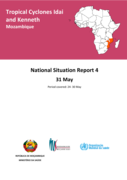
CYCLONE IDAI
1.85M People affected; 400K Displaced; 603 Deaths; 1641 Injured; 1.2M People in need; 6766 Cholera cases; 43556 Malaria case
CYCLONE KENNETH
3214 Displaced; 45 Deaths; 91 Injured; 374K People in need; 225 Cholera cases; 7279 Malari
...
a case
more
Meningitis Outbreak Response in Sub-Saharan Africa
Christina Brandes-Barbier, Véronique Millot, Tomas Allen et al
World Health Organization WHO
(2014)
C_WHO
WHO Guideline. Since 2010, countries in the meningitis belt have started to introduce a new serogroup A meningococcal conjugate vaccine conferring individual protection and herd immunity. Following the successful roll-out of this vaccine, epidemics due to Neisseria meningitidis serogroup A (NmA) are
...
disappearing, but other serogroups (e.g. NmW, NmX and NmC) still cause epidemics, albeit at a lower frequency and of a smaller size. Due to these changes, WHO organized the review of the evidence to provide recommendations for epidemic control, related to operational thresholds for investigation and response to outbreaks, the use of rapid diagnostic tests, antibiotic regimens in epidemics, and prophylaxis for household contacts of cases
more
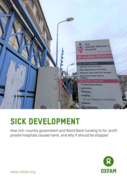
Development finance institutions owned by European governments and the World Bank Group are spending hundreds of millions of dollars on expensive for-profit hospitals in the Global South that block patients from getting care, or bankrupt them, with some even imprisoning patients who cannot afford th
...
eir bills. At the height of the COVID-19 pandemic, some of these same hospitals denied entry to patients suffering from the virus or sold intensive care beds at eyewatering prices to the highest bidder. These development institutions have woefully inadequate safeguards, invest via a complex web of tax-avoiding financial intermediaries, and offer little to zero evidence on the impacts their investments are having. Oxfam is calling on rich-country governments and the World Bank Group to immediately halt their spending on for-profit private healthcare, and for an urgent independent investigation to be conducted into all active and historic investments.
more
This document provides interim recommendations for the surveillance of Zika virus infection, microcephaly and Guillain-Barré syndrome, in four different contexts and describes reporting requirements to WHO. Transmission refers to vector-borne transmission, unless specified differently. Autochthonou
...
s infection is considered to be an infection acquired in-country, i.e. among patients with no history of travel during the incubation period or who have travelled exclusively to non-affected areas during the incubation period. This document does not provide guidance on laboratory investigation or vector surveillance.
more
This Rapid Advice Guideline updates the Interim Guidance on the “Assessment of infants with microcephaly in the context of Zika virus” published in February 2016 (WHO/ZIKV/MOC/16.3). The recommendations provides guidance on the screening, clinical assessment, neuroimaging, laboratory
...
investigation and follow-up of children born to women living in areas of Zika virus transmission. The Guideline summarises the evidence base and rationale in support of the recommendations and expands the scope to address complications beyond microcephaly and what is now referred to as the congenital Zika virus syndrome
more
The aim of this publication is to provide practical guidance for public information officers on the preparation for and response to a nuclear or radiological emergency, and to fulfil in part functions assigned to the IAEA in the Convention on Assistance in the
...
Case of a Nuclear
Accident or Radiological Emergency (Assistance Convention), as well as meeting requirements stated in IAEA Safety Standards Series No. SF-1, Fundamental Safety Principles, and in IAEA Safety Standards No. GS-R-2, Preparedness and Response for a Nuclear or Radiological Emergency.
Also available in Arabic, Chinese, French, Russian and Spanish: https://www-pub.iaea.org/books/IAEABooks/8889/Communication-with-the-Public-in-a-Nuclear-or-Radiological-Emergency
more
Recent efforts to fight malaria in the Greater Mekong Subregion (GMS) have yielded impressive results. According to the latest WHO estimates, the six GMS countries cut their malaria case incidence by an estimated 54% between 2012 and 2015. Malaria d
...
eath rates fell by 84% over the same period.
In May 2015, GMS Ministers of Health adopted the WHO Strategy for malaria elimination in the Greater Mekong Subregion 2015-2030. Urging immediate action, the plan aims to eliminate P. falciparum malaria from the subregion by 2025 and all species of human malaria by 2030. more
In May 2015, GMS Ministers of Health adopted the WHO Strategy for malaria elimination in the Greater Mekong Subregion 2015-2030. Urging immediate action, the plan aims to eliminate P. falciparum malaria from the subregion by 2025 and all species of human malaria by 2030. more
The mandate of the National Tuberculosis Control Programme is to provide leadership and stewardship to accelerate intense and coordinated efforts to reduce the adult TB burden of 290 per 100,000 population recently established in the 2013 National TB Prevalence Survey. Other key challenges are low T
...
B case notification, unacceptably high TB death rates, low antiretroviral therapy (ART) coverage among TB/HIV patients and low drug-resistant notification and treatment.
more

Outstanding child and adolescent TB priorities include the need to: find the missing children with active TB and link them to TB care; prevent TB in children who are in contact with infectious TB cases (through implementation of active contact investigatio
...
n and provision of preventive treatment); and advance integration within general child health services, including maternal and child health/ reproductive, maternal, newborn, child and adolescent health, HIV, nutrition and other programmes.
more

Purpose: This research study aimed to investigate the effectiveness of the services provided by CBR programmes in Jordan.
Method: This was a mixed- methods investigation. A survey was carried out with 47 participants (stakeholders and volunteers) f
...
rom four CBR centres in Jordan. It comprised 18 questions that collected both qualitative and quantitative data with both closed- and open-ended questions. The quantitative data were analysed using SPSS Version 22.0. Qualitative data were analysed through thematic content analysis and open coding to identify emergent themes.
Results: 40.4% of the participants evaluated the effectiveness of CBR services as low. This mainly stemmed from the lack of efforts to increase the local community’s knowledge about CBR, disability and the role of CBR programmes towards people with disabilities.
Conclusions: A proposal was offered concerning the priorities of CBR programmes in Jordan. Efforts need to be directed at promoting livelihood and empowerment components in order to actualise the principles of CBR, mainly by promoting multispectral collaboration as a way of operation.
Implications: This study was inclusive of all types of disability. Barriers to the effectiveness of services may stem from accessibility issues to the families of persons with disabilities (hard to reach) or from CBR services themselves (hard to access). The culturally specific evaluative tool in this study was of “good” specificity and sensitivity, this evaluative instrument can be transferrable to measure the impact of CBR programmes in other settings.
more
International Journal of Mental Health Systems December 2011, 5:3
Community mental health programs in low-income countries face a number of challenges. Using a case study methodology developed for this purpose, it is possible to compare programs an
...
d begin to assess the effectiveness of diverse service delivery models
more
Since May 2019, Confirmation of 4 new emergence of type 2 vaccine-derived poliovirus (VDPV2) in Bambari (2) and Bimbo (2) health districts without any genetic link between them and other known viruses ; Bambari Health District: CAF-RS4-BAM-19-058, onset of paralysis: May 02, 2019. 07 positive contac
...
ts with the same genetic link. Community samples CAF-RS4-BAM-19-058CC14 and CAF-RS4-BAM-19-058CC17 positive, genetically related to each other but not genetically linked to the CAF-RS4-BAM-19-058 index case (new emergence)
more

The issue of Antimicrobial resistance has become one of the most substantial health issues, prompting the World Health Assembly (WHA) to urge Member States to finalise tailor made national action plans by May 2017, aligning them with objectives of the Global Action Plan (GAP). These cover awareness,
...
surveillance and research, hygiene infection prevention & control, optimal use of antimicrobial medicines and economic case for sustainable investment. Indonesia, by virtue of its geographical terrain and complex interactions with diverse stakeholders, indicates a higher burden of AMR. Most of the country’s data currently relies on local studies conducted by labs and universities. To get a more accurate estimate of the situation, one has to rely on results from the Regional Resistance Surveillance Programme. By undertaking such measure, Indonesia would acquire data to detect AMR trends at a national level.
more
The Table Top (TTX) COVID-19 exercise is a tool that has been developed to assist Governments and Agencies in the process of strengthening plans and policies with the intention of being able to identify and contain and outbreak of COVID19 in the country. The TTX Simulation is designed to support the
...
use of the “WHO Operational Readiness Benchmarks for COVID-19” (see in reference documents provided). This exercise uses the scenario of an imported case, as the base for a detailed discussion guided by the exercise facilitator.
more

A pocket guide to antibiotic prescribing for adults in South Africa 2015
Wasserman, S.; T. Boyles, M. Mendelson
SOUTH AFRICAN ANTIBIOTIC STEWARDSHIP PROGRAMME (SAASP)
(2015)
C2
The international community sits at the tipping pointof a post-‐antibiotic era, where common bacterial infections are no longer treatable with the antibiotic armamentarium that exists. In South Africa, t
...
he identification of the first case of pan-‐resistant Klebsiella pneumoniae(Brink et al, J Clin Microbiol. 2013;51(1):369-‐72) marks a watershed moment and highlights ourtip of the antibiotic resistance ‘iceberg’ in this country. Multi-‐drug resistant (MDR)-‐bacterial infections, predominantly in Gram-‐negative bacteria such as Klebsiella pneumoniae, Escherichia coli, Pseudomonas aeruginosaand Acinetobacter baumanniiare now commonplace in South African hospitals. Whilst a number of expensive new antibiotics for Gram-‐positive bacterial infections have been manufactured recently (some of which are licenced for usein South Africa), no new antibiotics active against Gram-‐negative infections are expected in the next 10-‐15years. Hence what we have now, needs conserving
more

13 May 2021
To avoid a reversal of progress from the adverse impacts of the COVID-19 pandemic, new knowledge and lessons from successful programmatic innovations are urgently needed to improve TB prevention and care. Experience can provide evidence for innovative approaches and strategies to mainta
...
in and scale up high-quality TB services. WHO therefore called for case studies on programmatic innovations that address emerging challenges in TB prevention and care during the pandemic in order to collect and disseminate the findings to the TB community. Between November 2020 and February 2021, a total of 23 case studies relevant to the call were accepted from 19 countries in the six regions of WHO. The lessons learnt from these country activities to ensure the continuity of essential services like TB care in the face of the crippling crisis may also inform strategies for minimizing the impact of future emerging pathogens on health services.
more
The Boston Medical Center Patient Navigation Toolkit
The Boston Medical Center AVON Foundation for Women
The Boston Medical Center AVON Foundation for Women
(2020)
C1
This toolkit is designed to help you plan and implement a Patient Navigation program with the best chance of reducing health disparities and improving health outcomes for your patients. It contains evidence-based and experience-based examples, case
...
studies, practical tools, and resources to help you:
1. Establish an evidence-based patient navigation program tailored to reduce barriers for your patients
2. Incorporate best practices to enhance current patient navigation programs or services
3. Implement a patient navigation model to address any targeted medical condition
where disparities exist
4. Hire, prepare, supervise, support and retain effective Patient Navigators
5. Navigate patients who experience health disparities
6. Evaluate patient navigation programs with the aim of continuous quality
improvement
more

This guidance provides interim guidance for the integration of SARS-CoV-2 and influenza virologic and genomic surveillance, from sentinel site case enrolment and sampling to the eventual sharing of the virus sequence data, a process known as end-to-
...
end surveillance. This guidance builds on experiences and lessons learned as countries adapted their influenza surveillance systems in the context of the COVID-19 pandemic and reviews new evidence to provide guidance on end-to-end surveillance. The guidance includes new algorithms and strategies to adapt sentinel systems to make them resilient and agile for addressing global and national surveillance needs for influenza and COVID-19.covid-
more

The Updated guidelines on Management of tuberculosis in children and adolescents include new recommendations that cover diagnostic approaches for TB, shorter treatment for children with non-severe drug-susceptible TB, a new option for the treatment of TB meningitis, the use of bedaquiline and delama
...
nid in young children with multidrug- and rifampicin-resistant TB and decentralized and family-centred, integrated models of care for TB case detection and prevention in children and adolescents.
more
