
Filter
399
Text search:
World
Federation
for
Mental
Health
Featured
Recommendations
48
New Publications
74
Language
Document type
No document type
222
Studies & Reports
63
Guidelines
53
Manuals
27
Strategic & Response Plan
19
Training Material
7
Fact sheets
4
Situation Updates
2
App
1
Resource Platforms
1
Countries / Regions
Global
24
Ukraine
14
Western and Central Europe
14
India
9
Syria
9
Nigeria
8
Eastern Europe
7
South Sudan
5
Myanmar / Burma
5
Latin America and the Carribbean
5
Nepal
4
Malawi
4
Mozambique
4
Namibia
4
Liberia
3
Congo, Democratic Republic of
3
Ethiopia
3
Zambia
3
Kenya
3
Tanzania
3
Venezuela
3
Russia
3
Guinea
2
Sierra Leone
2
Uganda
2
Philippines
2
Jordan
2
Rwanda
2
Bangladesh
2
Eswatini/ Swaziland
2
Colombia
2
Lesotho
2
Yemen
2
Eastern Europe and Central Asia
2
Asia
2
Albania
2
Tajikistan
2
Cameroon
1
Pakistan
1
Germany
1
Turkey
1
Cambodia
1
Indonesia
1
Malaysia
1
South Africa
1
Brazil
1
Hungary
1
Botswana
1
Angola
1
Africa
1
Poland
1
Romania
1
Moldova
1
Kazakhstan
1
United Kingdom
1
Portugal
1
Azerbaijan
1
Belarus
1
Authors & Publishers
Publication Years
Category
Countries
88
Key Resources
41
Clinical Guidelines
29
Women & Child Health
25
Public Health
22
Capacity Building
10
Pharmacy & Technologies
3
Toolboxes
Mental Health
65
Disability
41
Conflict
31
HIV
31
COVID-19
31
TB
19
Refugee
18
Planetary Health
14
Caregiver
9
NTDs
9
NCDs
8
Natural Hazards
7
Rapid Response
7
Global Health Education
7
Pharmacy
7
Ebola & Marburg
3
Zika
1
Specific Hazards
1
Social Ethics
1
Health Financing Toolbox
1
2.0 Rapid Response
1

Guidelines for WHO Representatives and Country
Offices in the Western Pacific Region
The WHO Regional Office for Europe has established the Childhood Obesity Surveillance Initiative in more than half the countries in the Region for routine monitoring of the policy response to the em
...
The WHO European Office for the Prevention and Control of Noncommunicable Diseases organized an expert meeting on monitoring of digital marketing of unhealthy products to children and adolescents in June 2018. Based on that meeting, this report aims
...
The WHO COVID-19 Clinical management: living guidance contains the most up-to-date recommendations for the clinical management of people with COVID-19. Providing guidance that is comprehensive and holistic
...

The Updated guidelines on Management of tuberculosis in children and adolescents include new recommendations that cover diagnostic approaches for TB, shorter treatment for children with non-severe d
...

Communities can play a critical role in suicide prevention. Facilitating community engagement in suicide prevention is an important task. The toolkit is a step-by-step guide for communities to engage in suicide prevention activities and have ownersh
...

While there has been real progress in addressing the burden of disease in the WHO African region, the COVID-19 pandemic has highlighted the link between health, economics and security, as the region saw decades of progress threatened, including posi
...

Quality of care in fragile, conflict-affected and vulnerable settings: tools and resources compendium
recommended
This compendium represents a curated, pragmatic and non-prescriptive collection of tools and resources to support the implementation of interventions to improve quality of care in such contexts. Relevant tools and resources are listed under five areas: Ensuring access and basic infrastructure
...

Getting on track to end AIDS as a public health threat by 2030. This new Road Map charts a way forward for country-level actions to achieve an ambitious set of HIV prevention targets by 2025. Those
...

Saving lives is the priority of WHO’s response in Ukraine. WHO works to ensure time-critical, lifesaving multisectoral assistance, non-discriminatory access to emergency and essential health services and priority prevention programmes, and laying
...

This technical guidance outlines current evidence, knowledge and best practice relating to incidences of violence and injuries among refugees and migrants in the WHO European Region. It highlights key principles, summarizes priority actions and challenges, maps existing international commitments and
...
• provide scientific information on the safety, efficacy, and quality control/ quality assurance of widely used medicinal plants, in order to facilitate their appropriate use in Member States;
• provide models to assist Member States in developing their own mono- graphs or formularies
...
WHO has issued a new recommendation on the length of bladder catheterization following surgical repair of a simple obstetric urinary fistula. Currently the length of catheterization is not standard and ranges from 5 to 42 days. The new guidance recommends a 7–10 day period of bladder catheterizati
...
As of 12 December 2022, over 645 million people worldwide have been diagnosed with COVID-19, with over 6.6 million deaths (4).
The Omicron variant, which emerged in late November 2021, and its subvariants, are now the dominant circulating viruses, contributing to the ongoing surge in several countr
...
Updated 2022. This guide addresses the care pathway from presentation of the patient to a health facility to patient discharge. It considers different levels of disease severity, from asymptomatic individuals to critically ill patients. Accounting
...
The seventh WHO Report on the global tobacco epidemic analyses national efforts to implement the most effective measures from the WHO Framework Convention on Tobacco Control (WHO FCTC) that are proven to reduce demand for tobacco.
The report show
...
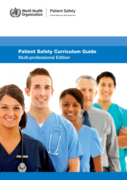
The Multi-professional Patient Safety Curriculum Guide (2011) was developed to assist in the teaching of patient safety in universities and schools in the fields of dentistry, medicine, midwifery, nursing and pharmacy. It also supports the on-going training of all
...
Vitamin D deficiency is thought to be common among pregnant women, particularly during the winter months, and has been found to be associated with an increased risk of pre-eclampsia, gestational diabetes mellitus, preterm birth, and other tissue-specific conditions.
This guideline is intended
...
The International Pharmaceutical Federation (FIP) is the global body representing over 4 million pharmacists and pharmaceutical scientists. We work to meet the world's
...
Guidance for addressing a global infodemic and fostering demand for immunization
December 2020
Misinformation threatens the success of vaccination programs across the
...
