Filter
2001
Text search:
exposure
to
violence
Featured
191
528
Language
1938
52
34
25
22
10
7
7
4
3
3
3
3
3
2
2
2
2
2
2
2
2
2
2
2
2
1
1
1
1
1
1
1
1
1
1
1
1
1
1
1
Document type
1153
356
215
106
84
31
25
17
5
5
1
Countries / Regions
96
73
73
47
46
44
39
38
38
34
33
33
32
31
30
29
28
28
27
25
21
19
18
18
17
16
16
15
15
14
13
13
12
11
11
10
10
9
8
8
8
7
7
7
7
6
6
6
5
5
5
5
5
5
5
4
4
4
4
3
3
3
3
3
3
2
2
2
2
2
2
2
2
2
2
2
2
2
2
2
2
2
2
2
1
1
1
1
1
1
1
1
1
1
1
1
1
1
1
1
1
1
1
1
1
1
1
1
1
1
1
1
Authors & Publishers
226
93
86
57
54
50
33
31
30
27
24
23
23
20
19
16
14
14
11
11
10
9
9
9
9
8
8
8
8
8
8
8
8
7
7
7
7
7
6
6
6
6
6
6
6
6
6
6
5
5
5
5
5
5
5
5
5
5
5
5
5
4
4
4
4
4
4
4
4
4
4
4
4
4
4
4
4
4
4
4
4
4
4
4
4
4
4
4
4
4
4
3
3
3
3
3
3
3
3
3
3
3
3
3
3
3
3
3
3
3
3
3
3
3
3
3
3
3
3
3
3
3
3
3
3
3
3
3
3
3
3
3
3
3
3
3
3
3
3
3
3
3
3
3
3
3
2
2
2
2
2
2
2
2
2
2
2
2
2
2
2
2
2
2
2
2
2
2
2
2
2
2
2
2
2
2
2
2
2
2
2
2
2
2
2
2
2
2
2
2
2
2
2
2
2
2
2
2
2
2
2
2
2
2
2
2
2
2
2
2
2
2
2
2
2
2
2
2
2
2
2
2
2
2
2
2
2
2
2
2
2
2
2
2
2
2
2
2
2
2
2
2
2
2
2
2
2
2
2
2
2
2
2
2
2
2
1
1
1
1
1
1
1
1
1
1
1
1
1
1
1
1
1
1
1
1
1
1
1
1
1
1
1
1
1
1
1
1
1
1
1
1
1
1
1
1
1
1
1
1
1
1
1
1
1
1
1
1
1
1
1
1
1
1
1
1
1
1
1
1
1
1
1
1
1
1
1
1
1
1
1
1
1
1
1
1
1
1
1
1
1
1
1
1
1
1
1
1
1
1
1
1
1
1
1
1
1
1
1
1
1
1
1
1
1
1
1
1
1
1
1
1
1
1
1
1
1
1
1
1
1
1
1
1
1
1
1
1
1
1
1
1
1
1
1
1
1
1
1
1
1
1
1
1
1
1
1
1
1
1
1
1
1
1
1
1
1
1
1
1
1
1
1
1
1
1
1
1
1
1
1
1
1
1
1
1
1
1
1
1
1
1
1
1
1
1
1
1
1
1
1
1
1
1
1
1
1
1
1
1
1
1
1
1
1
1
1
1
1
1
1
1
1
1
1
1
1
1
1
1
1
1
1
1
1
1
1
1
1
1
1
1
1
1
1
1
1
1
1
1
1
1
1
1
1
1
1
1
1
1
1
1
1
1
1
1
1
1
1
1
1
1
1
1
1
1
1
1
1
1
1
1
1
1
1
1
1
1
1
1
1
1
1
1
1
1
1
1
1
1
1
1
1
1
1
1
1
1
1
1
1
1
1
1
1
1
1
1
1
1
1
1
1
1
1
1
1
1
1
1
1
1
1
1
1
1
1
1
1
1
1
1
1
1
1
1
1
1
1
1
1
1
1
1
1
1
1
1
1
1
1
1
1
1
1
1
1
1
1
1
1
1
1
1
1
1
1
1
1
1
1
1
1
1
1
1
1
1
1
1
1
1
1
1
1
1
1
1
1
1
1
1
1
1
1
1
1
1
1
1
1
1
1
1
1
1
1
1
1
1
1
1
1
1
1
1
1
1
1
1
1
1
1
1
1
1
1
1
1
1
1
1
1
1
1
1
1
1
1
1
1
1
1
1
1
1
1
1
1
1
1
1
1
1
1
1
1
1
1
1
1
1
1
1
1
1
1
1
1
1
1
1
1
1
1
1
1
1
1
1
1
1
1
1
1
1
1
1
1
1
1
1
1
1
1
1
1
1
1
1
1
1
1
1
1
1
1
1
1
1
1
1
1
1
1
1
1
1
1
1
1
1
1
1
1
1
1
1
1
1
1
1
1
1
1
1
1
1
1
1
1
1
1
1
1
1
1
1
1
1
1
1
1
1
1
1
1
1
1
1
1
1
1
1
1
1
1
1
1
1
1
1
1
1
1
1
1
1
1
1
1
1
1
1
1
1
1
1
1
1
1
1
1
1
1
1
1
1
1
1
1
1
1
1
1
1
1
1
1
1
1
1
1
1
1
1
1
1
1
1
1
1
1
1
1
1
1
1
1
1
1
1
1
1
1
1
1
1
1
1
1
1
1
1
1
1
1
1
1
1
1
1
1
1
1
1
1
1
1
1
1
1
1
1
1
1
1
1
1
1
1
1
1
1
1
1
1
1
1
1
1
1
1
1
1
1
1
1
1
1
1
1
1
1
1
1
1
1
1
1
1
1
1
1
1
1
1
1
1
1
1
1
1
1
1
1
1
1
1
1
1
1
1
1
1
1
1
1
1
1
1
1
1
1
1
1
1
1
1
1
1
1
1
1
1
1
1
1
1
1
1
1
1
1
1
1
1
1
1
1
1
1
1
1
1
1
1
1
1
1
1
1
1
1
1
1
1
1
1
1
1
1
1
1
1
1
1
1
1
1
1
1
1
1
1
1
1
1
1
1
1
1
1
1
1
1
1
1
1
1
1
1
1
1
1
1
1
1
1
1
1
1
1
1
1
1
1
1
1
1
1
1
1
1
1
1
1
1
1
1
1
1
1
1
1
1
1
1
1
1
1
1
1
1
1
1
1
1
1
1
1
1
1
1
1
1
1
1
1
1
1
1
1
1
1
1
1
1
1
1
1
1
1
1
1
1
1
1
1
1
1
1
1
1
1
1
1
1
1
1
1
1
1
1
1
1
1
1
1
1
1
1
1
1
1
1
1
1
1
1
1
1
1
1
1
1
1
1
1
1
1
1
1
1
1
1
1
1
1
1
1
1
1
1
1
1
1
1
1
1
1
1
1
1
1
1
1
1
1
1
1
1
1
1
1
1
1
1
1
1
1
1
1
1
1
1
1
1
1
1
1
1
1
1
1
1
1
1
1
1
1
1
1
1
1
1
1
1
1
1
1
1
1
1
1
1
1
1
1
1
1
1
1
1
1
1
1
1
1
1
1
1
1
1
1
1
1
1
1
1
1
1
1
1
1
1
1
1
1
1
1
1
1
1
1
1
1
1
1
1
1
1
1
1
1
1
1
1
1
1
1
1
1
1
1
1
1
1
1
1
1
1
1
1
1
1
1
1
1
1
1
1
1
1
1
1
1
1
1
1
1
1
1
1
1
1
1
1
1
1
1
1
1
1
1
1
1
1
1
1
1
1
1
1
1
1
1
1
1
1
1
1
1
1
1
1
1
1
1
1
1
1
1
1
1
1
1
1
1
1
1
1
1
1
1
1
1
1
1
1
1
1
1
1
1
1
1
1
1
1
1
1
1
1
1
1
1
1
1
1
1
1
1
1
1
1
1
1
1
1
1
1
1
1
1
1
1
1
1
1
1
1
1
1
1
1
1
1
1
1
1
1
1
1
1
1
1
1
1
1
1
1
1
1
1
1
1
1
1
1
1
1
1
1
1
1
1
1
1
1
1
1
1
1
1
1
1
1
1
1
1
1
1
1
1
1
1
1
1
1
1
1
1
1
1
1
1
1
1
1
1
1
1
1
1
1
1
1
1
1
1
1
1
1
1
1
1
1
1
1
1
1
1
1
1
1
1
1
1
1
1
1
1
1
1
1
1
1
1
1
1
1
1
1
1
1
1
1
1
1
1
1
1
1
1
1
1
1
1
1
1
1
1
1
1
1
1
1
1
1
1
1
1
1
1
1
1
1
1
1
1
1
1
1
1
1
1
1
1
1
1
1
1
1
1
1
1
1
1
1
1
1
1
1
1
1
1
1
1
1
1
1
1
1
1
1
1
1
1
1
1
1
1
1
1
1
1
1
1
1
1
1
1
1
1
1
1
1
1
1
1
1
1
1
1
1
1
1
1
1
1
1
1
1
1
1
1
1
1
1
1
1
1
1
1
1
1
1
1
1
1
1
1
1
1
1
1
1
1
1
1
1
1
1
1
1
1
1
1
1
1
1
1
1
1
1
1
1
1
1
1
1
1
1
1
1
1
1
1
1
1
1
1
1
1
1
1
1
1
1
1
1
1
1
1
1
1
1
1
1
1
1
1
1
1
1
1
1
1
1
1
1
1
1
1
1
1
1
1
1
1
1
1
1
1
1
Publication Years
621
1226
150
4
Category
745
143
131
88
68
28
Toolboxes
318
203
187
114
70
66
65
42
42
40
34
33
14
11
10
9
8
8
7
6
5
5
2
2
2
1
NSW Health Disaster Mental Health, handbook 3
The Disaster Mental Health Manual and associated handbooks are intended as a resource for mental health staff who are seeking background information and practical guidance and resources to assist in a d
...
isaster mental health response.
more
In Control. A Practical Handbook for Professionals Working in Health Emergencies Internationally
recommended
In Control imparts knowledge, provokes reflection and triggers curiosity. The first half of the book provides an overview of the organisations, principles, frameworks and themes that every professional deploying to health emergencies should be aware
...
of. The second half of the book provides practical advice to help professionals survive and thrive during their mission – from staying healthy, protecting oneself from cyber-attacks and coping with stress to building trust among the host community or dealing with language barriers and the press.
This handbook is free of charge and can be made available in small quantities as long as supply lasts. To order, please send this form to: incontrol-handbook@rki.de
more
Countries reported disruptions in all health-care settings. In more than half of countries surveyed, many people are still unable to access care at the primary care and community care levels. Significant disruptions have also been reported in emerg
...
ency care, particularly concerning given the impact on people with urgent health needs. Thirty-six per cent of countries reported disruptions to ambulance services; 32% to 24-hour emergency room services; and 23% to emergency surgeries.
Elective surgeries have also been disrupted in 59% of countries, which can have accumulating consequences on health and well-being as the pandemic continues. Disruptions to rehabilitative care and palliative care were also reported in around half of the countries surveyed.
Major barriers to health service recovery include pre-existing health systems issues which have been exacerbated by the pandemic as well as decreased demand for care.
more
This report provides an overview of the operations and activities of the WHO Country Office in Ukraine in 2023. Despite the acute health impacts of the war in Ukraine, the Country Office continued its work according to its core mandate. WHO supporte
...
d the Government of Ukraine in managing the health emergency and pursued existing priorities set out in WHO’s Thirteenth General Programme of Work 2019–2023, the European Programme of Work 2020–2025, and the Biennial Collaborative Agreement 2022–2023 signed with the Government of Ukraine. The report presents the achievements of the WHO Country Office in Ukraine in 2023 in the context of the war’s impact on the lives, health, and well-being of Ukrainians.
more
PEPFAR Malawi’s Country Operational Plan 2022 (COP22) embodies joint priorities from national and subnational dialogues building on the 2020-2025 National Strategic Plan for HIV/AIDS. The interagency team has developed a person-centered, district-tailored and Malawi Population-Based HIV Impact Ass
...
essment (MPHIA)-informed strategy through extensive engagement with Government of Malawi (GoM) and Civil Society Organizations (CSOs) to sustain HIV epidemic control. At the end of COP21, PEPFAR Malawi was commended for contributing to reaching epidemic control in strong collaboration with GoM and stakeholders including the Global Fund to Fight AIDS, Tuberculosis and Malaria (Global Fund). This includes enrollment of 88% of recipients of care on three or more months of antiretroviral treatment (ART), better outcomes for Malawian children through remarkable efforts in Orphans and Vulnerable Children (OVC) programming and progress made towards reaching men with more intentional and focused programming.
more
Findings from a cross-sectional qualitative study of HIV vulnerabilities among People Who Inject Drugs and their sex partners in Bihar and Manipur, India. The study is one of the first qualitative comparative studies to seek an in-depth understandin
...
g of the vulnerabilities to HIV acquisition among PWID in the states of Manipur and Bihar
more
This guidelines is aimed at humanitarian and human rights actors engaged in protection work, and is intended to act as an easy reference to the minimum standards
...
to be met and the recommended guidelines to be followed in such work.
The 45 standards and 15 guidelines are reproduced in full, together with a short explanation in each case of the main challenges they are designed to address
more
2021 UNAIDS Global AIDS Update. UNAIDS report shows that people living with HIV face a double jeopardy, HIV and COVID-19, while key populations and children continue to be left behind in access to H
...
IV services
more
The World Climate and Security Report 2021
Brock, S.; Barrett, O.L.; Birkman, L.; et al.
International Military Council on Climate and Security
(2021)
CC
The World Climate and Security Report (WCSR) 2021 from the Expert Group of the International
Military Council on Climate and Security is a global assessment of the security dimensions of a changing
climate and effective means to address them. It i
...
s intended to inform timely climate and security policy
and action, and builds upon the analysis in the first WCSR, released in February 2020.
more
The World Climate and Security Report 2021_2
Brock, S.; Barrett, O.L.; Birkman, L.; et al.
International Military Council on Climate and Security
(2021)
C1
The World Climate and Security Report (WCSR) 2021 from the Expert Group of the International Military Council on Climate and Security is a global assessment of the security dimensions of a changing climate and effective means to address them. It is
...
intended to inform timely climate and security policy and action, and builds upon the analysis in the first WCSR, released in February 2020.
more
The report provides a global knowledge base on suicide and suicide attempts as well as actionable steps for countries based on their current resources and context to move forward in suicide prevention.
Following an overview of maternal and neonatal child health in Nepal and in the districts covered by the project, the briefing outlines the background to the Strengthening Approaches for Maximizing Maternal, Neonatal and Reproductive Health (SAMMAN)
...
project. It then describes the key aspects of the two main project approaches: one focused on the community level, and the other on health systems
more
The Republic of the Union of Myanmar’s National Strategic Plan on HIV/AIDS 2016–2020 is the strategic guide for the country’s response to HIV at national, state/regional and local levels. The framework describes the current dynamics of the HIV
...
epidemic and articulates a strategy to optimize investments through a fast track approach with the vision of ending HIV as a public health threat by 2030. Myanmar’s third National Strategic Plan (HIV NSP III) issues a call to all partners to front-load investments to close the testing gap and reach the 90–90–90 prevention and treatment targets to protect health for all.
more
USAID/KENYA Evaluation Services and Program Support (ESPS)
The United States Agency for International Development (USAID) has a solid track record of supporting health and development initiatives in Kenya. AIDS, Population, and Health Integrated Assistance (APHIA) is the agency’s flagship hea ... lth initiative in the country. APHIA is currently in its third iteration, APHIAPlus, which began in January 2011 and is slated to end in December 2015. APHIAPlus was designed to contribute to Result 3 (“Increased use of quality health services, products, and information”) and Result 4 (“Social determinants of health”) of USAID/Kenya’s implementation framework. The main technical areas of focus are HIV/AIDS; malaria; family planning (FP); tuberculosis (TB); maternal, newborn, and child health (MNCH); and water, sanitation, and hygiene (WASH). more
The Community Action Research on Disability (CARD) programme in Uganda embraced and modified the EDR approach, recognising the need for including people with disability in the research process from concept to outcome, and nurturing participation and
...

collaboration between all the stakeholders in achieving action-based research. T
more
At present at least 2.2 billion people around the world have a vision impairment, of whom at least 1 billion have a vision impairment that could have been prevented or is yet to be addressed. The world faces considerable challenges in terms of eye c
...
are, including inequalities in the coverage and quality of prevention, treatment and rehabilitation services; a shortage of trained eye care service providers; and poor integration of eye care services into health systems, among others. The World report on vision aims to address these challenges and galvanize action.
more
Antimicrobial resistance (AMR) is an important public health concern shared by developed and developing countries. In developing countries the burden of infectious diseases is greater and exacerbated by limited access to, and availability and afford
...
ability of, antimicrobials required to treat infections caused by AMR organisms. With drugs not listed on the essential drugs list (EDL), problems of increased morbidity, costs of extended hospitalisation and mortality are extremely serious. The problem of susceptibility to and spread of infections caused by multidrug-resistant (MDR) infectious agents is fuelled by factors such as limited access to clean water and sanitation to ensure personal hygiene, malnutrition, and the HIV/TB epidemic.
more
COVID-19 has resulted in an unprecedented global crisis. As the pandemic spreads and countries around the world continue to struggle to contain its health and socio-economic consequences, UNRWA is i
...
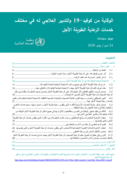
ssuing a new humanitarian appeal from August through December 2020 to address the worst impacts of the pandemic on Palestine refugees across the Agency’s five fields of operation. Through this appeal the Agency seeks US$ 94.6 million. The funds requested in this appeal are additional to the previous UNRWA COVID-19 appeal for March to July.
more
Policy brief, 24 July 2020
The COVID-19 pandemic has affected older people disproportionately, especially those living in long-term care facilities. In many countries, evidence shows that more than 40% of COVID-19 related deaths have been linked to
...
long-term care facilities, with figures being as high as 80% in some high-income countries. Concerted action is needed to mitigate the impact across all aspects of long-term care, including home- and community-based care, given that most users and providers of care are those who are vulnerable to severe COVID-19.
This policy brief provides 11 policy objectives and key action points to prevent and manage COVID-19 across long-term care. Its intended audience is policy makers and authorities (national, subnational and local) involved in the COVID-19 pandemic. The brief builds on currently available evidence on the measures taken to prevent, prepare for and respond to the COVID‑19 pandemic across long-term care services including care providers
more
Health in All Policies: A Guide for State and Local Governments was created by the Public Health Institute, the California Department of Public Health, and the American Public Health Association in response to growing interest in using collaborativ
...

e approaches to improve population health by embedding health considerations into decision-making processes across a broad array of sectors. The Guide draws heavily on the experiences of the California Health in All Policies Task Force and incorporates information from the published and gray literature and interviews with people across the country.
The guide was developed through funding from the American Public Health Association and The California Endowment.
more