
Filter
909
Text search:
amr
Featured
77
148
Language
Document type
272
179
139
79
67
43
28
21
18
18
17
13
12
1
Countries
31
30
27
23
16
14
14
10
9
8
7
7
6
6
6
6
6
6
6
6
5
5
5
4
4
4
4
4
4
3
3
3
3
3
3
3
3
3
3
3
3
3
3
2
2
2
2
2
2
2
2
2
2
2
2
2
2
1
1
1
1
1
1
1
1
1
1
1
1
1
1
1
1
1
1
1
1
1
1
1
1
1
1
1
1
1
1
1
1
1
1
1
1
1
1
1
1
1
1
1
1
1
1
Authors & Publishers
Publication Years
Category
166
61
33
27
13
12
8
2
Toolboxes
577
60
34
33
25
20
19
19
17
15
12
11
10
9
8
5
5
5
4
4
3
2
1
Nosocomial infections, or hospital-acquired infec-tions (HAI), are among the most significant causesof morbidity and mortality in healthcare settingsthroughout the world.Prevention of HAIs iscentral to providing high quality and safe health-care, even in settings with limited resources.Transmi
...

Improving the quality of hospital antibiotic use is a major goal of WHO’s global action plan to combat antimicrobial resistance. The WHO Essential Medicines List Access, Watch, and Reserve (AWaRe) classification could facilitate simple stewardship interventions that are widely applicable globally.
...

Antibiotic resistance has been recognized as a major global health threat and optimizing prescribing is one of the most effective measures to preserve the effectiveness of antibiotics. The quality of prescribing depends mostly on those prescribers belonging to clinical medical specialties
...
Des milliers de personnes meurent chaque jour des suites d’infections acquises au cours des procédures de soins.
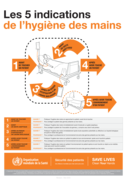
Ces cinq indications sur l’hygiène des mains sont extraites des directives de l'OMS sur l'hygiène des mains dans les soins de santé pour ajouter de la valeur à toute stratégie d'amélioration de l'hygiène des mains. Tout simplement, elles définissent des moments clés de l'hygiène des main
...
Guide de Mise en Œuvre de la Stratégie multimodale de l’OMS pour la Promotion de l’Hygiène des Mains
Les infections associées aux soins (IAS) constituent une menace sérieuse dont l’impact économique pour les patients et les systèmes de santé dans le monde entier est significatif. Pourtant, la pratique de l’hygiène des mains – le simple fait d’assurer l’antisepsie des mains au moment
...
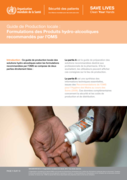
Ce guide de production locale des solutions hydro-alcooliques selon les formulations recommandées par l’OMS se compose de deux parties étroitement liées
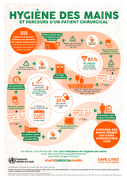
313 millions de personnes subissent une opération chirurgicale chaque année – soit deux fois le nombre de bébés qui naissent dans le monde
A l’attention des professionnels soignants, des formateurs et des observateurs des pratiques d’hygiène des mains
Des mains propressont des mains sûres. Mes mains sont-elles propres ?
Les infections associées aux soins (IAS) touchent des centaines de millions de patients dans le monde chaque année. Ces infections sont à l’origine de pathologies graves, de prolongements de la durée du séjour en établissement de soins, d’invalidités à long terme, de coûts personnels im
...
Las infecciones relacionadas con la atención sanitaria (IRAS) plantean una seria carga de enfermedad y tienen un efecto económico considerable en los pacientes y en los sistemas sanitarios de todo el mundo. Sin embargo, la higiene de las manos, la simple t
...
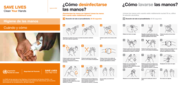
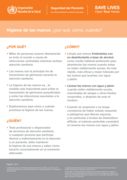
Miles de personas mueren diariamente en todo el mundo a causa de infecciones contraídas mientras reciben atención sanitaria.
Guía de aplicación de la estrategia multimodal de la OMS para la mejora de la higiene de las manos y del modelo “Los cinco momentos para la higienede las manos”
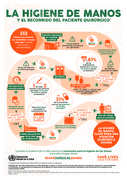
313 millones de personas son sometidas a cirugía cada año, el doble del número de nacimientos
Las infecciones relacionadas con la atención sanitaria (IRAS) suponen una tremenda carga de enfermedad y tienen un importante impacto económico en los pacientes y los sistemas sanitarios de todo el mundo. Pero una buena higiene de las manos, la sencilla tarea de limpiarse las manos en el m
...
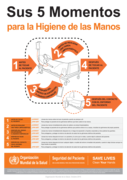
A guide for practical implementation in adult and pediatric emergency department and urgent care settings

The Transatlantic Task Force on Antimicrobial Resistance (TATFAR) fosters cooperation between the European Union (EU) andthe United States (US) on the issue of antimicrobial resistance. The first TATFAR recommendation refers to appropriate use of antimicrobials in human medicine through hospital Ant
...
