
Filter
465
Text search:
World
Health
Organization
WHO,
Regional
Office
for
South
East
Asia
Featured
Recommendations
52
New Publications
113
Language
Document type
No document type
215
Studies & Reports
110
Guidelines
68
Manuals
28
Strategic & Response Plan
22
Situation Updates
6
Training Material
5
Fact sheets
5
Resource Platforms
3
Infographics
2
Online Courses
1
Countries / Regions
Global
32
South–East Asia Region
28
India
18
Asia
14
Myanmar / Burma
12
Western and Central Europe
10
Nepal
8
Bangladesh
6
Uganda
4
Syria
4
Africa
4
Philippines
3
Tanzania
3
Thailand
3
Indonesia
3
Middle East and North Africa
3
Western Pacific Region
3
Eastern Europe and Central Asia
3
Afghanistan
2
Zambia
2
Kenya
2
Cambodia
2
Sri Lanka
2
Yemen
2
Latin America and the Carribbean
2
Moldova
2
Kazakhstan
2
Guinea
1
Sierra Leone
1
Liberia
1
Congo, Democratic Republic of
1
Ghana
1
Zimbabwe
1
Haiti
1
Pakistan
1
South Sudan
1
Jordan
1
Rwanda
1
South Africa
1
Malawi
1
Sudan
1
Eswatini/ Swaziland
1
Brazil
1
North Macedonia
1
Hungary
1
Croatia
1
Ukraine
1
Other region
1
Venezuela
1
Poland
1
Eastern Europe
1
Laos
1
Tajikistan
1
Russia
1
Romania
1
Maldives
1
Belarus
1
Authors & Publishers
Publication Years
Category
Countries
89
Clinical Guidelines
62
Key Resources
38
Women & Child Health
37
Public Health
34
Capacity Building
10
Pharmacy & Technologies
6
Toolboxes
HIV
56
COVID-19
35
Planetary Health
30
Mental Health
29
TB
26
NTDs
21
AMR
19
Caregiver
15
Rapid Response
14
Refugee
13
Global Health Education
13
Disability
12
Natural Hazards
12
Conflict
7
Health Financing Toolbox
7
NCDs
7
Pharmacy
6
2.0 Rapid Response
6
Zika
5
Ebola & Marburg
3
Polio
3
Malaria
3
Typhoon
2
Specific Hazards
2
Cholera
1
Social Ethics
1

The strategic priorities of the CCS 2014–2018 are:
(1) Strengthening the health system.
(2) Enhancing the achievement of communicable disease control targets.
(3) Controlling the growth of the noncommunicable disease burden.
(4 ...
(1) Strengthening the health system.
(2) Enhancing the achievement of communicable disease control targets.
(3) Controlling the growth of the noncommunicable disease burden.
(4 ...
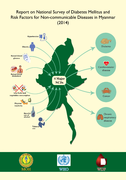
The Ministry of Health conducted STEPS surveys on adult risk factors surveillance in Myanmar in 2003, 2009 and 2014. Amongst these three surveys, the 2014 one is the most comprehensive, providing an analysis of all States and Regions within Myanmar
...

Mpox continues to affect people around the world. A new framework released today by WHO will guide health authorities, communities and other stakeh
...

Rabies is a global public health problem with important socioeconomic impacts. Human rabies is preventable; almost all cases are transmitted through the bite of a rabid dog. Elimination of human rabies is possible. Technical support and tools are av
...

Practical Guidance for collaborative interventions
This technical report presents results from the FEEDcities Project – Eastern Europe and Central Asia, a cross-sectional survey conducted in Almaty, Aktau and Kyzylorda, Kazakhstan, between July and August 2017, to evaluate the local street food en
...

This technical guidance outlines current evidence, knowledge and best practice relating to incidences of violence and injuries among refugees and migrants in the WHO European Region. It highlights key principles, summarizes priority actions and chal
...
In response to the COVID-19 outbreak, this guidance provides information on infection and prevention control (IPC) for older people, their friends and families, carers, and healthcare providers. Anyone who
...
Algorithm for COVID-19 triage and referral
recommended
Efficient triage of patients with COVID-19 at all health facility levels (primary, secondary and tertiary) will help the national response planning and case management system cope with patient influx, direct necessary medical resources to efficientl
...

The purpose of this publication is to to provide a practical, stepwise approach to the implementation of the national action plans on AMR within the human health sector; and to provide a process and collation of existing
...

Self-care interventions are among the most promising and exciting new approaches to improve health and well-being, both from a health systems perspective and
...

The WHO global health sector strategy on sexually
transmitted infections, 2016–2021 (1) includes country
milestones for achievement by 2020 a
...
The framework is to be used as a reference guide, applied according to local priorities and needs, and targeted at academic institutions, educators, accreditation bodies, regulatory agencies and other users. The ultimate aim is to ensure that all health
...
Recent efforts to fight malaria in the Greater Mekong Subregion (GMS) have yielded impressive results. According to the latest WHO estimates, the six GMS countries cut their malaria case incidence by an estimated 54% between 2012 and 2015. Malaria d
...
People living with HIV depend on life-saving antiretroviral therapy (ART) and access to ART must be maintained during periods of travel restrictions and lockdowns resulting from the COVID-19 pandemic. The Information note on HIV and COVID-19 addresses common concerns people living with HIV have rega
...

The 2030 health-related Sustainable Development Goals call on countries to end AIDS as a public health threat and also to achieve universal health
...

This report aims to support countries in the necessary transition toward healthier, more sustainable diets by integrating biodiversity in food-based interventions to support nutrition and health. It is intended to help guide decision-makers in the
...
