
Filter
429
Text search:
Infektionskrankheiten
Featured
53
59
Language
Document type
104
71
61
54
50
32
18
11
8
7
5
4
3
1
Countries
103
65
19
14
12
8
7
7
7
5
4
4
3
3
3
3
3
3
3
2
2
2
2
2
2
2
2
1
1
1
1
1
1
1
1
1
1
1
1
1
1
1
1
1
1
1
Authors & Publishers
Publication Years
Category
105
28
22
18
12
2
1
Toolboxes
105
100
58
33
28
23
18
10
10
7
6
6
6
5
2
2
2
2
2
1
1
La fiche d'information sur le choléra de l'Organisation mondiale de la santé fournit des informations essentielles sur le choléra, une infection diarrhéique aiguë causée par l'ingestion d'aliments ou d'eau contaminés par la bactérie Vibrio cholerae. La maladie reste une menace mondiale pour
...
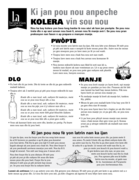
Fact sheet Cholera in Creole
The cholera factsheet provides key information on prevention, symptoms, and treatment. It emphasizes hygiene, safe food handling, and water treatment through boiling, filtering, or disinfection. Cholera, a severe diarrheal disease from contaminated water, causes dehydra
...
The document is a UNICEF cholera toolkit designed to support prevention, preparedness, and response to cholera outbreaks. It provides guidance on water sanitation, hygiene, and health education, along with practical tools and resources for managing outbreaks. It is intended for use by UNICEF teams,
...
UNICEF Guide pratique de lutte contre le choléra
recommended
Le document est une boîte à outils sur le choléra élaborée par l'UNICEF, conçue pour soutenir la prévention, la préparation et la réponse aux épidémies de choléra. Il fournit des directives sur l'assainissement de l'eau, l'hygiène et l'éducation sanitaire, ainsi que des outils pratique
...

Integrated Response Plan: Yemen Cholera Outbreak
recommended
The plan outlines emergency health, WASH and communications interventions to contain and prevent further spread of the outbreak in the 227 high risk districts, where suspected cholera cases were reported during the period October 2016 to May 2017. Health and WASH clusters will continually identify p
...
The World Health Organization's cholera fact sheet provides essential information about cholera, an acute diarrheal infection caused by ingesting food or water contaminated with Vibrio cholerae bacteria. The disease remains a global public health threat, particularly in areas lacking safe water and
...
The document provides WHO guidelines on fluid management for children with severe acute malnutrition (SAM) and cholera. It outlines protocols for rehydration therapy, including oral rehydration solutions (ORS) and intravenous fluids for cases of severe dehydration or shock. The guidelines emphasize
...
The document provides essential guidelines for managing cholera outbreaks. It includes instructions for preparing oral rehydration solutions (ORS) using simple ingredients like sugar and salt to treat dehydration caused by cholera. The text also emphasizes the importance of access to clean water, sa
...

The WHO Guide on Oral Cholera Vaccines in Mass Immunization Campaigns provides guidance on the planning and implementation of oral cholera vaccine (OCV) campaigns. It covers key aspects such as when and where to use OCVs, vaccine specifications, and recommendations for use in endemic areas, outbreak
...

The technical note by the Global Task Force on Cholera Control (GTFCC) discusses the use of Oral Cholera Vaccines (OCVs) for international workers and travelers in cholera-affected areas. It reviews the effectiveness of WHO-prequalified vaccines (Dukoral®, Shanchol™, and Euvichol®), emphasizing
...
The Interim Guidance on Cholera Rapid Diagnostic Tests (RDTs) by the Global Task Force on Cholera Control (GTFCC) provides recommendations for using RDTs to detect cholera in areas with limited laboratory capacity. It highlights the advantages of RDTs, such as rapid detection (within 30 minutes), ea
...
The WHO Cholera Rapid Diagnostic Test (RDT) Target Product Profile outlines the key requirements for developing improved cholera RDTs. It highlights the need for fast, accurate, and easy-to-use tests for early outbreak detection in resource-limited settings. The document sets desired and acceptable
...
The document outlines the 2017 cholera outbreak in Zambia, mainly in Lusaka, due to poor sanitation and unsafe water. By December, 493 cases were reported, with risks increasing due to the rainy season. The Zambia Red Cross Society (ZRCS), in collaboration with the Ministry of Health, WHO, and UNICE
...

WHO supports Zambia in vaccinating 1 million people in Lusaka against cholera to combat an outbreak that began in October 2017, causing 2,672 cases and 63 deaths. Two million vaccine doses were provided by Gavi. WHO and the Zambia National Public Health Institute are improving water access, sanitati
...
Le Plan Stratégique Multisectoriel d’Élimination du Choléra en République Démocratique du Congo (2013-2017) vise à réduire l’incidence du choléra à moins d’un cas pour 100 000 habitants. Ce plan repose sur une approche multisectorielle, combinant santé, eau, hygiène et assainissemen
...
Le panorama du paludisme a profondement changé durant la dernière décénnie. Les financements ont augmenté, les outils permettant de sauver des vies ont été mis en œuvre à plus grande échelle, la charge du paludisme a diminué et un nombre grandissant de pays envisagent son élimination.
C
...
The National Integrated Comprehensive Cholera Prevention and Control Plan (2017-2022) outlines Uganda's strategy to reduce cholera cases and mortality by 50% by 2022. The plan focuses on improving access to clean water, sanitation, and hygiene (WASH), strengthening disease surveillance, enhancing ca
...
A cólera é uma infecção intestinal provocada por uma bactéria conhecida como Vibrio cholerae. Os principais sintomas desta doença são diarréia e vômitos. Transmissão de cólera ocorre principalmente pelo consumo de alimentos contaminados ou água potável. Neste vídeo descrevemos várias
...
The document provides a detailed overview of cholera, including its clinical features, diagnosis, treatment, and prevention. It explains the causes of cholera, its symptoms such as severe diarrhea and dehydration, and the importance of rehydration therapy (oral or intravenous) to reduce mortality. T
...

The Zimbabwe Multi-Sectoral Cholera Elimination Plan (2018–2028) aims to eradicate cholera by improving water, sanitation, and healthcare infrastructure, strengthening disease surveillance, and expanding oral cholera vaccination (OCV). The strategy focuses on five pillars, including public health
...
