
Filter
1203
Text search:
large-scale
comprehensive
care
Featured
126
358
Language
Document type
639
239
130
83
81
11
9
7
2
1
1
Countries
59
57
32
29
26
26
25
24
24
24
22
20
18
15
15
15
14
13
13
12
12
12
10
10
10
10
9
9
8
8
8
7
7
7
7
7
7
6
6
6
6
6
6
5
5
4
4
4
4
3
3
3
3
3
3
3
2
2
2
2
2
2
2
2
2
2
2
2
2
2
1
1
1
1
1
1
1
1
1
1
1
1
1
1
1
1
1
1
1
1
1
1
Authors & Publishers
Publication Years
Category
370
122
91
89
75
21
7
Toolboxes
113
78
63
55
45
44
42
41
41
39
37
28
27
26
26
22
22
16
15
12
10
9
8
3
3
2
1

UNAIDS 2016 / Meeting Report
The report and an accompanying series of studies show the global uptake of the World Health Organization (WHO) Surgical Safety Checklist in its first ten years since its launch and recommend ways the Checklist can be more effectively used to improve surgical safety for millions at risk.
The report
...
The National Action Plan for Combating Antibiotic-Resistant Bacteria (CARB), 2020-2025, presents
coordinated, strategic actions that the United States Government will take in the next five years to improve the health and wellbeing of all Americans by changing the course of antibiotic resistance.
T
...

The issue of Antimicrobial resistance has become one of the most substantial health issues, prompting the World Health Assembly (WHA) to urge Member States to finalise tailor made national action plans by May 2017, aligning them with objectives of the Global Action Plan (GAP). These cover awareness,
...

Antimicrobial agents play an indispensable role in animal health and welfare management. At the same time, the need for prudent use is obvious to ensure good food safety outcomes and to manage the potential risk of antimicrobial resistance. The emergence of multi-resistant bacteria is posing challen
...
Social distancing is an action taken to minimise contact with other individuals; social distancing measures comprise one category of non-pharmaceutical countermeasures (NPCs)1 aimed at reducing disease transmission and thereby also reducing pressure on health services.
This document builds upon exi
...

How we respond both now and going forward will help mitigate the impact of COVID-19, and to the extent possible preserve children’s rights to Survive, Learn, and Be Protected. We will focus our efforts on the most critical work essential to maintaining these commitments to the extent possible.
A new respiratory infectious disease, COVID-19, caused by a new coronavirus called SARS-CoV-2, emerged in early December 2019. Since then, the virus has spread to India and 106 other countries in Asia, Europe, North America, Africa, and Oceania. On March 11, the World Health Organization (WHO) decl
...
Accessed: 16.04.2020
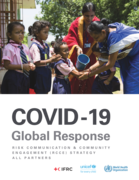
This strategy, produced by IFRC, UNICEF and WHO, provides an overview of RCCE coordination approach and priorities across the different phases of the COVID-19 preparedness and response

This guidance note is meant to assist humanitarian actors, youth-led organizations, and young people themselves across sectors, working at local, country, regional, and global levels in their response to the novel coronavirus pandemic. It begins diagnostically, exploring the impacts of coronavirus d
...
Mental health and psychosocial considerations during the COVID-19 outbreak

The arrival of COVID-19 in Afghanistan has brought heartache to millions of people who are now battling a deadly pandemic while simultaneously fighting for their survival amid poverty, disaster and war. Over my three years as Humanitarian Coordinator, I have marvelled at the resilience of the people
...
Previous crises, such as the Ebola virus disease (EVD) in West Africa in 2014, indicate the direct impact movement restrictions and disease containment efforts have on food availability, access, utilization and violence – particularly gender-based violence (GBV). The importance of maintaining and
...
The European Commission against Racism and Intolerance (ECRI) was established by the Council of Europe. It is an independent body which ensures respect for human rights in the fight against racism, discrimination (based on "race", ethnic/national origin, colour, nationality, religion, language, sexu
...
The two-year impact report for the Access to COVID-19 Tools (ACT) Accelerator details impact, case studies and timelines of key milestones for the Diagnostics, Therapeutics and Vaccines pillars, as well as the Health Systems and Response Connector.
According to the Report, cascading and interlinked crises are putting the 2030 Agenda for Sustainable Development in grave danger, along with humanity’s very own survival. The Report highlights the severity and magnitude of the challenges before us. The confluence of crises, dominated by COVID-19,
...
