
Filter
909
Text search:
AMR
Featured
77
148
Language
Document type
272
179
139
79
67
43
28
21
18
18
17
13
12
1
Countries
31
30
27
23
16
14
14
10
9
8
7
7
6
6
6
6
6
6
6
6
5
5
5
4
4
4
4
4
4
3
3
3
3
3
3
3
3
3
3
3
3
3
3
2
2
2
2
2
2
2
2
2
2
2
2
2
2
1
1
1
1
1
1
1
1
1
1
1
1
1
1
1
1
1
1
1
1
1
1
1
1
1
1
1
1
1
1
1
1
1
1
1
1
1
1
1
1
1
1
1
1
1
1
Authors & Publishers
Publication Years
Category
166
61
33
27
13
12
8
2
Toolboxes
577
60
34
33
25
20
19
19
17
15
12
11
10
9
8
5
5
5
4
4
3
2
1
Personne ne se rend dans un établissement de soins de santé pour tomber malade. On s’y rend pour aller mieux, pour accoucher, pour se faire vacciner. Cependant, des centaines de millions de gens sont confrontés à un risque accru d’infection quand ils se font soigner dans des établissements
...
A Guide to the Application of the WHO Multimodal Hand HygieneImprovement Strategy and the “My Five Moments for Hand Hygiene”Αpproach
Health care-associated infection (HCAI) places a serious disease burden and has a significant economic impact on patients and health-care systems throughout the world. Yet good hand hygiene, the simple task of cleaning hands at the right times and in the right way, can save lives. World Health O
...
Confronted with the important issue of patient safety, in 2002 the Fifty-fifth World Health Assembly adopted a resolution urging countries to pay the closest possible attention to the problem and to strengthen safety and monitoring systems. In May 2004, the Fifty-seventh World Health Assembly approv
...
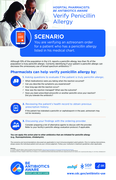
Although 10% of the population in the U.S. reports a penicillin allergy, less than 1% of the population is truly penicillin allergic. Correctly identifying if your patient is penicillin allergic can decrease the unnecessary use of broad spectrum antibiotics.

Comprehensive Reviews in Food Science and Food Safety, Vol.12 (2013) pp.234-248
In 2006, the Institute of Food Technologists (IFT) published an Expert Report entitled “Antimicrobial Resistance: Implications for the Food System” (IFT 2006). That report summarized current scientific knowledge pe
...
Given an increase in outbreaks caused by resistant microorganisms associated with medical tourism, the Pan American Health Organization / World Health Organization (PAHO/WHO) encourages Member States to strengthen their capacity to detect and manage infections caused by resis
...
The global increase of healthcare-associated infections (HAI) presents a growing concern in healthcare worldwide. According to the European Centre for Disease Prevention and Control (ECDC), the annual number of HAI exceeds 2.6million and produces the highest estimated amou
...

This guideline covers making people aware of how to correctly use antimicrobial medicines (including antibiotics) and the dangers associated with their overuse and misuse. It also includesmeasures to prevent and control infection that can stop people needing antimicrobials or spreadinginfection to o
...
Antibiotic Stewardship (AS) is a coordinated program that promotes the appropriate use of antimicrobials to improve patient outcomes, reduce microbial resistance, and decrease the spread of multi-drug resistant organisms. In clinical settings, stewardship activities focus on measuring and improving
...

La résistance aux antimicrobiens (ou RAM, cette abréviation étant est ici également employée en mode adjectif pour désigner les organismes « résistants aux antimicrobiens ») est une préoccupation majeure pour la santé publique mondiale et une question de sécurité san
...

La resistencia a los antimicrobianos (RAM, utilizado también como equivalente de "resistente a los antimicrobianos en este documento) constituye un importante motivo de preocupación mundial en el ámbito de la salud pública y un problema para la inocuidad de los alimentos. Cuando l
...
Antimicrobials are used in veterinary medicine to treat infectious diseases in animals caused or complicated by microorganisms, mainly bacteria, or to prevent the development or spread of infection in healthy animals.
L’Assemblée mondiale de la Santé, tenue en mai 2015, a adopté un Plan d’action mondial pour combattre la résistance aux antimicrobiens, qui définit 5 objectifs:
mieux faire connaître et comprendre le problème de la résistance aux antimicrobiens grâce à une communication, une éduc
...
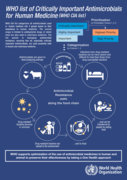
WHO CIA list categorizes all antimicrobials used in human medicine into 3 groups based on their importance to human medicine. The current scope is limited to antibacterial drugs of which most are also used in veterinary medicine. The list assists in man
...
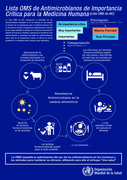
La lista OMS de AIC categoriza la totalidad de los antimicrobianos utilizados en el ser humano en tres grupos en función de su importancia para la medicina humana. Por el momento se limita a los fármacos antibacterianos, muchos de los cuales también se utilizan en la medicina v
...
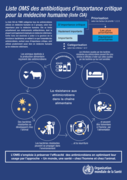
La liste CIA de l’OMS catégorise tous les antimicrobiens utilisés en médecine humaine en 3 groupes, selon leur importance pour la médecine humaine. Elle se limite actuellement aux médicaments antibactériens, dont la plupart sont également employés en médecine vété
...
This document updates the 2014 Core Elements for Hospital Antibiotic Stewardship Programs and incorporates new evidence and lessons learned from experience with the Core Elements. The Core Elements are applicable in all hospitals, regardless of size. There are suggestions specific to small and criti
...
Learn what antibiotic resistance is and how to prevent it while increasing productivity among your livestock - This course is for livestock keepers and professionals working in the livestock production sector (such as veterinarians and advisors) in low-income countries and emerging economies worldwi
...
Nosocomial infections and antimicrobial resistance are two special health issues listed in Annex 1 of Commission Decision 2000/96/EC of 22 December 1999 on the communicable diseases to be progressively covered by the Community network under Decision No 2119/98/EC of the European Parliament and of th
...
