
Filter
596
Text search:
Child
Development
&
Cultural
Variations
Featured
44
191
Language
Document type
418
82
41
33
13
3
3
1
1
1
Countries
30
29
26
21
20
17
16
14
13
12
12
12
11
9
9
8
8
8
7
7
6
6
6
5
5
5
4
4
4
3
3
3
3
3
2
2
2
2
2
2
2
2
2
2
2
2
2
1
1
1
1
1
1
1
1
1
1
1
1
1
1
1
1
Authors & Publishers
Publication Years
Category
254
46
42
34
31
5
2
Toolboxes
81
56
22
21
16
15
14
13
11
10
10
10
9
6
5
4
4
4
2
2
2
2
1
1
DHS Further Analysis Reports No. 107 - This report, based largely on the 2014-15 national survey in Rwanda, focuses on changes and trends in reproductive behavior since 2010. In the 4-5 years after the 2010 survey, fertility continued its decline to 4.2 births per woman as contraceptive prevalence i
...

Africa’s health sector is facing an unprecedented financing crisis, driven by a sharp decline of 70% in Official Development Assistance (ODA) from 2021 to 2025 and deep-rooted structural vulnerabilities. This collapse is placing immense pressure o
...
Introduction
Chapter A.2

Findings from this report reveal that, rates of early marriage are high, a significant percentage of children contribute to the household’s income or are its main source of income, and restrictions on the mobility of women and girls constrain their participation in social and economic activities a
...

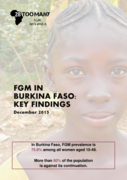
With an FGM prevalence of 75.8% among women aged 15-491, Burkina Faso is classified by UNICEF2 as a ‘moderately high prevalence’ country.
FGM is practised across all regions, ethnic groups and religions in Burkina Faso. There are distinct regional
...

One of the main aims of the WHO Global Initiative for Childhood Cancer and the CureAll Americas framework is to strengthen centers of excellence and promote the training of the health workforce, especially pediatric oncology nurses, specialized in nursing care for children and adolescents with cance
...
Further analysis of the 2011 Nepal Demographic and Health Survey
As a lower-middle-income country (LMIC), South Africa (SA) bears
the burden of maternal and neonatal mortality similar to other sub-
Saharan African countries. According to the Saving Mothers Report
2017/19, there has been a progressive and sustained reduction
in institutional maternal mortality
...
Guiding Principles and Recommendations
Operational Guidelines

Every year, around 830 000 children die from unintentional or "accidental" injuries. The vast majority of these injuries occur in low-income and middle-income countries. However, dozens of prevention strategies and programmes exist. If they were integrated into other
...
Mental Health Policy and Service Guidance Package
Languages: Arabic, English, French, Chinese, Russian
This framework has been developed with the aim of providing standard procedures, assessment and planning tools, and guidance in the delivery of case management services. As Malawi moves forward to build a holistic child protection system, case manag
...
The Toolkit for Child Friendly Spaces in Humanitarian Settings was developed by
the International Federation of the Red Cross and Red Crescent Societies Reference
Centre for Psychosocial Support and World Vision International. The toolkit provides
...
The toolkit aims to provide researchers with guidance for improving the quality of studies that use administrative data to better ascertain child maltreatment incidence, response and service delivery. However, these are complex studies to conduct, a
...
