
Filter
279
Text search:
latvia
Featured
16
50
Language
Document type
165
66
17
12
6
6
2
1
1
1
1
1
Countries
66
22
17
10
9
3
2
2
2
2
1
1
1
1
1
1
1
1
1
1
1
1
1
1
1
1
1
1
1
Authors & Publishers
Publication Years
Category
38
23
19
13
11
4
2
Toolboxes
65
63
13
12
12
11
10
9
7
7
6
5
4
3
3
3
2
2
2
2
1
1
1
1
Tuberculosis (TB) is, and should be, a curable disease; however, each year significant numbers of patients acquire or develop drug-resistant TB, which has a much lower cure rate. Patients with drug-resistant TB have a high prevalence of symptoms; hence, staff caring for these patients should h
...

2021 UNAIDS Global AIDS Update. UNAIDS report shows that people living with HIV face a double jeopardy, HIV and COVID-19, while key populations and children continue to be left behind in access to HIV services
English Analysis on World about Food and Nutrition and Epidemic; published on 13 Dec 2021 by FAO
A Snapshot of European Collection Schemes
Community pharmacists are the health professionals most accessible to the public and are a cornerstone of primary health care. The role of community pharmacists is expanding globally. This report provides an overview of existing components and provisions of the legal and regulatory framework for com
...
English Analysis on World about Climate Change and Environment, Food and Nutrition and more; published on 07 Oct 2021 by IEP

This report reviews and analyses the Affordable Medicines Programme, which was introduced in Ukraine in April 2017 to provide patients with improved access to 23 outpatient medicines for the treatment of chronic noncommunicable diseases. The evaluation combines both quantitative and qualitative anal
...

Working towards better COVID-19 outcomes in the WHO European Region.From the first COVID-19 cases in Europe reported on
24 January 2020, the pandemic reached 1 million cases
within 3 months, 10 million cases within 8 months, and
100 million cases in Europe alone within 2 years. Over
the course o
...
This report of the EFSA and ECDC presents the results of zoonoses monitoring activities carried out in 2020 in 27 EU Member States (MS) and nine non-MS. Key statistics on zoonoses and zoonotic agents in humans, food, animals and feed are provided and interpreted historically.
If you are fleeing the war in Ukraine and coming to the European Union, you will find key information about your rights with regard to crossing the border into an EU country, eligibility for temporary protection and applying for international protection, as well as the rights of travel inside the Eu
...
The extensive use of natural resources threatens to exceed the carrying capacity of the Earth. The concept of a
circular economy offers an avenue to sustainable growth, good health and decent jobs, while saving the environment
and its natural resources. Further, the change from a linear economy (t
...
This report provides an overview of the main findings of the 2019–2020 harmonised AMR monitoring in the main food-producing animal populations monitored, in carcase/meat samples and in humans. Where available, monitoring data obtained from pigs, calves, broilers, laying hens and turkeys, as well a
...
his publication addresses surveillance and outbreak management of WRID associated with drinking-water supply systems, building on existing guidelines for infectious disease surveillance and outbreak response. It aims to help countries to build on and strengthen their systems by providing technical i
...
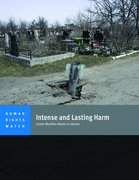
This report presents the types of cluster munitions being used in the international armed conflict in Ukraine in 2022 and the civilian casualties immediately suffered and civilian objects damaged.
Given that the emergency has exceeded the worst-case scenario, this revised supplementary appeal for the Ukraine situation outlines UNHCR’s additional requirements of $1.246 billion for March to December 2022.
El objetivo de esta GPC es proporcionar recomendaciones para el tamizaje organizado
del CCR en el territorio nacional, permitiendo el acceso equitativo a medidas de
prevención y detección temprana de la enfermedad con el fin de disminuir la
incidencia y la mortalidad por el CCR en Argentina.
...
Following a long recovery from the economic crisis (2007–2013), young people in the EU proved to be more vulnerable to the effects of the restrictions put in place to slow the spread of the COVID-19 pandemic. Young people were more likely than older groups to experience job loss, financial insecur
...
