Filter
1061
Text search:
operational
updates
Featured
138
310
Language
Document type
481
193
151
99
79
20
16
15
7
Countries
49
35
30
30
28
24
23
21
18
18
17
17
16
16
16
14
14
14
13
13
13
11
11
11
9
9
9
9
8
8
8
7
7
7
6
6
5
5
5
5
5
5
5
5
4
4
4
4
3
3
3
3
3
3
3
3
3
3
3
3
2
2
2
2
2
2
2
2
2
2
2
2
2
2
2
2
2
2
1
1
1
1
1
1
1
1
1
1
1
1
1
1
1
1
1
1
1
1
1
1
1
1
Authors & Publishers
Publication Years
Category
391
114
78
54
49
16
11
Toolboxes
134
66
57
53
50
33
32
32
31
31
31
26
23
19
18
17
14
13
12
12
10
9
9
9
3
1
Myanmar is prone to various natural hazards that include earthquakes, floods, cyclones, droughts, fires, tsunamis, some of whichhave the potential to impact large numbers of people. In the event that large numbers of people are affected (such as was the case in 2008 following cyclone Nargis), the go
...

- Build community resilience to coastal hazards by improving capacity of inclusive disaster management systems.
- Reduce the mortality rate of persons with disabilities in situations of risk.
- Raise awareness about inclusive policies, practices and disaster risk reduction strategies that address
...

In view of the ongoing political, peace and reconciliation, administrative and economic reforms as well as plans to establish the United Nations Development Assistance Framework (UNDAF) in 2018, WFP extended the current Protracted Relief and Recovery Operation (PRRO 200299), launched in January 2
...
. To echo this extension and provide a more appropriate response to the country's rapid and multi-pronged transition, WFP adopted a transition strategy with gradually reduced emphasis on humanitarian assistance and greater focus on early recovery and development interventions. WFP's strategic engagement in-country was driven by the overarching goal to assist Myanmar to achieve the national Zero Hunger Challenge by 2025, and was guided by three priorities: emergency preparedness and response; nutrition; and provision of social safety nets.
Best Practice for the Care of Patients with Tuberculosis: a Guide for Low-Income Countries
recommended
2nd edition.
The practical aspects of TB patient care from the onset of symptoms to the completion of treatment are covered in this guide
Strengthening of SDB teams through refresher trainings and regular simulation exercises/drills
Continue social mobilization and community engagement through mobile cinema and community awareness sessions
Procure and preposition additional PPE kits
Volume 20, September
Global smart update
The idea to the ANDEMIA online course manual is based on the challenge that resources for sending ANDEMIA students to a variety of face to face courses is limited not only due to financial but also time constraints. Online course provide a good basis for the students, Master, PhD and Post Docs to pr
...

Public Health is the science field dedicated to promoting health and well-being, and preventing disease within the human population to ultimately increase the quality of our livelihood and life span. Public Health does not focus on individual patients or diseases, but rather a given population and
...
The following protocol has been designed to investigate the First Few X cases (FFX) and their close contacts. It is envisioned that the FFX 2019-nCoV investigation will be conducted across several countries or sites with geographical and demographical diversity. Using a standardized protocol such a
...

16-24 February 2020

The National Department of Health and Department of Agriculture, Forestry and Fisheries have collectively engaged to determine the key interventions that will form the basis for this strategy taking into account the recommendations from the WHO and OIE.
The development and implementation of a Natio
...
The global COVID-19 outbreak is leading to an acute and drastic shortage of essential supplies, including personal protective equipment, diagnostics and clinical management. At the request of the UN Secretary-General and in support of the UN Crisis Management Team, a Supply Chain Tas
...
As information about COVID-19 is rapidly evolving, it can be challenging to navigate and synthesize all of the information. The purpose of this document is to provide a synthesized, indexed reference of accurate, standardized COVID-19 information from trustworthy sources. Information is presented in
...
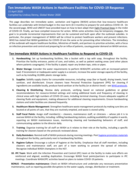
This page describes ten immediate water, sanitation and hygiene (WASH) actions that low-resource healthcare facilities can undertake with limited budget in the near-term (0-3 months) to prepare for and address COVID-19. On the second page, WHO and UNICEF have provided input on how to best adapt thei
...
The COVID-19 pandemic is a rapidly evolving global crisis and there
is much that is still emerging in terms of the psychosocial and mental
health consequences for the diverse populations affected by this
emergency. This toolkit is based on what is currently available and
will be updated as addit
...
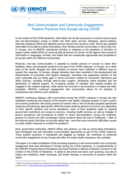
This paper is an initial compilation of the promising practices on risk communication and community engagement that have developed in Europe during the COVID pandemic, in complementarity to the UNHCR’s Practical Recommendations and Good Practice to Address Protection Concerns in the Context of the
...