Filter
120
Text search:
Yaws
Featured
18
27
Language
Document type
43
41
16
12
2
2
1
1
1
1
Countries
8
6
3
3
2
2
2
2
2
2
2
2
2
2
2
1
1
1
1
1
1
1
1
1
1
1
1
1
1
1
1
1
1
1
1
1
Authors & Publishers
Publication Years
Category
32
24
6
5
4
2
1
Toolboxes
51
4
3
3
2
2
2
1
1
1
1
1
1
1
1
N Engl J Med 2015;372:703-10. Click on the external link to get access to the article
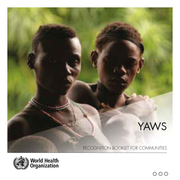
Recognition Booklet For Communities
PLOS Neglected Tropical Diseases September 2014 | Volume 8 | Issue 9 | e3016 DOI: 10.1371/journal.pntd.0003016
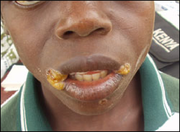
Cases of yaws treated with single-dose oral azithromycin .Click on the link to open the Photo Gallery
Accessed Febraury 25, 2015
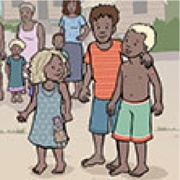
Click on the link to open the video
This document provides guidance for countries on how to implement activities to achieve the interruption of yaws transmission. It is intended for use by national yaws eradication programmes, partner
...
n this study, low-dose azithromycin did not meet the prespecified non-inferiority margin compared with standard-dose azithromycin in achieving clinical and serological cure in PCR-confirmed active yaws. Only a single participant (with presumed laten
...
This document sets out the criteria and procedures to be followed by countries in verifying the interruption of yaws transmission. It is intended for use by international verification teams, national yaws
...
Yaws forms part of a group of chronic bacterial infections commonly known as the endemic treponematoses. These diseases are caused by spiral bacteria of the genus Treponema, which also includes endemic syphilis (bejel) and pinta.
...
Course information
Yaws is targeted for eradication by WHO in the 2021-2030 NTD Roadmap. It is therefore crucial to know how to identify cases, design and implement activities to eradicate the disease at the community level.
In the context of inte
...

Yaws, an infectious disease caused by Treponema pallidum subspecies pertenue, is endemic in many parts of the world. A community-wide treatment program in Papua New Guinea, in which a single dose of azithromycin was administered, showed substantial
...

Yaws is a chronic skin infection characterized by papillomas (noncancerous lumps) and ulcers. It is caused by the bacterium Treponema pallidum subspecies pertenue, which belongs to the same group of bacteria that causes venereal syphilis.

Yaws is a non-venereal endemic treponemal infection caused by Treponema pallidum sub-species pertenue, a bacterium closely related to Treponema pallidum ssp. pallidum, the agent of venereal syphilis. Yaws
...
Yaws forms part of a group of chronic bacterial infections commonly known as the endemic treponematoses. These diseases are caused by spiral bacteria of the genus Treponema, which also includes endemic syphilis (bejel) and pinta.
...
Yaws is a chronic tropical skin disease that mainly affects children in remote, tropical and often impoverished areas. The disease presents with highly infectious lesions of the skin which can spread to the cartilage and bone. It is one of three end
...

Yaws is a disfiguring non-venereal disease caused by infection with the spirochaete. Treponema pallidum subspecies pertenue which is closely related to the causative agent of syphilis and those of the other endemic treponematoses, bejel and pinta. T
...

Yaws, a neglected tropical disease (NTD) of the skin caused by the bacterium Treponema pallidum subspecies pertenue, is targeted in the latest WHO NTD Roadmap for eradication by 2030. In January, 2022, WHO published a manual that outlines the key ac
...
Yaws is targeted for eradication by 2030, using a strategy based on mass drug administration (MDA) with azithromycin. New diagnostics are needed to aid eradication. Serology is currently the mainstay for y
...

Report of a global meeting on yaws eradication surveillance, monitoring and evaluation: Geneva, 29–30 January 2018. World Health Organization.