Filter
57
Featured
1
Language
Document type
30
8
6
5
3
1
1
1
1
1
Countries
4
2
1
1
1
1
1
1
1
1
1
Authors & Publishers
Publication Years
Category
2
1

To enhance health co-benefits across urban policies which tackle air pollution and climate change, WHO, in cooperation with various international, national, and local partners, implemented the Urban Health Initiative (UHI) pilot project in Accra, Ghana. The Initiative prompted the health sector to u
...
This Urban Flood Risk Handbook: Assessing Risk and Identifying Interventions is a roadmap for conducting an urban flood risk assessment in any city in the world. It includes practical guidance for a flood risk assessment project, covering the key hazard and risk modeling stages as well as the evalua
...
In 2019, WHO estimated that 6.7 million premature deaths could be attributed to ambient and household air pollution from particulate matter (particles with a diameter less than 2.5 μm, PM2.5. Of the 4.2 million deaths attributed specifically to ambient air pollution exposures.
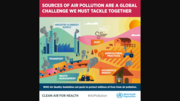
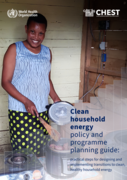
Exposure to household air pollution (HAP) is one of the greatest environmental risks to human health worldwide. Policies to accelerate the adoption of clean cooking, heating and lighting are essential for reducing HAP and the enormous burden of disease it causes and for lowering climate-warming emis
...
The world is becoming increasingly urbanized. Since 2007, more than half the world’s population has been living in cities, and that share is projected to rise to 60 per cent by 2030.
Note de planification

A handbook on child-responsive urban planning
This report provides an overview of air pollution levels and associated health impacts in cities around the world. Since urban areas are often hotspots for poor air quality, city-level data can help to inform targeted efforts to curb urban air pollution and improve public health. This report draws o
...
Briefing Note 8.
Ecosystem-based adaptation (EbA) is a strategy for adapting to the adverse impacts of climate change by harnessing nature and the services it can provide. This strategy is crucial for cities and peri-urban areas, threatened by a multitude of climate hazards and home to more than ha
...

Cities are uniquely positioned to understand local needs and respond rapidly to changing conditions to safeguard health. These changes require strong city leadership to implement multisectoral, health-relevant policies and public services that engage communities. The response to malaria must be an i
...
Today is the launch of the Amsterdam City Doughnut, which takes the global concept of the Doughnut and turns it into a tool for transformative action in the city of Amsterdam.
Lancet 2021; 398: Series: Heat and Health
Hot weather and heat extremes harm human health, with poverty, ageing, and chronic illnesses as aggravating factors. As the global community contends with even hotter weather in a changing climate, there is a pressing need to better understand the most eff
...