
Filter
951
Featured
48
21
Language
Document type
508
85
80
51
44
37
36
36
29
21
10
6
4
3
Countries
88
15
13
10
9
9
8
8
8
6
6
6
5
5
5
4
4
4
4
3
3
3
3
3
3
3
2
2
2
2
2
2
2
2
2
2
1
1
1
1
1
1
1
1
1
1
1
1
1
1
1
1
1
1
1
1
1
1
1
1
1
1
Authors & Publishers
Publication Years
Category
106
59
27
15
14
7
4
Hendra virus (HeV) continues to pose a serious public health concern as spillover events occur sporadically. Terminally ill horses can exhibit a range of clinical signs including frothy nasal discharge, ataxia or forebrain signs. Early signs, if detected, can include depression, inappetence, colic o
...

Research Programme on Religious Communities and Sustainable Development Humboldt-Universität zu Berlin


The new review paper, The Impacts of Climate Change on Health, identifies the extent to which increasing emissions, extreme weather and temperatures elevate health risks, from infectious disease to malnutrition, and assesses the associated health burden. It concludes that the health burden will exce
...
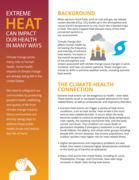
Climate change also affects human health by increasing the frequency and intensity of extreme heat events. Increases in
the overall temperature of the atmosphere and oceans associated with climate change cause changes in wind, moisture, and heat circulation patterns. These changes contribute to shi
...
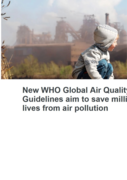
New WHO Global Air Quality Guidelines (AQGs) provide clear evidence of the damage air pollution inflicts on human health, at even lower concentrations than previously understood. The guidelines recommend new air quality levels to protect the health of populations, by reducing levels of key air pollu
...

his sequel to the Groundswell report includes projections and analysis of internal climate migration for three new regions: East Asia and the Pacific, North Africa, and Eastern Europe and Central Asia. Qualitative analyses of climate-related mobility in countries of the Mashreq and in Small Island D
...
Findings, interpretations and conclusions
expressed in this document are based on infor-
mation gathered by GIZ and its consultants,
partners and contributors from reliable sources.

The World Climate and Security Report (WCSR) 2021 from the Expert Group of the International
Military Council on Climate and Security is a global assessment of the security dimensions of a changing
climate and effective means to address them. It is intended to inform timely climate and security po
...
Non-Motorized Transport (NMT) has immense benefits for individual users, as well as society at large, through improvements to physical health, air quality, the environment, climate change, personal finance, accessibility, mobility and the empowerment of vulnerable groups.
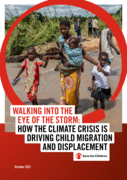
Discussions about climate change often focus on the future, but millions of children are experiencing its devastating impacts now. The scale of the crisis is huge, and growing fast. It is children that will bear the brunt of climate change, yet its impact on them is understudied, their voices are no
...

The World Climate and Security Report (WCSR) 2021 from the Expert Group of the International Military Council on Climate and Security is a global assessment of the security dimensions of a changing climate and effective means to address them. It is intended to inform timely climate and security poli
...
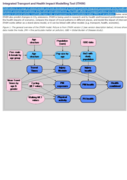
ITHIM refers to a range of related models and tools developed at CEDAR to perform integrated assessment of the health effects of transport scenarios and policies at the urban and national level. The health effects of transport policies are modelled through the changes in physical activity, road traf
...

The HEAT is designed to enable users without expertise in impact assessment to conduct economic assessments of the health impacts of walking or cycling.

M. Zaman et al. (eds.), Measuring Emission of Agricultural Greenhouse Gases
and Developing Mitigation Options using Nuclear and Related Techniques,
https://doi.org/10.1007/978-3-030-55396-8_
The global burden of disease associated with air pollution exposure exacts a massive toll on human health worldwide: exposure to air pollution is estimated to cause millions of deaths and lost years of healthy life annually. The burden of disease attributable to air pollution is now estimated to be
...
