
Filter
367
Text search:
virus
variants
Featured
69
20
Language
Document type
117
79
46
44
31
23
8
8
5
3
2
1
Countries
23
15
13
10
8
7
7
7
5
5
5
4
4
4
4
4
4
3
3
3
3
3
3
2
2
2
2
2
2
2
2
2
2
2
2
2
2
2
2
2
2
2
2
1
1
1
1
1
1
1
1
1
1
1
1
1
1
1
1
1
1
1
1
1
1
1
1
1
1
1
1
1
1
1
1
1
1
1
1
1
1
1
Authors & Publishers
Publication Years
Category
93
31
16
15
12
7
3
Toolboxes
217
16
14
11
11
8
8
7
7
6
4
4
4
4
3
2
2
1
1
1
1
1
Cet article fait partie d’une série de notes explicatives sur la mise au point et la distribution de vaccins.
1 March 2021
This article is part of a series of explainers on vaccine development and distribution. Learn more about vaccines – from how they work and how they’re made to ensuring safety and equitable access – in WHO’s Vaccines Explained series.

What are the variants circulating at this time? How are variants classified as variants of interest or concern? What does this mean for the public?
...
While COVID-19 virus continues to circulate and evolve, new variants are constantly emerging. Most of the current COVID-19 cases are driven by the circulation of the BA.5 subvariant of Omicron. The
...
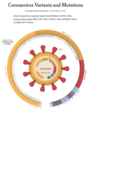
The NY Times variant tracker is perhaps the most accessible and relevant publication for non-molecular biologists and the general public
Each coronavirus contains nearly 30,000 letters of RNA. This genetic information allows the virus to infect ce
...
The New England Journal of Medicine
Genetic analysis of the virus indicates that it is closely related (97% identical) to variants of Ebola virus
...
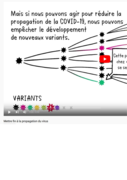
Lorsqu’un virus circule largement dans une population et entraîne de nombreuses infections, la probabilité de mutation augmente. Plus un virus a de possibilités de se propager, plus il se répl
...

The WHO continuously reviews available data on SARS-CoV-2 variants of concern. For this version, the global epidemiological
situation of the COVID-19 pandemic as of 21 January 2022 – at a time when the Omicron VOC had been identified in 171
coun
...
Orientations provisoires, 28 janvier 2021
Dans cette version mise à jour des orientations sur la sécurité biologique en laboratoire en rapport avec le SARS-CoV-2, le virus responsable de la maladie à coronavirus 2019 (COVID-19), les poi
...

Countries across the world are facing diverse epidemiological situations with varying response
capacities and access to life saving tools. The World Health Organization (WHO) recommends that national authorities continue to apply a risk-based approach when implementing measures related to COVID-19
...

Rabies is a fatal viral zoonosis and serious public health problem.1 All mammals are believed to be susceptible to the disease, and for the purposes of this document, use of the term animal refers to mammals. The disease is an acute, progressive encephalitis caused by viruses in the genus Lyssavirus
...
WHO has updated its guidelines for COVID-19 therapeutics, with revised recommendations for patients with non-severe COVID-19. This is the 13th update to these guidelines.
Updated risk rates for hospital admission in patients with non-severe COVID-19
The guidance includes updated risk rates for
...
The text “Pathogen Genomic Surveillance Policy Framework (2023)” is a strategic framework developed by Africa CDC to strengthen genomic surveillance of pathogens in the Member States of the African Union.
Its content focuses on how African countries can systematically integrate genome sequencin
...
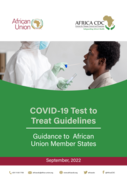
Covid-19 Test to Treat Guidelines
recommended
n response to the outbreak, the Africa Centres for Disease Control and Prevention (Africa CDC) has been supporting African Union Member States in responding to the COVID-19 pandemic through a variety of interventions such as non-pharmaceutical interventions, quarantine, testing, isolation, contact t
...
Dengue is the fastest spreading, mosquito-borne viral infectious disease worldwide, with remarkable morbidity and mortality. In the past decades, profound contributions have been made towards understanding its epidemiology, including disease burden and distributions, risk factors, and control and pr
...
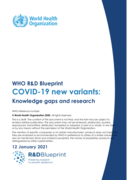
n light of the potential risk posed by SARS-CoV-2 variants, in January 2021 WHO organized an ad hoc consultation to discuss the development of an R&D agenda in response to existing and emerging SARS-CoV-2
...
Available in English, French, Chinese, Arabic, Russian
8 February 2021

Weekly epidemiological update on COVID-19, 28 September 2022
Orientations provisoires
9 août 2021
Le présent document vise à décrire un ensemble minimal d'activités de surveillance recommandées au niveau national pour détecter et surveiller la prévalence relative des variantes du SRAS-CoV-2 et à présenter un ensemble d'activités pour la caractér
...
This document aims to provide interim guidance for microbiology and virology experts, other laboratory professionals, laboratory managers, infectious disease programme managers, public health professionals and other stakeholders that provide primary, confirmatory or advanced testing for SARS-CoV-2,
...
