
Filter
1224
Text search:
acute
respiratory
failure
Featured
200
303
Language
Document type
553
322
177
83
28
27
19
8
3
2
1
1
Countries
101
62
46
40
33
26
22
21
20
20
19
19
17
16
16
16
15
13
12
11
11
11
10
9
9
9
9
8
7
7
7
6
6
6
6
5
5
5
5
4
3
3
3
3
3
3
3
3
3
2
2
2
2
2
2
2
2
2
2
2
2
2
2
2
1
1
1
1
1
1
1
1
1
1
1
1
1
1
1
1
1
1
1
1
1
1
1
1
1
1
1
1
1
1
1
1
1
1
Authors & Publishers
Publication Years
Category
534
173
85
76
58
20
15
Toolboxes
187
63
53
50
49
43
37
35
33
28
25
24
22
21
20
18
12
10
9
7
6
5
5
5
Management of critical COVID-19: Acute hypoxaemic respiratory failure and COVID-19: Recognize ARDS
recommended
WHO recommends prompt recognition of progressive acute hypoxaemic respiratory failure when a patient with
...
WHO recommends prompt recognition of progressive acute hypoxaemic respiratory failure when a patient with
...
Demographic and epidemiological transitions are changing the age structure of the population and the most common diseases. Non-communicable respiratory diseases are an increasing problem at both ends of the age range in low-income and middle-income
...
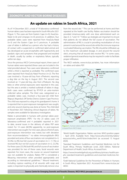
As of 14 December 2021, a total of 19 laboratory-confirmed human rabies cases has been reported in South Africa for 2021. The cases are from Eastern Cape, KwaZuluNatal and Limpopo provinces. In addition, four probable rabies cases were reported from KwaZulu-Natal and the Eastern Cape provinces. A pr
...
The Integrated Management of Adolescent/Adult Illness (IMAI) approach

Severe acute respiratory infections treatment centre: practical manual to set up and manage a SARI treatment centre and a SARI screening facility in health care facilities
To provide recommendations on the initial care of persons with acute respiratory illness (ARI) in the context of coronavirus disease (COVID-19) in healthcare facilities based on a decision-making pr
...

First published in 2020, this toolkit is intended for clinicians working in acute care, managing adult and paediatric patients with acute respiratory
...


Many critical questions remain about the effectiveness of COVID-19 vaccines in real-world settings. These questions can only be answered in post-introduction vaccine effectiveness studies.This guidance document outlines an approach to leverage existing surveillance systems for Severe
...

This protocol provides an approach for public health authorities and investigators at all levels to plan for and conduct investigations of nonseasonal influenza and other emerging respiratory diseases and provides tips and reminders for linking the
...
Person under investigation (PUI) form for coronavirus disease 2019 (COVID-19): Request for severe acute respiratory syndrome coronavirus 2 (SARS-CoV-2) testing
and
COVID-19 Contact line list
Asthma is the most common chronic respiratory disease among school-going adolescents worldwide. However, the burden of severe asthma is highest in Sub-Saharan Africa. This study aimed to explore teachers’ perceptions of asthma care across six Afri
...

Severe acute respiratory syndrome coronavirus 2 (SARS-CoV‑2) causing coronavirus disease 2019 (COVID-19) has reached pandemic levels;
Patients with cardiovascular (CV) risk factors and establishe
...

Clinical care for severe acute respiratory infection: toolkit: COVID-19 adaptation
Clinical care for severe acute respiratory infection: toolkit: COVID-19 adaptation
22 July 2022. This document summarizes current WHO guidance for public health surveillance of coronavirus disease 2019 (COVID-19) in humans caused by infection with severe acute respiratory syndrome
...

Covid19 - Standard Operating Procedures – UNHAS ROSS
This SOP defines WFP Aviation/UNHAS procedures to be followed when operating in areas affected by the current outbreak of the coronavirus disease (COVID-19). This SOP will be communicated to UNHAS staff, Operators, and user organisations.
Acco
...

Diphtheria is caused by Corynebacterium species, mostly by toxin-producing Corynebacterium diphtheriae and rarely by toxin-producing strains of C. ulcerans and C. pseudotuberculosis. The most common type of diphtheria is classic respiratory diphther
...

Myanmar, as a country going through rapid socio-political transition and institutional development also suffers with a high burden of infectious disease. An ongoing challenge has been to effectively reach its 51 million population, most of whom battle tuberculosis,
...
