Filter
3611
Text search:
TB
HIV
Featured
307
1066
Language
3020
213
164
76
49
48
38
16
16
11
9
9
7
6
5
5
4
3
3
2
2
2
2
2
1
1
1
1
1
1
1
1
1
1
1
1
1
1
1
1
1
1
1
Document type
2253
431
399
138
123
80
76
56
22
19
6
2
2
1
Countries / Regions
200
148
136
94
92
90
86
84
82
79
66
66
61
55
54
53
51
49
48
48
47
44
43
35
34
33
33
30
30
30
29
29
28
27
27
25
23
21
20
20
20
19
18
16
16
15
15
15
13
11
11
11
10
10
9
8
8
8
8
8
8
7
7
6
6
5
4
4
4
4
4
4
4
4
4
3
3
3
3
3
2
2
2
2
2
2
2
2
2
2
1
1
1
1
1
1
1
1
1
1
1
1
1
1
1
1
1
1
1
1
1
1
1
1
1
1
1
1
1
1
1
Authors & Publishers
277
187
152
107
93
79
63
51
39
38
38
29
29
27
26
26
25
25
24
24
24
22
21
21
19
19
18
18
18
18
17
16
15
14
14
14
13
13
13
12
12
12
12
12
11
11
11
11
11
11
10
10
10
10
9
9
9
9
9
9
8
8
8
8
8
8
8
8
8
8
8
8
7
7
7
7
7
7
7
7
7
7
7
7
7
7
6
6
6
6
6
6
6
6
6
6
6
6
6
6
6
6
6
6
5
5
5
5
5
5
5
5
5
5
5
5
5
5
5
5
5
5
5
5
5
5
5
5
5
5
5
5
5
5
5
5
4
4
4
4
4
4
4
4
4
4
4
4
4
4
4
4
4
4
4
4
4
4
4
4
4
4
4
4
4
4
4
4
4
4
4
4
4
4
4
4
4
4
4
4
4
4
4
4
4
4
4
4
4
4
4
4
4
4
4
3
3
3
3
3
3
3
3
3
3
3
3
3
3
3
3
3
3
3
3
3
3
3
3
3
3
3
3
3
3
3
3
3
3
3
3
3
3
3
3
3
3
3
3
3
3
3
3
3
3
3
3
3
3
3
3
3
3
3
3
3
3
3
3
3
3
3
3
3
3
3
3
3
3
3
3
3
3
3
3
3
3
3
3
3
3
3
3
3
3
3
3
3
3
3
3
3
3
3
3
3
3
3
3
3
3
3
3
3
3
3
3
3
2
2
2
2
2
2
2
2
2
2
2
2
2
2
2
2
2
2
2
2
2
2
2
2
2
2
2
2
2
2
2
2
2
2
2
2
2
2
2
2
2
2
2
2
2
2
2
2
2
2
2
2
2
2
2
2
2
2
2
2
2
2
2
2
2
2
2
2
2
2
2
2
2
2
2
2
2
2
2
2
2
2
2
2
2
2
2
2
2
2
2
2
2
2
2
2
2
2
2
2
2
2
2
2
2
2
2
2
2
2
2
2
2
2
2
2
2
2
2
2
2
2
2
2
2
2
2
2
2
2
2
2
2
2
2
2
2
2
2
2
2
2
2
2
2
2
2
2
2
2
2
2
2
2
2
2
2
2
2
2
2
2
2
2
2
2
2
2
2
2
2
2
2
2
2
2
2
2
2
2
2
2
2
2
2
2
2
2
2
2
2
2
2
2
2
2
2
2
2
2
2
2
2
2
2
2
2
2
2
2
2
2
2
2
2
2
2
2
2
2
2
2
2
2
2
2
2
2
2
2
2
2
2
2
2
2
2
1
1
1
1
1
1
1
1
1
1
1
1
1
1
1
1
1
1
1
1
1
1
1
1
1
1
1
1
1
1
1
1
1
1
1
1
1
1
1
1
1
1
1
1
1
1
1
1
1
1
1
1
1
1
1
1
1
1
1
1
1
1
1
1
1
1
1
1
1
1
1
1
1
1
1
1
1
1
1
1
1
1
1
1
1
1
1
1
1
1
1
1
1
1
1
1
1
1
1
1
1
1
1
1
1
1
1
1
1
1
1
1
1
1
1
1
1
1
1
1
1
1
1
1
1
1
1
1
1
1
1
1
1
1
1
1
1
1
1
1
1
1
1
1
1
1
1
1
1
1
1
1
1
1
1
1
1
1
1
1
1
1
1
1
1
1
1
1
1
1
1
1
1
1
1
1
1
1
1
1
1
1
1
1
1
1
1
1
1
1
1
1
1
1
1
1
1
1
1
1
1
1
1
1
1
1
1
1
1
1
1
1
1
1
1
1
1
1
1
1
1
1
1
1
1
1
1
1
1
1
1
1
1
1
1
1
1
1
1
1
1
1
1
1
1
1
1
1
1
1
1
1
1
1
1
1
1
1
1
1
1
1
1
1
1
1
1
1
1
1
1
1
1
1
1
1
1
1
1
1
1
1
1
1
1
1
1
1
1
1
1
1
1
1
1
1
1
1
1
1
1
1
1
1
1
1
1
1
1
1
1
1
1
1
1
1
1
1
1
1
1
1
1
1
1
1
1
1
1
1
1
1
1
1
1
1
1
1
1
1
1
1
1
1
1
1
1
1
1
1
1
1
1
1
1
1
1
1
1
1
1
1
1
1
1
1
1
1
1
1
1
1
1
1
1
1
1
1
1
1
1
1
1
1
1
1
1
1
1
1
1
1
1
1
1
1
1
1
1
1
1
1
1
1
1
1
1
1
1
1
1
1
1
1
1
1
1
1
1
1
1
1
1
1
1
1
1
1
1
1
1
1
1
1
1
1
1
1
1
1
1
1
1
1
1
1
1
1
1
1
1
1
1
1
1
1
1
1
1
1
1
1
1
1
1
1
1
1
1
1
1
1
1
1
1
1
1
1
1
1
1
1
1
1
1
1
1
1
1
1
1
1
1
1
1
1
1
1
1
1
1
1
1
1
1
1
1
1
1
1
1
1
1
1
1
1
1
1
1
1
1
1
1
1
1
1
1
1
1
1
1
1
1
1
1
1
1
1
1
1
1
1
1
1
1
1
1
1
1
1
1
1
1
1
1
1
1
1
1
1
1
1
1
1
1
1
1
1
1
1
1
1
1
1
1
1
1
1
1
1
1
1
1
1
1
1
1
1
1
1
1
1
1
1
1
1
1
1
1
1
1
1
1
1
1
1
1
1
1
1
1
1
1
1
1
1
1
1
1
1
1
1
1
1
1
1
1
1
1
1
1
1
1
1
1
1
1
1
1
1
1
1
1
1
1
1
1
1
1
1
1
1
1
1
1
1
1
1
1
1
1
1
1
1
1
1
1
1
1
1
1
1
1
1
1
1
1
1
1
1
1
1
1
1
1
1
1
1
1
1
1
1
1
1
1
1
1
1
1
1
1
1
1
1
1
1
1
1
1
1
1
1
1
1
1
1
1
1
1
1
1
1
1
1
1
1
1
1
1
1
1
1
1
1
1
1
1
1
1
1
1
1
1
1
1
1
1
1
1
1
1
1
1
1
1
1
1
1
1
1
1
1
1
1
1
1
1
1
1
1
1
1
1
1
1
1
1
1
1
1
1
1
1
1
1
1
1
1
1
1
1
1
1
1
1
1
1
1
1
1
1
1
1
1
1
1
1
1
1
1
1
1
1
1
1
1
1
1
1
1
1
1
1
1
1
1
1
1
1
1
1
1
1
1
1
1
1
1
1
1
1
1
1
1
1
1
1
1
1
1
1
1
1
1
1
1
1
1
1
1
1
1
1
1
1
1
1
1
1
1
1
1
1
1
1
1
1
1
1
1
1
1
1
1
1
1
1
1
1
1
1
1
1
1
1
1
1
1
1
1
1
1
1
1
1
1
1
1
1
1
1
1
1
1
1
1
1
1
1
1
1
1
1
1
1
1
1
1
1
1
1
1
1
1
1
1
1
1
1
1
1
1
1
1
1
1
1
1
1
1
1
1
1
1
1
1
1
1
1
1
1
1
1
1
1
1
1
1
1
1
1
1
1
1
1
1
1
1
1
1
1
1
1
1
1
1
1
1
1
1
1
1
1
1
1
1
1
1
1
1
1
1
1
1
1
1
1
1
1
1
1
1
1
1
1
1
1
1
1
1
1
1
1
1
1
1
1
1
1
1
1
1
1
1
1
1
1
1
1
1
1
1
1
1
1
1
1
1
1
1
1
1
1
1
1
1
1
1
1
1
1
1
1
1
1
1
1
1
1
1
1
1
1
1
1
1
1
1
1
1
1
1
1
1
1
1
1
1
1
1
1
1
1
1
1
1
1
1
1
1
1
1
1
1
1
1
1
1
1
1
1
1
1
1
1
1
1
1
1
1
1
1
1
1
1
1
1
1
1
1
1
1
1
1
1
1
1
1
1
1
1
1
1
1
1
1
1
1
1
1
1
1
1
1
1
1
1
1
1
1
1
1
1
1
1
1
1
1
1
1
1
1
1
1
1
1
1
1
1
1
1
1
1
1
1
1
1
1
1
1
1
1
1
1
1
1
1
1
1
1
1
1
1
1
1
1
1
1
1
1
1
1
1
1
1
1
1
1
1
1
1
1
1
1
1
1
1
1
1
1
1
1
1
1
1
1
1
1
1
1
1
1
1
1
1
1
1
1
1
1
1
1
1
1
1
1
1
1
1
1
1
1
1
1
1
1
1
1
1
1
1
1
1
1
1
1
1
1
1
1
1
1
1
1
1
1
1
1
1
1
1
1
1
1
1
1
1
1
1
1
1
1
1
1
1
1
1
1
1
1
1
1
1
1
1
1
1
1
1
1
1
1
1
1
1
1
1
1
1
1
1
1
1
1
1
1
1
1
1
1
1
1
1
1
1
1
1
1
1
1
1
1
1
1
1
1
1
1
1
1
1
1
1
1
1
1
1
1
1
1
1
1
1
1
1
1
1
1
1
1
1
1
1
1
1
1
1
1
1
1
1
1
1
1
1
1
1
1
1
1
1
1
1
1
1
1
1
1
1
1
1
1
1
1
1
1
1
1
1
1
1
1
1
1
1
1
1
1
1
1
1
1
1
1
1
1
1
1
1
1
1
1
1
1
1
1
1
1
1
1
1
1
1
1
1
1
1
1
1
1
1
1
1
1
1
1
1
1
1
1
1
1
1
1
1
1
1
1
1
1
1
1
1
1
1
1
1
1
1
1
1
1
1
1
1
1
1
1
1
1
1
1
1
1
1
1
1
1
1
1
1
1
1
1
1
1
1
1
1
1
1
1
1
1
1
1
1
1
1
1
1
1
1
1
1
1
1
1
1
1
1
1
1
1
1
1
1
1
1
1
1
1
1
1
1
1
1
1
1
1
1
1
1
1
1
1
1
1
1
1
1
1
1
1
1
1
1
1
1
1
1
1
1
1
1
1
1
1
1
1
1
1
1
1
1
1
1
1
1
1
1
1
1
1
1
1
1
1
1
1
1
1
1
1
1
1
1
1
1
1
1
1
1
1
1
1
1
1
1
1
1
1
1
1
1
1
1
1
1
1
1
1
1
1
1
1
1
1
1
1
1
1
1
1
1
1
1
1
1
1
1
1
1
1
1
1
1
1
1
1
1
1
1
1
1
1
1
1
1
1
1
1
1
1
1
1
1
1
1
1
1
1
1
1
1
1
1
1
1
1
1
1
1
1
1
1
1
1
1
1
1
1
1
1
1
1
1
1
1
1
1
1
1
1
1
1
1
1
1
1
1
1
1
1
1
1
1
1
1
1
1
1
1
1
1
1
1
1
1
1
1
1
1
1
1
1
1
1
1
1
1
1
1
1
1
1
1
1
1
1
1
1
1
1
1
1
1
1
1
1
1
1
1
1
1
1
1
1
1
1
1
1
1
1
1
1
1
1
1
1
1
1
1
1
1
1
1
1
1
1
1
1
1
1
1
1
1
1
1
1
1
1
1
1
1
1
1
1
1
1
1
1
1
1
1
1
1
1
1
1
1
1
1
1
1
1
1
1
1
1
1
1
1
1
1
1
1
1
1
1
1
1
1
1
1
1
1
1
1
1
1
1
1
1
1
1
1
1
1
1
1
1
1
1
1
1
1
1
1
1
1
1
1
1
1
1
1
1
1
1
1
1
1
1
1
1
1
1
1
1
1
1
1
1
1
1
1
1
1
1
1
1
1
1
1
1
1
1
1
1
1
1
1
1
1
1
1
1
1
1
1
1
1
1
1
1
1
1
1
1
1
1
1
1
1
1
1
1
1
1
1
1
1
1
1
1
1
1
1
1
1
1
1
1
1
1
1
1
1
1
1
1
1
1
1
1
1
1
1
1
1
1
1
1
1
1
1
1
1
1
1
1
1
1
1
1
1
1
1
1
1
1
1
1
1
1
1
1
1
1
1
1
1
1
1
1
1
1
1
1
1
1
1
1
1
1
1
1
1
1
1
1
1
1
1
1
1
1
1
1
1
1
1
1
1
1
1
1
1
1
1
1
1
1
1
1
1
1
1
1
1
1
1
1
1
1
1
1
1
1
1
1
1
1
1
1
1
1
1
1
1
1
1
1
1
1
1
1
1
1
1
1
1
1
1
1
1
1
1
1
1
1
1
1
1
1
1
1
1
1
1
1
1
1
1
1
1
1
1
1
1
1
1
1
1
1
1
1
1
1
1
1
1
1
1
1
1
1
1
1
1
1
1
1
1
1
1
1
1
1
1
1
1
1
1
1
1
1
1
1
1
1
1
1
1
1
1
1
1
1
1
1
1
1
1
1
1
1
1
1
1
1
1
1
1
1
1
1
1
1
1
1
1
1
1
1
1
1
1
1
1
1
1
1
1
1
1
1
1
1
1
1
1
1
1
1
1
1
1
1
1
1
1
1
1
1
1
1
1
1
1
1
1
1
1
1
1
1
1
1
1
1
1
1
1
1
1
1
1
1
1
1
1
1
1
1
1
1
1
1
1
1
1
1
1
1
1
1
1
1
1
1
1
1
1
1
1
1
1
1
1
1
1
1
1
1
1
1
1
1
1
1
1
1
1
1
1
1
1
1
1
1
1
1
1
1
1
1
1
1
1
1
1
1
1
1
1
1
1
1
Publication Years
825
2430
347
9
Category
1911
218
98
94
79
55
26
3
Toolboxes
856
464
113
93
73
55
52
48
46
38
37
34
32
32
23
22
15
13
13
13
8
6
6
3
3
1

Private health sector assessment: selected health products and services in Sénégal
Brunner B., J. Barnes, A. Carmona et. al.
United States Agency for International Development
(2016)
C2
USAID Senegal and Health in Africa (HIA) initiative of the World Bank Group engaged the Strengthening Health Outcomes through the Private Sector (SHOPS) project to conduct an assessment of the private health sector in Senegal. The assessment’s primary focus is family planning, and its secondary fo
...
cus is maternal, neonatal and child health (MNCH), HIV and AIDS, malaria, and nutrition.
more
The 2007 Rwanda Service Provision Assessment (RSPA) was a national representative survey conducted in 538 health facilities throughout Rwanda. The survey covered hospitals, health centers, dispensaries and
health posts, including all public facilities such as government and government-assisted heal
...
th facilities. The 2007 RSPA used interviews with health service providers and clients and observations of provider client consultations to obtain information on the capacity of facilities to provide quality services and the existence of functioning systems to support quality services. The areas addressed were the overall facility
infrastructure, maternal and child health, reproductive health, tuberculosis, malaria services; and services for sexually transmitted infections and HIV/AIDS. The objective was to assess the strengths and
weaknesses of the infrastructure and systems supporting these services, and to assess the adherence to standards in the delivery of services.
more
Pocket book of hospital care for children
recommended
Guidelines for the Management of common childhood Illness. 2nd edition
These guidelines focus on the management of the major causes of childhood mortality in most developing countries, such as newborn problems, pneumonia, diarrhoea, malaria, meningitis, septicaemia, measles and related conditions,
...
severe acute malnutrition and paediatric HIV/AIDS. It also covers common procedures, patient monitoring and supportive care on the wards and some common surgical conditions that can be managed in small hospitals.
A smart phone and tablet application is available from the Apple or Google Play Store.
Special attention is drawn to the following sections, which are particulary relevant within the COVID-19 context:
Chapter 4: information on cough and difficulty in breathing, pneumonia and bronchiolitis;
Chapter 10: information on essential supportive care including feeding, fluid and oxygen provision;
Annex 1: information on related practical procedures.
more

An essential resource that helps a community understand, treat, and prevent many health problems that affect women. Topics include reproductive health, violence, mental health, HIV, and more.
Guidelines for the prevention, care and treatment of persons with chronic hepatitis B infection
recommended
The recommendations in these guidelines promote the use of simple, non-invasive diagnostic tests to assess the stage of liver disease and eligibility for treatment; prioritize treatment for those with most advanced liver disease and at greatest risk of mortality; and recommend the preferred use of n
...
ucleos(t)ide analogues with a high barrier to drug resistance (tenofovir and entecavir, and entecavir in children aged 2–11 years) for first- and second-line treatment. Recommendations for the treatment of HBV/HIV-coinfected persons are based on the WHO 2013 Consolidated guidelines on the use of antiretroviral drugs for treating and preventing HIV infection, which will be updated in 2015.
more

The primary objective of the 2015-16 MDHS project is to provide up-to-date estimates of basic demographic and health indicators. Specifically, the MDHS collected information on fertility levels, marriage, fertility preferences, awareness and use of family planning methods, breastfeeding practices, n
...
utrition, maternal and child health and mortality, awareness and behavior regarding HIV/AIDS and other sexually transmitted infections (STIs), and other health-related issues such as smoking and knowledge of tuberculosis. As the 2015-16 MDHS is the first DHS survey in the country, trend analysis is not carried out in this report.
more
The 2015-16 MDHS is a national sample survey that provides up-to-date information on fertility levels; marriage; fertility preferences; awareness and use of family planning methods; child feeding practices; nutrition; adult and childhood mortality; awareness and attitudes regarding
...
HIV/AIDS; women’s empowerment; and domestic violence. The target groups were women and men age 15-49 residing in randomly selected households across the country. In addition to national estimates, the report provides estimates of key indicators for both urban and rural areas in Myanmar and also for the 15 states and regions.
more
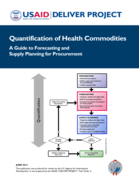
The USAID | DELIVER PROJECT, Task Order 4, developed this guide for quantifying health commodities; it will assist technical advisors, program managers, warehouse managers, procurement officers, and service providers in (1) estimating the total commodity needs and costs for successful implementation
...
of national health program strategies and goals, (2) identifying the funding needs and gaps for procuring the required commodities, and (3) planning procurements and shipment delivery schedules to ensure a sustained and effective supply of health commodities.
The step-by-step approach to quantification presented in this guide is complemented by a set of product-specific companion pieces that include detailed instructions for forecasting consumption of antiretroviral drugs, HIV test kits, antimalarial drugs, and laboratory supplies.
more
State of Health in the WHO African Region
recommended
This report is not a country scorecard. Rather, its purpose is to act as a compass to guide progress towards health in the SDGs.
There has been a significant improvement in the state of health in the region with healthy life expectancy - time spent in full health - in the region increasing from 50
...
.9 years to 53.8 between 2012 and 2015 - the most marked increase of any region in the world.
What is making Africans sick is changing. The top killers are still lower respiratory infections, HIV and diarrhoeal disease and countries have routinely focused on preventing and treating this trio, often through specialized programmes. The payoff has been significant declines in deaths due to these diseases. There has been a 50% reduction in the burden of disease caused by what have been the top 10 killers since 2000 and death rates have dropped from 87.7 to 51.1 deaths per 100,000 persons between 2000 and 2015...
Chronic diseases like heart disease and cancer are now claiming more lives with a person aged 30 to 70 in the region having a one in five chance of dying from a noncommunicable disease (NCDs).
Countries are specifically failing to provide essential services to two critical age groups – adolescents and the elderly...
more
This guide provides an overview of the major elements that must be considered before, during and after the implementation of antigen-detecting rapid diagnostic tests (Ag-RDTs) for SARS-CoV-2. This guide is complementary to policy guidance issued by the World Health Organization (WHO). The guide may
...
appeal to a range of audiences including Ministries of Health, donors, public and private organizations/agencies acting as implementing partners and community based and civil society organizations with experience working on health, especially organizations familiar with similar testing campaigns for other disease programmes like HIV and malaria
more
Community-based strategies play a significant role in many health systems in low- and middle-income countries, especially in light of critical shortages in the health workforce. The term community health worker has been used to refer to volunteers and salaried, professional or lay health workers wit
...
h a wide range of training, experience, scope of practice and integration in health systems. In the context of this study, we use the term community-based practitioner (CBPs) to reflect the diverse nature of these cadres of health workers.
CBPs provide preventive, promotive, curative and palliative services across a range of areas, including reproductive, maternal, newborn and child health, HIV, tuberculosis, malaria, control of other endemic diseases, and noncommunicable diseases. Significant evidence has emerged over the past two decades on their effectiveness, which has triggered interest in the potential to use their services to expand access to care, in particular in rural and underserved areas where deployment and retention of more qualified health workers is problematic. Calls have been made to integrate CBP programmes in human resources and health strategies, and to scale up rapidly the extent and coverage of CBP initiatives.
more

Pan American Journal of Public Health.
Objetivo. Identificar os fatores associados ao êxito do tratamento da tuberculose multirresistente (TBMR) relacionados ao paciente e à equipe de saúde nos seis municípios da Colômbia com o maior número de casos. Métodos. Mediante regresiones logísticas
...
bifactorial y multifactorial se analizó la asociación entre el tratamiento exitoso (curación o cumplimiento del tratamiento) y las características de los pacientes, y de los médicos, profesionales de enfermería y psicólogos vinculados al tratamiento. Se exploró la importancia del conocimiento en el manejo de los casos de TB-MDR mediante grupos focales con esos profesionales.
more

The meningitis road map has been designated as a flagship global strategy of the WHO’s Thirteenth General Programme of Work, 2019–2023 and is an essential component in achieving universal health coverage.
The road map will reinforce and combine with wider initiatives, such as those aimed at s
...
trengthening primary health care and health systems, increasing immunization coverage, improving global health security, fighting antimicrobial resistance and advocating for the rights of persons with disabilities. It will complement other global control strategies, such as those addressing sepsis, pneumonia, tuberculosis and HIV. Implementation will be a challenge for all countries across the world, but especially in resource-poor settings where the burden of meningitis is greatest. The targets for the visionary and strategic goals will be adapted to regional and local contexts.
more

During the year 2022, COVID-19 continued to be a significant challenge in Eritrea as in many other countries across the world. As COVID-19 devastated communities around the world, WHO worked with the MoH to strengthen the National and Sub-National health systems in order to meet community needs and
...
mitigate the devastation during the pandemic and beyond.
One of the major achievements in the year 2022 was the beginning of the journey towards validation of
the elimination of mother to child transmission of HIV, syphilis, and hepatitis B. This is the culmination of years
of commitment and determination by the political leadership, national and international partnerships to
reduce the associated indices to levels that qualify for elimination.
more
The article discusses the significant impact of chronic obstructive pulmonary disease (COPD) as a global health issue, with cigarette smoking as the main risk factor. However, in developing countries, the causes of COPD are often multifactorial, involving environmental tobacco smoke, biomass fuel sm
...
oke, dust, fumes, childhood illnesses, and tuberculosis (TB). Up to half of COPD patients in these regions are non-smokers. The article emphasizes that while smoking is crucial, other risk factors contribute significantly to COPD, particularly in low- and middle-income countries. It highlights the need for targeted research and public health strategies to address these diverse contributors to COPD, especially in Africa.
more

This document consolidates, for the first time, WHO recommendations on the prevention, testing, treatment and monitoring of hepatitis B and C, and includes testing strategies for hepatitis D. Drawing on a decade of evidence-based guidance issued between 2015 and 2025, it provides a single, practical
...
handbook to support global progress toward eliminating viral hepatitis by 2030.
The document also highlights simplified service delivery models that promote decentralization, integration with primary care and related programmes such as HIV and tuberculosis, as well as task sharing and differentiated care to expand access and improve efficiency. It further underscores the need for robust data and monitoring systems to support effective programme implementation.
more

Malawi is a landlocked country with a surface area of 118,484 km2. Administratively, the country is divided into three regions, namely the Northern, Central and Southern regions. The country has 28 districts, which are further divided into traditional authorities (TA) ruled by chiefs. The TAs are su
...
b-divided into villages, which form the smallest administrative units. The Village Development Committees (VDCs) under the TAs are responsible for development activities. Politically, each district is divided into constituencies that are represented by Members of Parliament (MPs) in the National Assembly for purposes of legislations. Constituencies are further divided into wards which are represented by a ward councillor at district assembly.
more
Detailed clinical guidelines focusing on dolutegravir-based regimens.