
Filter
2774
Text search:
World
Health
Organization
(Europe)
Featured
269
412
Language
2470
217
138
80
49
35
32
31
26
7
6
5
5
4
4
4
3
3
3
2
2
2
2
2
2
2
2
2
1
1
1
1
1
1
1
1
1
1
1
1
1
1
Document type
1171
739
380
178
95
72
52
48
16
7
6
6
1
1
Countries / Regions
204
186
107
103
84
49
45
34
32
32
25
24
21
20
19
19
17
16
16
16
15
14
14
14
14
14
13
12
12
11
11
11
10
10
10
9
9
9
8
8
8
7
7
7
7
7
6
6
6
6
6
6
6
6
6
6
5
5
5
5
5
4
4
4
4
4
4
4
4
4
3
3
3
3
3
3
3
3
3
3
3
2
2
2
2
2
2
2
2
2
2
2
2
2
2
1
1
1
1
1
1
1
1
1
1
1
1
1
1
1
1
1
1
1
1
1
1
1
1
Authors & Publishers
601
193
119
97
96
94
47
47
42
41
36
23
22
22
21
20
19
18
18
15
13
13
11
10
10
10
10
10
9
9
9
9
9
8
8
8
8
8
8
8
7
7
7
7
7
7
7
7
6
6
6
6
6
5
5
5
5
5
5
5
5
5
5
5
5
5
5
5
5
5
5
5
4
4
4
4
4
4
4
4
4
4
4
4
4
4
4
4
4
4
4
4
4
4
4
4
4
4
4
4
3
3
3
3
3
3
3
3
3
3
3
3
3
3
3
3
3
3
3
3
3
3
3
3
3
3
3
3
3
3
3
3
3
3
3
3
3
3
3
3
3
3
3
3
3
3
3
3
3
2
2
2
2
2
2
2
2
2
2
2
2
2
2
2
2
2
2
2
2
2
2
2
2
2
2
2
2
2
2
2
2
2
2
2
2
2
2
2
2
2
2
2
2
2
2
2
2
2
2
2
2
2
2
2
2
2
2
2
2
2
2
2
2
2
2
2
2
2
2
2
2
2
2
2
2
2
2
2
2
2
2
2
2
2
2
2
2
2
2
2
2
2
2
2
2
2
2
2
2
2
2
2
2
2
2
2
2
2
2
2
2
2
2
2
2
2
2
2
2
2
2
1
1
1
1
1
1
1
1
1
1
1
1
1
1
1
1
1
1
1
1
1
1
1
1
1
1
1
1
1
1
1
1
1
1
1
1
1
1
1
1
1
1
1
1
1
1
1
1
1
1
1
1
1
1
1
1
1
1
1
1
1
1
1
1
1
1
1
1
1
1
1
1
1
1
1
1
1
1
1
1
1
1
1
1
1
1
1
1
1
1
1
1
1
1
1
1
1
1
1
1
1
1
1
1
1
1
1
1
1
1
1
1
1
1
1
1
1
1
1
1
1
1
1
1
1
1
1
1
1
1
1
1
1
1
1
1
1
1
1
1
1
1
1
1
1
1
1
1
1
1
1
1
1
1
1
1
1
1
1
1
1
1
1
1
1
1
1
1
1
1
1
1
1
1
1
1
1
1
1
1
1
1
1
1
1
1
1
1
1
1
1
1
1
1
1
1
1
1
1
1
1
1
1
1
1
1
1
1
1
1
1
1
1
1
1
1
1
1
1
1
1
1
1
1
1
1
1
1
1
1
1
1
1
1
1
1
1
1
1
1
1
1
1
1
1
1
1
1
1
1
1
1
1
1
1
1
1
1
1
1
1
1
1
1
1
1
1
1
1
1
1
1
1
1
1
1
1
1
1
1
1
1
1
1
1
1
1
1
1
1
1
1
1
1
1
1
1
1
1
1
1
1
1
1
1
1
1
1
1
1
1
1
1
1
1
1
1
1
1
1
1
1
1
1
1
1
1
1
1
1
1
1
1
1
1
1
1
1
1
1
1
1
1
1
1
1
1
1
1
1
1
1
1
1
1
1
1
1
1
1
1
1
1
1
1
1
1
1
1
1
1
1
1
1
1
1
1
1
1
1
1
1
1
1
1
1
1
1
1
1
1
1
1
1
1
1
1
1
1
1
1
1
1
1
1
1
1
1
1
1
1
1
1
1
1
1
1
1
1
1
1
1
1
1
1
1
1
1
1
1
1
1
1
1
1
1
1
1
1
1
1
1
1
1
1
1
1
1
1
1
1
1
1
1
1
1
1
1
1
1
1
1
1
1
1
1
1
1
1
1
1
1
1
1
1
1
1
1
1
1
1
1
1
1
1
1
1
1
1
1
1
1
1
1
1
1
1
1
1
1
1
1
1
1
1
1
1
1
1
1
1
1
1
1
1
1
1
1
1
1
1
1
1
1
1
1
1
1
1
1
1
1
1
1
1
1
1
1
1
1
1
1
1
1
1
1
1
1
1
1
1
1
1
1
1
1
1
1
1
1
1
1
1
1
1
1
1
1
1
1
1
1
1
1
1
1
1
1
1
1
1
1
1
1
1
1
1
1
1
1
1
1
1
1
1
1
1
1
1
1
1
1
1
1
1
1
1
1
1
1
1
1
1
1
1
1
1
1
1
1
1
1
1
1
1
1
1
1
1
1
1
1
1
1
1
1
1
1
1
1
1
1
1
1
1
1
1
1
1
1
1
1
1
1
1
1
1
1
1
1
1
1
1
1
1
1
1
1
1
1
1
1
1
1
1
1
1
1
1
1
1
1
1
1
1
1
1
1
1
1
1
1
1
1
1
1
1
1
1
1
1
1
1
1
1
1
1
1
1
1
1
1
1
1
1
1
1
1
1
1
1
1
1
1
1
1
1
1
1
1
1
1
1
1
1
1
1
1
1
1
1
1
1
1
1
1
1
1
1
1
1
1
1
1
1
1
1
1
1
1
1
1
1
1
1
1
1
1
1
1
1
1
1
1
1
1
1
1
1
1
1
1
1
1
1
1
1
1
1
1
1
1
1
1
1
1
1
1
1
1
1
1
1
1
1
1
1
1
1
1
1
1
1
1
1
1
1
1
1
1
1
1
1
1
1
1
1
1
1
1
1
1
1
1
1
1
1
1
1
1
1
1
1
1
1
1
1
1
1
1
1
1
1
1
1
1
1
1
1
1
1
1
1
1
1
1
1
1
1
1
1
1
1
1
1
1
1
1
1
1
1
1
1
1
1
1
1
1
1
1
1
1
1
1
1
1
1
1
1
1
1
1
1
1
1
1
1
1
1
1
1
1
1
1
1
1
1
1
1
1
1
1
1
1
1
1
1
1
1
1
1
1
1
1
1
1
1
1
1
1
1
1
1
1
1
1
1
1
1
1
1
1
1
1
1
1
1
1
1
1
1
1
1
1
1
1
1
1
1
1
1
1
1
1
1
1
1
1
1
1
1
1
1
1
1
1
1
1
1
1
1
1
1
1
1
1
1
1
1
1
1
1
1
1
1
1
1
1
1
1
1
1
1
1
1
1
1
1
1
1
1
1
1
1
1
1
1
1
1
1
1
1
1
1
1
1
1
1
1
1
1
1
1
1
1
1
1
1
1
1
1
1
1
1
1
1
1
1
1
1
1
1
1
1
1
1
1
1
1
1
1
1
1
1
1
1
1
1
1
1
1
1
1
1
1
1
1
1
1
1
1
1
1
1
1
1
1
1
1
1
1
1
1
1
1
1
1
1
1
1
1
1
1
1
1
1
1
1
1
1
1
1
1
1
1
1
1
1
1
1
1
1
1
1
1
1
1
1
1
1
1
1
1
1
1
1
1
1
1
1
1
1
1
1
1
1
1
1
1
1
1
1
1
1
1
1
1
1
1
1
1
1
1
1
1
1
1
1
1
1
1
1
1
1
1
1
1
1
1
1
1
1
1
1
1
1
1
1
1
1
1
1
1
1
1
1
1
1
1
1
1
1
1
1
1
1
1
1
1
1
1
1
1
1
1
1
1
1
1
1
1
1
1
1
1
1
1
1
1
1
1
1
1
1
1
1
1
1
1
1
1
1
1
1
1
1
1
1
1
1
1
1
1
1
1
1
1
1
1
1
1
1
1
1
1
1
1
1
1
1
1
1
1
1
1
1
1
1
1
1
1
1
1
1
1
1
1
1
1
1
1
1
1
1
1
1
1
1
1
1
1
1
1
1
1
1
1
1
1
1
1
1
1
1
1
1
1
1
1
1
1
1
1
1
1
1
1
1
1
1
1
1
1
1
1
1
1
1
1
1
1
1
1
1
1
1
1
1
1
1
1
1
1
1
1
1
1
1
1
1
1
1
1
1
1
1
1
1
1
1
1
1
1
1
1
1
1
1
1
1
1
1
1
1
1
1
1
1
1
1
1
1
1
1
1
1
1
1
1
1
1
1
1
1
1
1
1
1
1
1
1
1
1
1
1
1
1
1
1
1
1
1
1
1
1
1
1
1
1
1
1
1
1
1
1
1
1
1
1
1
1
1
1
1
1
1
1
1
1
1
1
1
1
1
1
1
1
1
1
1
1
1
1
1
1
1
1
1
1
1
1
1
1
1
1
1
1
1
1
1
1
1
1
1
1
1
1
1
1
1
1
1
1
1
1
1
1
1
1
1
1
1
1
1
1
1
1
1
1
1
1
1
1
1
1
1
1
1
1
1
1
1
1
1
1
1
1
1
1
1
1
1
1
1
1
1
1
1
1
1
1
1
1
1
1
1
1
1
1
1
1
1
1
1
1
1
1
1
1
1
1
1
1
1
1
1
1
1
1
1
1
1
1
1
1
1
1
1
1
1
1
1
1
1
1
1
1
1
1
1
1
1
1
1
1
1
1
1
1
1
1
1
1
1
1
1
1
1
1
1
1
1
1
1
1
1
1
1
1
1
1
1
1
1
1
1
1
1
1
1
1
1
1
1
1
1
1
1
1
1
1
1
1
1
1
1
1
1
1
1
1
1
1
1
1
1
1
1
1
1
1
1
1
1
1
1
1
1
1
1
1
1
1
1
1
1
1
1
1
1
1
1
1
1
1
1
1
1
1
1
1
1
1
1
1
1
1
1
1
1
1
1
1
1
1
1
1
1
1
1
1
1
1
1
1
1
1
1
1
1
1
1
1
1
1
1
1
1
1
1
1
1
1
1
1
1
1
1
1
1
1
1
1
1
1
1
1
1
1
1
1
1
1
1
1
1
1
1
1
1
1
1
1
1
1
1
1
1
1
1
1
1
1
1
1
1
1
1
1
1
1
1
1
1
1
1
1
1
1
1
1
1
1
1
1
1
1
1
1
1
1
1
1
1
1
1
1
1
1
1
1
1
1
1
1
1
1
1
1
1
1
1
1
1
1
1
1
1
1
1
1
1
1
1
1
1
1
1
1
1
1
1
1
1
1
1
1
1
1
1
1
1
1
1
1
1
1
1
1
1
1
1
1
1
1
1
1
1
1
1
1
1
1
1
1
1
1
1
1
1
1
1
1
1
1
1
1
1
1
1
1
1
1
1
1
1
1
1
1
1
1
1
1
1
1
1
1
1
1
1
1
1
1
1
1
1
1
1
1
1
1
1
1
1
1
1
1
1
1
1
1
1
1
1
1
1
1
1
1
1
1
1
1
1
1
1
1
1
1
1
1
1
1
1
1
1
Publication Years
1
1113
1424
216
20
Category
503
223
170
156
152
48
23
2
Toolboxes
363
309
241
202
201
116
100
100
98
87
73
72
68
66
55
54
51
48
26
20
19
16
15
15
14
2
Integrating Clinical Research into Epidemic Response: The Ebola Experience
Gerald Keusch, Keith McAdam, Patricia Cuff, Michelle Mancher, and Emily R. Busta
National Academies of Sciences, Engineering, and Medicine
(2017)
C1
The 2014–2015 Ebola epidemic in western Africa was the longest and most deadly Ebola epidemic in history, resulting in 28,616 cases and 11,310 deaths in Guinea, Liberia, and Sierra Leone. The Ebola virus has been known since 1976, when two separate outbreaks were identified in the Democratic Repub
...
lic of Congo (then Zaire) and South Sudan (then Sudan). However, because all Ebola outbreaks prior to that in West Africa in 2014–2015 were relatively isolated and of short duration, little was known about how to best manage patients to improve survival, and there were no approved therapeutics or vaccines. When the World Heath Organization declared the 2014-2015 epidemic a public health emergency of international concern in August 2014, several teams began conducting formal clinical trials in the Ebola affected countries during the outbreak.
more

The African Palliative Care Association is pleased to publish the first edition of Palliative Care Standards for Africa. The development of these standards was achieved through wide consultation with service beneficiaries and providers, and they have been developed to suit different levels of
...
service delivery, from primary to tertiary. These standards are underpinned by the World Health Organization’s definition of palliative care, and recognise that scaling up palliative care requires a public health approach with four pillars: policy, education, drug availability and implementation. In addition, the increasing need to establish specific indicators of quality and effectiveness for palliative care has been a big driving force behind these comprehensive standards. It is APCA’s wish that they will provide a framework for the development of evaluation
and performance indicators that can facilitate programme improvement and development. The standards are designed to allow the development or improvement of palliative care across the different services levels, within the organisational capacity of various service providers. They describe a relationship between primary, intermediary and tertiary level service providers, with expectations for all providers articulated through detailed criteria for each standard. It is therefore expected that these standards will influence the planning and delivery of palliative care services at all levels of health care service delivery.
more

This report provides an overview of the operations and activities of the WHO Country Office in Ukraine in 2023. Despite the acute health impacts of the war in Ukraine, the Country Office continued its work according to its core mandate. WHO supporte
...
d the Government of Ukraine in managing the health emergency and pursued existing priorities set out in WHO’s Thirteenth General Programme of Work 2019–2023, the European Programme of Work 2020–2025, and the Biennial Collaborative Agreement 2022–2023 signed with the Government of Ukraine. The report presents the achievements of the WHO Country Office in Ukraine in 2023 in the context of the war’s impact on the lives, health, and well-being of Ukrainians.
more
The technical note by the Global Task Force on Cholera Control (GTFCC) discusses the use of Oral Cholera Vaccines (OCVs) for international workers and travelers in cholera-affected areas. It reviews the effectiveness of WHO-prequalified vaccines (Dukoral®, Shanchol™, and Euvichol®), emphasizing
...
their role in preventing infection and reducing transmission risks.
The document highlights concerns about travelers contracting cholera in endemic regions and potentially spreading the disease upon returning home. While the overall risk is considered low, certain groups, such as humanitarian workers and travelers to high-risk areas like South Asia, face a higher exposure.
Recommendations include vaccination for emergency and relief workers who may come into direct contact with cholera patients or contaminated environments. However, routine vaccination for general travelers is not widely recommended. The note also calls for better surveillance and studies to assess the potential of vaccines in preventing international transmission.
more

An interdisciplinary approach to address global health challenges such as the Covid-19 pandemic, climate change, loss of biodiversity, human migration has been framed by the One Health approach. Thi
...
s approach is promoted at global level by the Tripartite of the World Health Organisation, the World Animal Health Organisation, the Food and Agriculture Organisation of the United Nations, recently joint by the United National Environment Program to form the Quadripartite. The German government through its Ministry of Economic Cooperation and Development supports this approach with its One Health strategy and investment in several technical cooperation projects.
more
This new publication presents the continuing and emerging challenges to children’s environmental health.
14 June 2022.
The aim of this document is to provide concise advice to public health authorities and guide their prevention, awareness-raising and behaviour change interventions before, during and after upcoming summer events.
Health in All Policies (HiAP) is not a new concept. While the term “HiAP” has received much attention since the 1990s, the concept
of working across sectors of government for improved population healt
...
h and wellbeing is much older than that. Over the last few decades the term has been applied to multiple health topics and challenges – whetherimplicitly or explicitly.
more
Scientific Paper
Unchecked inequality and failure to protect the rights of poorest women could undermine peace and world’s development goals, new UNFPA report warns:
- Only about half of the world’s women hold
...
paid jobs
- Globally, women earn 77 per cent of what men get
- Three in five women worldwide lack maternity leave, many pay "motherhood penalty"
The report is also available in French: https://www.unfpa.org/sites/default/files/sowp/downloads/UNFPA_PUB_2017_FR_swop_Etat_de_la_population_mondiale.pdf; in Spanish: https://www.unfpa.org/sites/default/files/sowp/downloads/UNFPA_PUB_2017_ES_SWOP_Estado_de_la_Poblacion_Mundial.pdf; in Russian: https://www.unfpa.org/sites/default/files/sowp/downloads/UNFPA_PUB_2017_RU_SWOP_NARODONASELENIE_MIRA_V_2017_GODU.pdf and in Arabic: https://www.unfpa.org/sites/default/files/sowp/downloads/UNFPA_PUB_2017_AR_SWOP_Hl_skn_llm_.pdf
more
Climate change (CC) impacts on health outcomes, both direct and indirect, are sufficient to jeopardize achieving the World Bank Group’s visions and agendas in poverty reduction, population resilie
...
nce, and health, nutrition and population (HNP). In the last 5 years, the number of voices calling for stronger international action on climate change and health has increased, as have the scale and depth of activities. But current global efforts in climate and health are inadequately integrated. As a result, actions to address climate change, including World Bank Group (WBG) investment and lending, are missing opportunities to simultaneously promote better health outcomes and more resilient populations and health sectors. Accordingly, with the financial support of the Nordic Development Fund (NDF), the World Bank Group set out to develop an approach and a 4-year action plan, outlined in this paper, to integrate health-related climate considerations into selected WBG sector plans and investments.
more

Child and adolescent Mental health in europe: infrastructures, policy and programmes
F. Braddick; V. Carral; R. Jenkins; E. Jané-Llopis
European Commission; Generalitat de Catalunya Department de Salud; Institute of Psychiatry; Kings College London; State Mental Health Center ; et al.
(2009)
C2
CAMHEE
Building on our decades of commitment to human rights in medicine and healthcare, we have published a new report on emerging threats in health-related human rights both globally and in the UK.
'Health
...
and human rights in the new world (dis)order' outlines a shifting rights landscape in which new technologies, environmental change and geopolitical reconfigurations are putting renewed and at times intense stress on human rights, both in medicine and healthcare more broadly.
more

The burden of diabetes is enormous, positioning it as one of the main challenges facing public health today. Currently, it is estimated that 62 million people are living with diabetes in the Region of the Americas and projections show its prevalence
...
will continue rising over the following years. The Region shows the highest number of years of healthy life lost (through either disability or premature death) due to diabetes worldwide. The high costs associated with its treatment produce a heavy economic burden. Its complications can seriously affect the quality of life of people living with diabetes, their families, and society and overload health systems. This report shows the latest internationally comparable data on diabetes and its main risk factors by year, country, and sex. It also includes a summary of the countries health systems’ response to diabetes, including national plans, targets, surveillance, guidelines, and access to essential drugs and technologies, and synthesizes information about diabetes-related complications and the close relationship between diabetes and other pathologies, such as cardiovascular diseases, tuberculosis, and COVID-19. The data presented here reveal that, despite advances in national responses, diabetes continues to expand, and our response remains insufficient. This report aims to draw attention to the urgent need to strengthen efforts to prevent, diagnose, and control diabetes in the Region of the Americas.
more
Comorbidity of substance use and mental health disorders in Europe
European Monitoring Centre for Drugs and Drug Addiction
(2016)
C2
Perspectives on drugs

Left unabated, climate change will have catastrophic effects on the health of present and future generations. Such effects are already seen in Europe, through more frequent and severe extreme weathe
...
r events, alterations to water and food systems, and changes in the environmental suitability for infectious diseases. As one of the largest current and historical contributors to greenhouse gases and the largest provider of financing for climate change mitigation and adaptation, Europe’s response is crucial, for both human health and the planet. To ensure that health and
wellbeing are protected in this response it is essential to build the capacity to understand, monitor, and quantify health impacts of climate change and the health co-benefits of accelerated action.
more
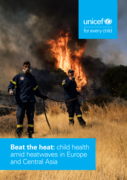
Beat the heat: child health amid heatwaves in Europe and Central Asia finds that half of these children died from heat-related illnesses in their first year of life. Most children died during the su
...
mmer months.
"Around half of children across Europe and Central Asia – or 92 million children – are already exposed to frequent heatwaves in a region where temperatures are rising at the fastest rate globally. The increasingly high temperatures can have serious health complications for children, especially the youngest children, even in a short space of time. Without care, these complications can be life-threatening,” said Regina De Dominicis UNICEF Regional Director for Europe and Central Asia.
Heat exposure has acute effects on children, even before they are born, and can result in pre-term births, low birth weight, stillbirth, and congenital anomalies. Heat stress is a direct cause of infant mortality, can affect infant growth and cause a range of paediatric diseases. The report also notes that extreme heat caused the loss of more than 32,000 years of healthy life among children and teenagers in the region.
As the temperatures continue to rise, UNICEF urges governments across Europe and Central Asia to:
- Integrate strategies to reduce the impact of heatwaves including through National Determined Contributions (NDC), National Adaptation Plans (NAP), and disaster risk reduction and disaster management policies with children at the centre of these plans
Invest in heat health action plans and primary health care to more adequately support heat-related illness among children
- Invest in early warning systems, including heat alert systems
- Adapt education facilities to reduce the temperatures in the areas children play in and equip teachers with skills to respond to heat stress
- Adapt urban design and infrastructure including ensuring buildings, particularly those housing the most vulnerable communities are equipped to minimize heat exposure
- Secure the provision of safe water, particularly in countries with deteriorating water quality and availability.
UNICEF works with governments, partners and communities across the region to build resilience against heatwaves. This includes equipping teachers, community health workers and families with the skills and knowledge to respond to heat stress.
more
EBioMedicine. 2016 Jun 16. pii: S2352-3964(16)30276-6. doi: 10.1016/j.ebiom.2016.06.020. Open Access
Depress Anxiety. 2018 March ; 35(3): 195–208. doi:10.1002/da.22711.
Against the backdrop of the COVID-19 pandemic, health is receiving unprecedented public and political attention. Yet the fact that climate change also presents us with a health crisis deserves furth
...
er recognition. From more deaths due to heat stress to increased transmission of infectious diseases, climate change affects the social and environmental determinants of health in ways that are profound and far-reaching. The fundamental interdependency of human health and the health of the environment is encapsulated in the concept of planetary health, a scientific field and social movement that has been gaining force since the 2015 publication of the Rockefeller Foundation-Lancet Commission report “Safeguarding human health in the Anthropocene epoch”.
We see an urgent need for strategic communication to raise awareness of climate-health synergies in order to overcome the misperception that climate and health are two independent agendas. The fragmented and sector-focused nature of thinking and action remains a significant barrier to integrating health considerations into climate planning and project development. Inevitably, collaboration across sectors requires a community of practice. Despite recent efforts focused on the climate-health nexus, much work remains to be done to translate scientific findings for policymakers, mobilise climate financing resources in support of health co-benefits, and promote genderjust solutions within climate change projects.
more
