
Filter
260
Text search:
Health
Cluster,
Nutrition
Cluster,
OCHA
Featured
Recommendations
31
New Publications
100
Language
Document type
No document type
141
Studies & Reports
30
Strategic & Response Plan
26
Situation Updates
20
Manuals
19
Guidelines
12
Fact sheets
8
Resource Platforms
2
Training Material
1
Infographics
1
Countries / Regions
Syria
23
South Sudan
17
Yemen
13
Myanmar / Burma
11
Central African Republic
10
Ukraine
10
Philippines
8
Global
8
Congo, Democratic Republic of
7
Mozambique
7
Sudan
7
Nigeria
6
Kenya
6
Madagascar
6
Venezuela
5
Sierra Leone
4
Ethiopia
4
Zimbabwe
4
Somalia
4
Bangladesh
4
Liberia
3
Cameroon
3
Niger
3
Haiti
3
Nepal
3
Afghanistan
3
Malawi
3
Guinea
2
Uganda
2
India
2
South Africa
2
Papua New Guinea
2
Asia
2
Laos
2
Burkina Faso
1
Senegal
1
Mali
1
Pakistan
1
Jordan
1
Lebanon
1
Thailand
1
Indonesia
1
Hungary
1
Colombia
1
Libya
1
East and Southern Africa
1
West and Central Africa
1
Western Pacific Region
1
Latin America and the Carribbean
1
Africa
1
Poland
1
Palestine
1
Bulgaria
1
Romania
1
Moldova
1
Slovakia
1
Iran
1
Authors & Publishers
Publication Years
Category
Countries
113
Key Resources
53
Public Health
9
Women & Child Health
4
Capacity Building
3
Clinical Guidelines
2
Toolboxes
Conflict
58
COVID-19
37
Natural Hazards
27
Rapid Response
9
Ebola & Marburg
7
Refugee
7
HIV
6
Mental Health
6
Disability
5
2.0 Rapid Response
5
Cholera
3
TB
3
Planetary Health
3
South Sudan
1
Typhoon
1
Zika
1
Specific Hazards
1
Global Health Education
1
Caregiver
1

Coronavirus Disease-19 (COVID-19) was declared a global pandemic on 11 March 2020, and Malawi declared its first case on 2 April. As of 30 April, there were 36 confirmed positive cases of COVID-19 and 3 deaths. A State of Disaster was declared by President Arthur Peter Mutharika on 20 March and a 21
...
The guide is designed to help disaster managers in national Governments gain basic knowledge of how to use international tools and services. It aims to support the growing disaster response and disaster response preparedness capabilities that exist at national level across Asia and the Pacific.
...
...
Since fighting between the Sudanese Armed Forces (SAF) and the Rapid Support Forces (RSF) erupted in mid-April, an estimated 6.3 million people have fled their homes, taking refuge inside and outside the country, with children representing about half of the people displaced. Sudan is now the country
...
Health Workers and Health Facilities under Attack 2015, and Early 2016
FAO’s component of the Global COVID-19 Humanitarian Response Plan
18.5.2020
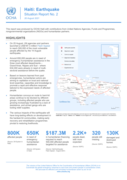
On 25 August, UN agencies and partners launched a US$187.3 million Flash Appeal to reach 500,000 of the most vulnerable people affected by the 14 August earthquake.
Around 650,000 people are in need of emergency humanitarian assistance in the three most affected departments – Grand’Anse, Nipp
...
• Clashes continued between the Syrian Democratic Forces (SDF), the Syrian Arab Army (SAA), and Turkish backed forces, concentrated around the M4 highway and Tal Tamer district in Al-Hasakeh. Further displacement was reported.
• Several civilian casualties occurred due to improvised explosive
...
Myanmar is prone to various natural hazards that include earthquakes, floods, cyclones, droughts, fires, tsunamis, some of whichhave the potential to impact large numbers of people. In the event that large numbers of people are affected(such as was the case in 2008 following cyclone Nargis), the gov
...
This document summarizes preparedness and response activities to address the coronavirus disease (COVID-19) outbreak in South Sudan through the end of 2020. The addendum includes the activities and financial requirements of the updated National COVID-19 Response Plan. Originally issued in March prio
...

WHO’s Country Cooperation Strategy (CCS) defines the Organization’s medium-term vision for working in and with a particular country. The CCS, developed in the context of global and national health priorities, examines the overall
...
Emergency response framework, 2nd ed.
recommended
The purpose of this Emergency Response Framework (ERF) is to clarify WHO’s roles and responsibilities in this regard and to provide a common approach for its work in emergencies. Ultimately, the ERF requires WHO to act with urgency and predictability to best serve and be accountable to populations
...
Myanmar is prone to various natural hazards that include earthquakes, floods, cyclones, droughts, fires, tsunamis, some of whichhave the potential to impact large numbers of people. In the event that large numbers of people are affected (such as was the case in 2008 following cyclone Nargis), the go
...
