
Filter
1998
Text search:
preventing
health
care
associated
infections
Featured
262
574
Language
Document type
1002
378
302
132
103
34
22
11
4
3
3
1
1
Countries
95
95
57
50
49
41
40
40
36
36
33
32
31
27
26
24
24
22
21
19
15
15
14
13
12
10
9
9
9
9
8
8
8
8
7
7
7
7
7
7
5
5
5
4
4
4
3
3
3
3
3
2
2
2
2
2
2
2
2
2
1
1
1
1
1
1
1
1
1
1
1
1
1
1
1
1
1
1
1
1
1
1
1
1
1
1
1
1
Authors & Publishers
Publication Years
Category
698
215
180
119
118
50
26
1
Toolboxes
171
134
112
101
80
76
67
58
55
41
40
39
38
36
34
31
30
25
19
15
14
9
7
5
1
These WHO interim recommendations on the use of the Pfizer – BioNTech BNT162b2 vaccine against Covid-19 were developed on the basis of advice issued by the Strategic Advisory Group of Experts on Immunization (SAGE) and the evidence summary included in the background document referenced below.
fir
...
Prepared by the Independent Panel for Pandemic Preparedness and Response for the WHO Executive Board, January 2021
“The world was not as prepared as it should have been, and it must do better,” concludes a WHO panel reviewing the pandemic response "
An Action Framework and annexe to Immunization Agenda 2030 (Draft version)
27 January 2021
This manual summarizes key issues related to the safety of NTD medicines and their administration, with a focus on essential medicines used in mass drug administration (MDA), also called preventive chemotherapy. It can be used as a standalone reference manual, but is intended to be used in conjuncti
...
Today more people are exposed to hazards. While humanitarian action to mitigate the impact of disasters will always be vitally important, the community is facing critical challenge- how to better anticipate, manage and reduce - disaster risks by integrating the potential threat into its planning and
...
This implementation brief addresses integration of HIV testing services into family planning (FP) services. It is intended as a practical resource for national health programmes seeking to introduce or scale up HIV testing and linkage to HIV prevent
...

A rapid evidence briefing. Vaccinated people are less likely to develop long COVID, even if they get infected, a rapid review of 15 studies by the UK Health Security Agency shows.

Saving lives is the priority of WHO’s response in Ukraine. WHO works to ensure time-critical, lifesaving multisectoral assistance, non-discriminatory access to emergency and essential health services and priority prevention programmes, and laying
...

The World Health Organization (WHO) and the global community of countries, partners, donors, technical experts, scientists and field implementation teams continue to work towards the ultimate goal of a world free of the burden of neglected tropical
...
Leptospirosis is a zoonotic disease with epidemic potential, especially after a heavy rainfall,
caused by a bacterium called Leptospira. Leptospira interrogans is pathogenic to humans and
animals, with more than 200 serologic variants or serovars. Humans usually acquire
leptospirosis through dire
...

Burden of T. solium: Neurocysticercosis is a disease induced by T. solium larvae penetrating human tissues, especially the nervous system. Neurocysticercosis burdens economies, societies and individuals because of the impact of epilepsy on wages, health
...

Rabies is a fatal viral zoonosis and serious public health problem.1 All mammals are believed to be susceptible to the disease, and for the purposes of this document, use of the term animal refers to mammals. The disease is an acute, progressive enc
...

13 August 2025.The conditionality of this recommendation is largely driven by the current higher unit cost of pyrethroid-PBO ITNs compared to pyrethroid-only LLINs and therefore the uncertainty of their cost-effectiveness. Furthermore, as PBO is less wash-resistant than pyrethroids, its bioavailabil
...

La violencia contra las mujeres y las niñas es generalizada en la Región de las Américas, y tiene enormes consecuencias para su salud y bienestar, así como el de sus familias y sus comunidades. Se trata de un costo inaceptable que puede ser prevenido mediante acciones basadas en la evidencia, pr
...

Skin-related neglected tropical diseases, or “skin NTDs”, are historically neglected because active case detection, individual case management, significant resources and intensive effort are required to control, eliminate and eradicate them. Integrated control and management of skin NTDs offers
...

The military offensive by the Russian Federation in Ukraine which began February 2022 has triggered one of the world’s fastest-growing displacement and humanitarian crisis, with geopolitical and economic ripples felt across the globe. The ongoing war has caused large-scale disruptions to the deliv
...
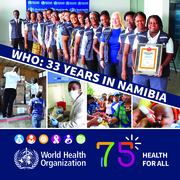
This publication is part of WHO 75th anniversary and aims to capture key successes in public health globally and in Namibia. It includes contributory messages from the Head of State, Prime Minister and the Minister of
...

This document provides technical guidance on concepts, definitions, indicators, criteria, milestones and tools to assist leprosy programmes in their journey towards the goals of interruption of transmission and elimination of leprosy disease and through the post-elimination period. Importantly, it p
...
