
Filter
1135
Text search:
parasites
Featured
104
233
Language
Document type
373
267
173
74
66
52
40
26
18
16
14
5
5
3
2
Countries
83
35
27
23
22
22
21
19
19
16
16
16
15
14
12
12
12
10
10
10
9
9
9
9
8
8
7
7
7
7
6
6
6
5
5
5
5
5
4
4
4
4
4
3
3
3
3
3
3
2
2
2
2
2
2
2
2
2
2
2
2
2
2
2
2
2
2
2
2
2
1
1
1
1
1
1
1
1
1
1
1
1
1
1
1
1
1
1
1
1
1
1
1
1
1
1
1
1
1
1
1
1
1
1
1
Authors & Publishers
Publication Years
Category
377
98
69
65
40
36
33
Toolboxes
297
153
87
58
19
19
18
14
12
12
11
10
9
9
8
8
7
7
5
4
3
3
2
2
2
It is estimated that, in Latin America alone, between 6 and 8 million people are infected with the parasite, and 99% of these are not receiving treatment, either because they are unaware of their infection or because they do not know that treatment exists. The potential spread of the disease is also
...
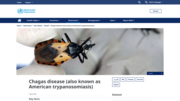
Chagas disease, also known as American trypanosomiasis, is a potentially life-threatening illness caused by the protozoan parasite Trypanosoma cruzi. About 6–7 million people worldwide are estimated to be infected with T. cruzi. The disease is found mainly in endemic areas of 21 continental Lati
...
Die Infektion wird durch nachtaktive, blutsaugende Raubwanzen übertragen. Während des Blutsaugens scheiden die infizierten Wanzen Trypanosomen aus, die Bindehaut, Schleimhäute, Abschürfungen und Hautverletzungen einschließlich der Bißwunde kontaminieren können. Die Übertragung kann auch durc
...

Info Chagas
What do we need to know abaout Chagas Disease? What is Chagas Disease?

How Chagas disease is transmitted video.
Video available with spanish sub title

Advice and guidance on the health needs of migrant patients for healthcare practitioners.
Chagas disease is increasingly reported in Latin American migrants who have settled in Europe. It has rarely been reported in the UK due to lack of testing and awareness.
Chagas disease (American trypanosomia
...

This motion graphic shows how the kissing bug transmits the Trypanosoma cruzi parasite to humans and causes Chagas disease.

Chagas disease is a tropical disease caused by a parasite called Trypansoma cruzi and is primarily spread by Triatomine bugs. It is estimated to affect 6-7 million people, mostly in Latin America, and can cause devastating chronic illness. In this video we take a look at the disease, what it is, and
...

The BeatChagas platform is a tool developed by the Technical Group of Information, Education, and Communication (IEC) for Chagas Disease (TG6-IEC Chagas), part of the Chagas Disease Control Program by the World Health Organization (WHO). The purpose of this platform is to share information about the
...

Video about Animated life cycle of T. cruzi in the human host.

Schistosomiasis, also known as bilharzia, is an infection caused by a parasitic worm that lives in fresh water in subtropical and tropical regions.
Localized cutaneous leishmaniasis and its evolving forms (diffuse cutaneous leishmaniasis, mucosal leishmaniasis and cutaneous leishmaniasis recidivans), together with the sequela of visceral leishmaniasis (post-kala-azar dermal leishmaniasis), account for about one million cases of dermal leishmani
...

In response to the recent publication “Is onchocerciasis elimination in Africa feasible by 2025: a perspective based on lessons learnt from the African control programmes” by Dadzie et al., it is important to clarify and highlight the positive and unequivocal research and operational contributio
...

Onchocerciasis causes skin and eye disease, visual impairment and neurological problems. It is mostly found in Africa, but also in Latin America and Yemen. The common name, ‘river blindness,’ gives a good indication where the disease can be found: the vector of the parasite, a small black fly of
...

People who accidentally swallow the eggs of the Echinococcus granulosus tapeworm are at risk for infection. Dogs that eat home-slaughtered sheep and other livestock become infected with the tapeworm Echinococcus granulosus and the tapeworm eggs can be found in their stool. Direct contact with infect
...
Fascioliasis is caused by two species of parasitic flatworms or trematodes that mainly affect the liver. It belongs to the group of foodborne trematode infections and is a zoonosis, meaning an animal infection that may be transmitted to humans.

Chromoblastomycosis (CBM), represents one of the primary implantation mycoses caused by melanized fungi widely found in nature. It is characterized as a Neglected Tropical Disease (NTD) and mainly affects populations living in poverty with significant morbidity, including stigma and discrimination.

Scabies is a contagious skin condition caused by the mite Sarcoptes scabiei which burrows into the skin and causes severe itching. Scabies is transmitted by direct skin-to-skin contact or indirectly by contact with contaminated material (fomites). This condition is often challenging to diagnose as m
...
Scabies is an infestation of the skin by the human itch mite (Sarcoptes scabiei var. hominis). The microscopic scabies mite burrows into the upper layer of the skin where it lives and lays its eggs. The most common symptoms of scabies are intense itching and a pimple-like skin rash. The scabies mite
...
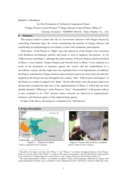
This project aimed to reduce the risk of vector-borne infection with Chagas disease by
controlling triatomine bugs, the vectors transmitting the parasite of Chagas disease, and
establishing an epidemiological surveillance system with community participation.
