
Filter
3445
Text search:
disease
outbreak
Featured
452
848
Language
3040
193
128
92
86
76
31
22
14
7
5
5
5
5
3
3
3
3
3
2
2
2
2
1
1
1
1
1
1
1
1
1
1
1
1
1
1
1
1
1
1
1
1
Document type
1258
717
587
227
225
163
87
76
39
27
18
11
9
1
Countries
210
185
178
105
94
92
87
75
66
61
59
59
55
54
54
53
53
51
49
49
42
42
38
36
36
35
34
29
28
27
27
26
26
25
25
24
24
24
23
22
21
19
18
18
17
16
15
14
13
12
11
11
11
10
10
10
10
10
9
9
9
9
8
8
8
8
8
8
7
6
6
6
6
5
5
5
5
5
5
5
4
4
4
4
4
4
3
3
3
3
3
3
3
2
2
2
2
2
2
2
2
2
2
2
2
2
2
2
2
2
2
2
2
2
2
2
2
2
1
1
1
1
1
1
1
1
1
1
1
1
1
1
1
1
1
1
1
1
1
1
1
1
Authors & Publishers
665
148
108
94
91
75
64
56
44
40
34
30
29
29
27
26
23
23
22
22
19
19
17
17
17
16
15
15
15
14
14
14
14
13
13
13
12
12
12
12
12
11
11
11
10
10
10
10
10
10
10
10
10
9
9
9
9
9
9
8
8
8
8
8
8
8
8
7
7
7
7
7
7
7
7
7
7
7
7
7
6
6
6
6
6
6
6
6
6
6
6
6
6
6
5
5
5
5
5
5
5
5
5
5
5
5
5
5
5
5
5
5
5
4
4
4
4
4
4
4
4
4
4
4
4
4
4
4
4
4
4
4
4
4
4
4
4
4
4
4
4
4
4
3
3
3
3
3
3
3
3
3
3
3
3
3
3
3
3
3
3
3
3
3
3
3
3
3
3
3
3
3
3
3
3
3
3
3
3
3
3
3
3
3
3
3
3
3
3
3
3
3
3
3
3
3
3
3
3
3
3
3
3
3
3
3
3
3
3
3
3
2
2
2
2
2
2
2
2
2
2
2
2
2
2
2
2
2
2
2
2
2
2
2
2
2
2
2
2
2
2
2
2
2
2
2
2
2
2
2
2
2
2
2
2
2
2
2
2
2
2
2
2
2
2
2
2
2
2
2
2
2
2
2
2
2
2
2
2
2
2
2
2
2
2
2
2
2
2
2
2
2
2
2
2
2
2
2
2
2
2
2
2
2
2
2
2
2
2
2
2
2
2
2
2
2
2
2
2
2
2
2
2
2
2
2
2
2
2
2
2
2
2
2
2
2
2
2
2
2
2
2
2
2
2
2
2
2
2
2
2
2
2
2
2
2
2
1
1
1
1
1
1
1
1
1
1
1
1
1
1
1
1
1
1
1
1
1
1
1
1
1
1
1
1
1
1
1
1
1
1
1
1
1
1
1
1
1
1
1
1
1
1
1
1
1
1
1
1
1
1
1
1
1
1
1
1
1
1
1
1
1
1
1
1
1
1
1
1
1
1
1
1
1
1
1
1
1
1
1
1
1
1
1
1
1
1
1
1
1
1
1
1
1
1
1
1
1
1
1
1
1
1
1
1
1
1
1
1
1
1
1
1
1
1
1
1
1
1
1
1
1
1
1
1
1
1
1
1
1
1
1
1
1
1
1
1
1
1
1
1
1
1
1
1
1
1
1
1
1
1
1
1
1
1
1
1
1
1
1
1
1
1
1
1
1
1
1
1
1
1
1
1
1
1
1
1
1
1
1
1
1
1
1
1
1
1
1
1
1
1
1
1
1
1
1
1
1
1
1
1
1
1
1
1
1
1
1
1
1
1
1
1
1
1
1
1
1
1
1
1
1
1
1
1
1
1
1
1
1
1
1
1
1
1
1
1
1
1
1
1
1
1
1
1
1
1
1
1
1
1
1
1
1
1
1
1
1
1
1
1
1
1
1
1
1
1
1
1
1
1
1
1
1
1
1
1
1
1
1
1
1
1
1
1
1
1
1
1
1
1
1
1
1
1
1
1
1
1
1
1
1
1
1
1
1
1
1
1
1
1
1
1
1
1
1
1
1
1
1
1
1
1
1
1
1
1
1
1
1
1
1
1
1
1
1
1
1
1
1
1
1
1
1
1
1
1
1
1
1
1
1
1
1
1
1
1
1
1
1
1
1
1
1
1
1
1
1
1
1
1
1
1
1
1
1
1
1
1
1
1
1
1
1
1
1
1
1
1
1
1
1
1
1
1
1
1
1
1
1
1
1
1
1
1
1
1
1
1
1
1
1
1
1
1
1
1
1
1
1
1
1
1
1
1
1
1
1
1
1
1
1
1
1
1
1
1
1
1
1
1
1
1
1
1
1
1
1
1
1
1
1
1
1
1
1
1
1
1
1
1
1
1
1
1
1
1
1
1
1
1
1
1
1
1
1
1
1
1
1
1
1
1
1
1
1
1
1
1
1
1
1
1
1
1
1
1
1
1
1
1
1
1
1
1
1
1
1
1
1
1
1
1
1
1
1
1
1
1
1
1
1
1
1
1
1
1
1
1
1
1
1
1
1
1
1
1
1
1
1
1
1
1
1
1
1
1
1
1
1
1
1
1
1
1
1
1
1
1
1
1
1
1
1
1
1
1
1
1
1
1
1
1
1
1
1
1
1
1
1
1
1
1
1
1
1
1
1
1
1
1
1
1
1
1
1
1
1
1
1
1
1
1
1
1
1
1
1
1
1
1
1
1
1
1
1
1
1
1
1
1
1
1
1
1
1
1
1
1
1
1
1
1
1
1
1
1
1
1
1
1
1
1
1
1
1
1
1
1
1
1
1
1
1
1
1
1
1
1
1
1
1
1
1
1
1
1
1
1
1
1
1
1
1
1
1
1
1
1
1
1
1
1
1
1
1
1
1
1
1
1
1
1
1
1
1
1
1
1
1
1
1
1
1
1
1
1
1
1
1
1
1
1
1
1
1
1
1
1
1
1
1
1
1
1
1
1
1
1
1
1
1
1
1
1
1
1
1
1
1
1
1
1
1
1
1
1
1
1
1
1
1
1
1
1
1
1
1
1
1
1
1
1
1
1
1
1
1
1
1
1
1
1
1
1
1
1
1
1
1
1
1
1
1
1
1
1
1
1
1
1
1
1
1
1
1
1
1
1
1
1
1
1
1
1
1
1
1
1
1
1
1
1
1
1
1
1
1
1
1
1
1
1
1
1
1
1
1
1
1
1
1
1
1
1
1
1
1
1
1
1
1
1
1
1
1
1
1
1
1
1
1
1
1
1
1
1
1
1
1
1
1
1
1
1
1
1
1
1
1
1
1
1
1
1
1
1
1
1
1
1
1
1
1
1
1
1
1
1
1
1
1
1
1
1
1
1
1
1
1
1
1
1
1
1
1
1
1
1
1
1
1
1
1
1
1
1
1
1
1
1
1
1
1
1
1
1
1
1
1
1
1
1
1
1
1
1
1
1
1
1
1
1
1
1
1
1
1
1
1
1
1
1
1
1
1
1
1
1
1
1
1
1
1
1
1
1
1
1
1
1
1
1
1
1
1
1
1
1
1
1
1
1
1
1
1
1
1
1
1
1
1
1
1
1
1
1
1
1
1
1
1
1
1
1
1
1
1
1
1
1
1
1
1
1
1
1
1
1
1
1
1
1
1
1
1
1
1
1
1
1
1
1
1
1
1
1
1
1
1
1
1
1
1
1
1
1
1
1
1
1
1
1
1
1
1
1
1
1
1
1
1
1
1
1
1
1
1
1
1
1
1
1
1
1
1
1
1
1
1
1
1
1
1
1
1
1
1
1
1
1
1
1
1
1
1
1
1
1
1
1
1
1
1
1
1
1
1
1
1
1
1
1
1
1
1
1
1
1
1
1
1
1
1
1
1
1
1
1
1
1
1
1
1
1
1
1
1
1
1
1
1
1
1
1
1
1
1
1
1
1
1
1
1
1
1
1
1
1
1
1
1
1
1
1
1
1
1
1
1
1
1
1
1
1
1
1
1
1
1
1
1
1
1
1
1
1
1
1
1
1
1
1
1
1
1
1
1
1
1
1
1
1
1
1
1
1
1
1
1
1
1
1
1
1
1
1
1
1
1
1
1
1
1
1
1
1
1
1
1
1
1
1
1
1
1
1
1
1
1
1
1
1
1
1
1
1
1
1
1
1
1
1
1
1
1
1
1
1
1
1
1
1
1
1
1
1
1
1
1
1
1
1
1
1
1
1
1
1
1
1
1
1
1
1
1
1
1
1
1
1
1
1
1
1
1
1
1
1
1
1
1
1
1
1
1
1
1
1
1
1
1
1
1
1
1
1
1
1
1
1
1
1
1
1
1
1
1
1
1
1
1
1
1
1
1
1
1
1
1
1
1
1
1
1
1
1
1
1
1
1
1
1
1
1
1
1
1
1
1
1
1
1
1
1
1
1
1
1
1
1
1
1
1
1
1
1
1
1
1
1
1
1
1
1
1
1
1
1
1
1
1
1
1
1
1
1
1
1
1
1
1
1
1
1
1
1
1
1
1
1
1
1
1
1
1
1
1
1
1
1
1
1
1
1
1
1
1
1
1
1
1
1
1
1
1
1
1
1
1
1
1
1
1
1
1
1
1
1
1
1
1
1
1
1
1
1
1
1
1
1
1
1
1
1
1
1
1
1
1
1
1
1
1
1
1
1
1
1
1
1
1
1
1
1
1
1
1
1
1
1
1
1
1
1
1
1
1
1
1
1
1
1
1
1
1
1
1
1
1
1
1
1
1
1
1
1
1
1
1
1
1
1
1
1
1
1
1
1
1
1
1
1
1
1
1
1
1
1
1
1
1
1
1
1
1
1
1
1
1
1
1
1
1
1
1
1
1
1
1
1
1
1
1
1
1
1
1
1
1
1
1
1
1
1
1
1
1
1
1
1
1
1
1
1
1
1
1
1
1
1
1
1
1
1
1
1
1
1
1
1
1
1
1
1
1
1
1
1
1
1
1
1
1
1
1
1
1
1
1
1
1
1
1
1
1
1
1
1
1
1
1
1
1
1
1
1
1
1
1
1
1
1
1
1
1
1
1
1
1
1
1
1
1
1
1
1
1
1
1
1
1
1
1
1
1
1
1
1
1
1
1
1
1
1
1
1
1
1
1
1
1
1
1
1
1
1
1
1
1
1
1
1
1
1
1
1
1
1
1
1
1
1
1
1
1
1
1
1
1
1
1
1
1
1
1
1
1
1
1
1
1
1
1
1
1
1
1
1
1
1
1
1
Publication Years
1742
1538
150
15
Category
1149
223
217
154
79
41
41
1
Toolboxes
917
511
194
150
129
105
104
103
100
93
76
64
58
50
50
50
47
45
39
26
22
21
11
11
3
3
2

PHSM are vital in reducing the risk and scale of infectious disease transmission and lowering hospitalization and deaths. Examples include contact tracing, quarantine and isolation, mask use, ventilation, school or workplace measures, mobility restr
...
ictions and travel requirements.
While these measures are essential, decision-making on PHSM becomes particularly complex during rapidly evolving health emergencies, with incomplete information and under significant public and political pressure, especially when the pathogen is novel or poorly understood. In such contexts, guidance needs to be agile and responsive, developed and adapted based on emerging evidence and shifting epidemiological patterns. Decision-makers are frequently confronted with difficult trade-offs, having to balance measures that are:
─ effective but socially disruptive;
─ cost-effective but logistically burdensome;
─ beneficial for public health but economically disruptive; or
─ practical but inequitable or unethical
more
Early Warning and Response to Outbreaks and other Public Health Events: A Guide provides practical guidance for strengthening early warning functions within existing public health surveillance systems in WHO’s South-East Asia Region. The document explains how countries can detect, verify, and resp
...
ond rapidly to outbreaks and other unusual public health events in line with the International Health Regulations (2005). It describes the five key steps of an Early Warning and Response (EWAR) system—information collection, signal detection, event verification, response, and communication—and outlines how to set alert thresholds, identify signals, and ensure timely reporting. The guide also includes recommendations for monitoring and evaluating system performance to improve timeliness, sensitivity, and overall effectiveness in preventing and controlling public health threats.
more
Practical recommendations to the attention of healthcare professionals and health authorities regarding the identification of and care delivered to suspected or confirmed carriers
Superior Health Council
(2014)
of highly contagious viruses (of the Ebola or Marburg type) in the context of an epidemic outbreak in West Africa
Package and approaches in areas of intense transmission of Ebola virus
World Health Organization
(2014)
Ebola interventions: The intervention to combat Ebola aims to stop human-to-human transmission. The package is composed of five elements necessary to control the spread of the disease: care to patients, contact monitoring, safe burials, laboratory
...
support and social mobilisation.
The document also describes key information on Ebola virus disease, patient care, contact tracing and monitoring, safe and dignified burial, laboratory diagnosis.
more
This document proposes surveillance objectives and describes global standards for a minimal basic respiratory disease surveillance system for the monitoring of influenza. The agreement on objectives allows for the prioritization of the many facets o
...
f influenza that might be measured and tracked. Use of international standards will enable Member States to understand how the epidemiology, transmission, and impact of influenza in their own countries differ from those of other Member States; in addition it will allow them to more easily interpret data gathered from other Member States
more
The Toolkit is a library of technical tools and resources that have been constructed to support the implementation of national health plans during the recovery phase in the context of the Ebola outbreak. It brings together technical expertise and re
...
sources on safe essential services into a single source
more
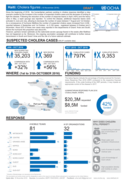
This document summarizes Haiti's cholera situation as of November 16, 2016. Between January and October 2016, Haiti reported 35,203 new suspected cholera cases (32% increase from 2015) and 369 deaths (56% increase). After Hurricane Matthew, cases rose dramatically, with 52% of new cases concentrated
...
in Grand'Anse and South departments. Since the 2010 outbreak began, Haiti had experienced 797,000 total cases and 9,353 deaths. The report identifies key factors contributing to cholera persistence: weak water and sanitation infrastructure, limited healthcare access, underfunding, population density, and mobility. Despite concerning trends, humanitarian partners were cautiously optimistic as a feared nationwide outbreak following Hurricane Matthew had not materialized, and a vaccination campaign was underway. However, the cholera response was significantly underfunded, with only 42% of requested funds received.
more
Polymerase Chain Reaction (PCR) has significantly helped in early diagnosis and commencement of specific interventions for diseases control. It also plays a critical role in understanding the disease epidemiology and unraveling the transmissio
...
n dynamics of the disease. This manual intends to provide primary guidelines to assist health lab personnel in developing countries to establish a PCR diagnostic facility for efficient support to patient care as well as public health actions.
more
A cólera é uma infecção intestinal provocada por uma bactéria conhecida como Vibrio cholerae. Os principais sintomas desta doença são diarréia e vômitos. Transmissão de cólera ocorre principalmente pelo consumo de alimentos contaminados ou água potável. Neste vídeo descrevemos várias
...
técnicas que podem ser utilizadas para ajudar a prevenir a cólera.
more
This guidance note aims to ensure continuity of case management service provision as well as appropriate response to cases associated with the disease during the COVID-19 crisis in Myanmar. Outlined below are priority areas that Child Protection Cas
...
e Management agencies should focus on
more

This Interim Guidance outlines how key public health and social measures needed to reduce the risk of COVID-19 spread and the impact of the disease can be adapted for use in low capacity and humanitarian settings. The recommendations outlined here n
...
eed to be adjusted to the scale of transmission, context and resources, in order to achieve the objective of managing COVID-19, namely to reduce transmission and facilitate the detection and management of infected and exposed individuals within the population. The Guidance is intended for humanitarian and development actors of all operational levels working with communities ocal authorities involved in COVID-19 preparedness and response operations in these settings, in support of national and local governments and plans. Additional considerations for support to residents of urban informal settlements and slums are available in Annex 1.
more
This document outlines minimum requirements of laboratory testing for COVID-19 and link laboratory testing with surveillance and contact tracing to guide the outbreak response by national health authorities using a reduced number of tests performed.
...
The strategies are organized according to stages of transmission: (1) No cases reported or observed (Stage 0); (2) Imported cases (Stage 1); (3) Localized community transmission (Stage 2); (4) Large-scale community transmission (Stage 3). For each stage, the recommended approaches indicate which testing strategy to prioritize when there are severe limitations on laboratory testing. The document is based on the current epidemiology of COVID-19 and available molecular testing methods.
more
BMJ Global Health, Vol.5 No. 12Spatial subdivision of the camp (‘sectoring’) was able to ‘flatten the curve’, reducing peak infection by up to 70% and delaying peak infection by up to several months. The use of face masks coupled with the efficient isolation of infected individuals reduced t
...
he overall incidence of infection, and sometimes averted epidemics altogether. These interventions must be implemented quickly in order to be maximally effective. Lockdowns had only small effects on COVID-19 dynamics.
Conclusions
Agent-based models are powerful tools for forecasting the spread of disease in spatially structured and heterogeneous populations. Our findings suggest that feasible interventions can slow the spread of COVID-19 in a refugee camp setting, and provide an evidence base for camp managers planning intervention strategies. Our model can be modified to study other closed populations at risk from COVID-19 or future epidemics.
more
VOX Sanguinis, 2021:
The coronavirus disease 2019 (COVID-19) affected millions of people worldwide and caused disruptions at the global level including in healthcare provision. Countries of the WHO African region have put in place measures for the
...
COVID-19 pandemic containment that may adversely affect blood system activities and subsequently reduce the supply and demand of blood and blood components. This study aims to assess the impact of the COVID-19 pandemic on blood supply and demand in the WHO African Region and propose measures to address the challenges faced by countries.
more
This study aimed to analyze the geographical distribution of coronavirus disease 2019 (COVID-19) and to identify high-risk areas in space and time for the occurrence of cases and deaths in the indigenous population of Brazil. This is an ecological s
...
tudy carried out between 24 March and 26 October 2020 whose units of analysis were the Special Indigenous Sanitary Districts. The Getis-Ord General G and Getis-Ord Gi* techniques were used to verify the spatial association of the phenomena and a retrospective space–time scan was performed. There were 32 041 confirmed cases of COVID-19 and 471 deaths. The non-randomness of cases (z score = 5.40; P < 0.001) and deaths (z score = 3.83; P < 0.001) were confirmed. Hotspots were identified for cases and deaths in the north and midwest regions of Brazil. Sixteen high-risk space–time clusters were identified for the occurrence of cases with a higher RR = 21.23 (P < 0.001) and four risk clusters for deaths with a higher RR = 80.33 (P < 0.001). These clusters were identified from 22 May and were active until 10 October 2020. The results indicate critical areas in the indigenous territories of Brazil and contribute to better directing the actions of control of COVID-19 in this population.
more
Some observers have described the coronavirus pandemic as an 'Anthropocene disease,' thereby highlighting its connection with this new ecological era that is characterised by the considerable pressure human activities are exerting on ecosystems and
...
the consequences on public health, society and the environment. This article focuses on the recent emergence of the 'Planetary Health' paradigm. Launched by the Rockefeller Foundation and the medical journal The Lancet, Planetary Health is one of the most ambitious attempts in recent years to systematize global health in the Anthropocene. While recognising the interest and necessity of reflecting on human health and the health of the planet, this article aims to show, however, that the Planetary Health paradigm is problematic and aporetic for two reasons. First, because it is based on a scientistic and depoliticised conception of the Anthropocene, which obscures capitalism's responsibility for the contemporary global and, especially, ecological crisis. Second, because this conception leads to a promotion of solutions that are essentially based on the financialization and technoscientific management of the living world - precisely the underlying cause of the degradation of ecosystems and living conditions that created the Anthropocene in the first place. A different kind of 'planetary health' remains possible and desirable.
more
This document summarizes current WHO guidance for public health surveillance of coronavirus disease 2019 (COVID-19) in humans caused by infection with severe acute respiratory syndrome coronavirus 2 (SARS-CoV-2).
New elements include:
upda
...
te of contact definitions, in line with latest contact tracing guidance
update of detection strategies in line with updated version of WHO SARS-CoV-2 testing guidance
reinfection evidence standardization and surveillance: molecular, genomic and immunological evidence of reinfection
inclusion of clinical case definition of Post COVID-19 condition as defined by WHO
definition of breakthrough infection
more
Buruli ulcer caused by Mycobacterium ulcerans is a neglected tropical disease characterized by extensive ulceration involving predominantly the upper and lower limbs of patients. The disease is comm
...
on in rural tropical communities in West and Central Africa, where access to proper health care is limited. Pathogenesis of the characteristic painless ulcers is linked to the elaboration by M. ulcerans of a lipid toxin called mycolactone that has potent cytopathic, immunosuppressive, and analgesic effects on a host of cells in cutaneous tissues. Mycolactone is known to profoundly inhibit secretion of a plethora of proteins that are essential for wound healing. Even though a combination antibacterial therapy of streptomycin and rifampicin for 8 weeks is effective for treatment, it relies on good and appropriate wound management to prevent secondary bacterial infections and improve healing. Evidence-based interventions for wound care in Buruli ulcer disease are often lacking and have relied on expert advice and recommendations. Surgical interventions are limited to debridement of necrotic tissue and grafting of extensive ulcers, usually after antibiotic therapy. Patients’ rehabilitation is an important component of care to reduce disabilities associated with the disease and proper integration into the community after treatment.
more

Rabies is a devastating and societally important zoonotic disease, which is transmitted principally to humans through the bite of infected dogs. This acute, progressive viral encephalitis has the highest case fatality of any infectious
...
disease and kills tens of thousands of people annually, with children and impoverished communities being affected disproportionately.
more
South Sudan continues to struggle with a severe health crisis affecting 8.9 million people, primarily in flood- and conflict-affected regions with population movements (displacement and returns), and disease outbreaks. The nation's health system, he
...
avily reliant on international aid, faces staffing and resource shortages. Vulnerable groups, including women, children, the elderly, and those with disabilities, have limited healthcare access and face heightened risks of mortality and illness.
The life expectancy at birth (55 years) is among the lowest globally, as mortality rates remain among the highest with neonatal, infant, under-five mortality rates estimated at 39.63, 63.76 and 98.69 deaths per 1000 live births respectively, and a maternal mortality ratio of 1,223 deaths per 100,000 live births. Although some disease specific mortality rates such as TB and AIDS-related mortality have declined, mortality due to malaria and non-communicable diseases have increased over the past five years.
The main causes of morbidity remain communicable diseases; malaria, is the top cause of morbidity (64%) and mortality (45%) among outpatients, followed by pneumonia and diarrhea.20 Several Counties report malaria cases above the threshold perennially especially during the rainy seasons, affecting mainly children under five years. The last malaria indicator survey (2017) estimated malaria prevalence of 32%, 34% and 18% among children under-five, protection of civilian’s sites, and internally displaced persons, respectively.
more
