Filter
599
Text search:
spinal
Featured
Recommendations
87
New Publications
125
Language
Document type
No document type
372
Guidelines
104
Manuals
43
Studies & Reports
36
Training Material
20
Strategic & Response Plan
10
Fact sheets
6
Brochures
3
Situation Updates
2
Resource Platforms
2
Videos
1
Countries / Regions
India
57
Nepal
20
Kenya
19
South Africa
16
Ethiopia
12
Uganda
12
Bangladesh
10
Africa
10
Tanzania
8
Liberia
7
Nigeria
7
Ghana
7
Indonesia
7
Malawi
7
Global
7
Sierra Leone
6
Syria
6
Rwanda
6
Namibia
6
Ukraine
5
Philippines
4
Zambia
3
Cambodia
3
Myanmar / Burma
3
South–East Asia Region
3
Latin America and the Carribbean
3
Western and Central Europe
3
Haiti
2
South Sudan
2
Botswana
2
Lesotho
2
Asia
2
Eastern Europe
2
Somalia
1
Germany
1
Thailand
1
Gambia
1
China
1
Sudan
1
Benin
1
North Macedonia
1
Hungary
1
Libya
1
Guatemala
1
Sri Lanka
1
Yemen
1
West and Central Africa
1
Other region
1
Solomon Islands
1
Venezuela
1
Poland
1
Palestine
1
Timor Leste/ East Timor
1
Tajikistan
1
Russia
1
Bulgaria
1
Romania
1
Lithuania
1
Moldova
1
Slovakia
1
Spain
1
Belarus
1
Latvia
1
Authors & Publishers
Publication Years
Category
Countries
214
Clinical Guidelines
128
Public Health
33
Women & Child Health
32
Key Resources
23
Capacity Building
16
Pharmacy & Technologies
1
Toolboxes
Disability
87
TB
40
Mental Health
39
NTDs
28
Caregiver
27
Conflict
23
Pharmacy
22
HIV
15
AMR
11
COVID-19
11
Natural Hazards
10
Refugee
10
Ebola & Marburg
6
Rapid Response
5
Specific Hazards
5
Global Health Education
5
NCDs
5
Zika
4
Planetary Health
4
Malaria
4
Polio
3
2.0 Rapid Response
2
Cholera
1
Social Ethics
1
This document, a first of its kind, clearly sets out the standards for rehabilitation and provides guidance on building or strengthening the capacity of EMTs in this area.The importance of early rehabilitation for functional outcomes is well documented. Rehabilitation needs can p
...
Global Qualitative Nursing Research March 31, 2021 Research Article Find in PubMed
https://doi.org/10.1177/23333936211005475
Solomon Islands pharmacy staff have developed an essential medicines supplies list. It was a collaborative effort involving a lot of staff taking the pictures and putting it all together. The list was launched as an initiative to improve the availability of medical stock within the country
Rehabilitation in health systems provides recommendations for Member States and other relevant stakeholders to strengthen and expand the availability of quality rehabilitation services. Currently, there is a significant unmet need for rehabilitation services and it is frequently undervalued in the h
...
Handout presentations in PDF for illustrating lectures
Accessed May 2014
Session outline
•Introduction to epilepsy.
•Assessment of epilepsy.
•Management of epilepsy.
•Follow-up of a person with epilepsy.
•Review or materials and skills.
Accessed November 2017
Guidelines for essential trauma care
recommended
The Guidelines for essential trauma care seek to set achievable standards for trauma treatment services which could realistically be made available to almost every injured person in the world. They then seek to define the resources that would be necessary to assure such care. These include human res
...
Handout presentations in PDF for illustrating lectures
Accessed May 2014
This is a checklist of major categories of the International Classification of Functioning, Disability and Health (ICF) of the World Health Organization . The ICF Checklist is a practical tool to elicit and record information on the functioning and disability of an individual. This information can b
...
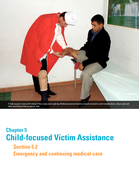
Preventing Physical Impairment in Childhood CBM Strategy Overview | Laminated flip charts | These are the main implementing tools in the prevention program, developed as A4 sized booklets which can be carried easily. They constitute the basic information a community rehabilitation worker needs to co
...
Neurological, Psychiatric, and Developmental Disorders: Meeting the Challenge in the Developing World
Institute of Medicine (US) Committee on Nervous System Disorders in Developing Countries.
Washington (DC): National Academies Press (US); 2001.
It is intended for use among clinicians taking care of moderate to severe COVID-19 cases.
The COVID-19 outbreak has brought with it the need for improved critical care for patients who develop severe disease. The majority of COVID-19 patients present with mild to moderate illness, 15% develop sever
...