
Filter
665
Text search:
World
Health
Organization
WHO
Western-Pacific
Region
Featured
Recommendations
86
New Publications
153
Language
Document type
No document type
267
Studies & Reports
170
Guidelines
123
Manuals
39
Strategic & Response Plan
29
Resource Platforms
9
Training Material
8
Fact sheets
8
Situation Updates
7
Infographics
5
Countries / Regions
Global
60
Western Pacific Region
27
Philippines
25
South–East Asia Region
23
Asia
16
Cambodia
14
Africa
11
India
10
Western and Central Europe
10
China
7
Myanmar / Burma
7
Nepal
6
Bangladesh
6
Latin America and the Carribbean
6
Nigeria
5
Kenya
5
Thailand
5
Russia
5
South Sudan
4
Tanzania
4
South Africa
4
Eastern Europe
4
Liberia
3
Ethiopia
3
Ghana
3
Yemen
3
Vietnam
3
Sierra Leone
2
Afghanistan
2
Zambia
2
Syria
2
Indonesia
2
Malawi
2
Ukraine
2
Middle East and North Africa
2
Eastern Europe and Central Asia
2
Fiji
2
Mongolia
2
Laos
2
Guinea
1
Burkina Faso
1
Congo, Democratic Republic of
1
USA
1
Uganda
1
Zimbabwe
1
Somalia
1
Pakistan
1
Egypt
1
Rwanda
1
Mozambique
1
Papua New Guinea
1
Sudan
1
Benin
1
Central African Republic
1
Namibia
1
Serbia
1
Ecuador
1
Botswana
1
Madagascar
1
Mexico
1
Sri Lanka
1
East and Southern Africa
1
West and Central Africa
1
Venezuela
1
Palestine
1
Iran
1
Authors & Publishers
Publication Years
Category
Countries
107
Clinical Guidelines
98
Public Health
68
Women & Child Health
49
Key Resources
34
Capacity Building
16
Pharmacy & Technologies
13
Toolboxes
Mental Health
57
HIV
53
COVID-19
48
TB
40
NTDs
39
Rapid Response
32
AMR
32
Planetary Health
32
Global Health Education
28
Caregiver
26
Pharmacy
20
Malaria
19
NCDs
18
2.0 Rapid Response
17
Disability
14
Zika
12
Polio
8
Conflict
8
Ebola & Marburg
7
Refugee
7
Natural Hazards
5
Health Financing Toolbox
4
Cholera
2
Specific Hazards
2
Since 1996, trachoma has been targeted for elimination as a public health problem worldwide. The active trachoma criterion for national elimination as a public health problem is a TF1–9 < 5%, sustained for at least two years in the absence of antibiotic mass drug administration (MDA), in each formerly endemic EU. Using A, F and E,
...
he WHO South-East Region in 2019 accounted for nearly a million missing TB patients from the estimated incidence. Active case-finding (ACF) or systematic screening for tuberculosis is an important t
...
People with underlying noncommunicable diseases (NCDs) such as hypertension, diabetes, cardiovascular disease, chronic respiratory disease and cancer have a high risk for developing severe and even fatal COVID-19. It is important for them to strictly follow basic protective measures and make sure th
...
In response to the COVID-19 outbreak, this guidance provides information on infection and prevention control (IPC) for older people, their friends and families, carers, and healthcare providers. Anyone who manages, works, volunteers or provides care
...
This strategy defines the World Health Organization (WHO) vision and framework for supporting Me
...
Access to safe blood and blood products is recognized as one of the key requirements for delivery of modern health care in the journey towards health for all. The foundation of safe and sustainable
...

Atlas of African Health Statistics 2022: Health situation analysis of the WHO African Region
Si
...
Data on the essential building blocks of mental health systems, including mental health
governance, financing, service delivery, human resources and information, are reported. For
mental
...

The WHO global health sector strategy on sexually
transmitted infections, 2016–2021 (1) includes country
milestones for achievement by 2020 and global
targets for achievement by 2030. In add
...

The 2024 edition reviews more than 50 health-related indicators from the Sustainable Development Goals and WHO’s Thirteenth General Programme of Work. It also highlights the findings from the Glob
...
This brief update on tuberculosis (TB) in the African region covers the state of TB in the WHO African region, strategic priorities and targets and
...

The 2021 WHO health and climate change global survey report provides a valuable snapshot of the overall progress governments have made in addressing the h
...

Benchmarking is a strategic process often used by businesses and institutes to standardize performance in relation to the best practices of their sector. The World Health
...
Injection practices worldwide and especially in low- and middle-income countries (LMICs) include multiple, avoidable unsafe practices that ultimately lead to the large-scale transmission of bloodborne viruses among patients, health care providers an
...
The framework is to be used as a reference guide, applied according to local priorities and needs, and targeted at academic institutions, educators, accreditation bodies, regulatory agencies and other users. The ultimate aim is to ensure that all health
...
Stewardship is defined as “the careful and responsible management of something entrusted to one’s care”. It was originally applied in the health-care setting as a tool for optimizing antimicrobial use, termed “antimicrob
...
Advances have been made through expanded interventions delivered through five public health approaches: innovative and intensified disease management; preventive chemotherapy; vector ecology and management; veterinary public
...
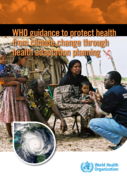
This guidance document is designed to ensure that the process of iteratively managing the health risks of climate change is integrated into the overall National Adaptation Planning (NAP) process, including through assessing risks; identifying, prior
...
