Filter
1640
Text search:
inclusive
principles
Featured
166
420
Language
Document type
858
275
209
127
117
28
14
4
4
1
1
1
Countries
98
49
46
41
40
38
34
32
30
27
25
23
23
22
20
19
18
18
17
16
16
16
15
14
13
12
12
10
10
10
10
10
8
8
8
7
7
7
7
6
6
6
6
6
6
5
5
5
5
5
4
4
4
4
4
4
3
3
3
3
3
2
2
2
2
2
2
2
2
2
2
2
2
2
2
2
2
2
2
1
1
1
1
1
1
1
1
1
1
1
1
1
1
1
1
1
1
1
1
Authors & Publishers
Publication Years
Category
555
165
106
80
57
26
3
Toolboxes
259
120
111
98
65
63
52
49
37
36
32
31
28
23
22
19
18
16
12
9
8
7
6
4
3
1
1

Essential triple EMTCT services include testing for HIV, syphilis and HBV in ante-
natal care (ANC) settings; prompt and efficacious interventions to treat women
who test positive; prevent transmission of any of the infections to their children;
counseling for women and their partners to reduce t
...
These guidelines focus on the provision of PrEP as part of comprehensive combination prevention,
drawing on implementation and research evidence and WHO recommendations.
O documento apresenta o quadro da Organização Mundial da Saúde para a gestão de riscos de emergências de saúde e desastres (Health EDRM). Explica que comunidades em todo o mundo enfrentam uma ampla variedade de perigos — como surtos de doenças infecciosas, desastres naturais e conflitos —
...

The World report on promoting the health of refugees and migrants: Monitoring progress on the WHO global action plan provides the first global baseline for assessing implementation of the 2019-2030 WHO Global Action Plan on Promoting the Health of Refugees and Migrants (GAP). Building on the 2022 Wo
...
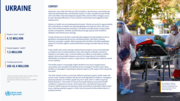
The 2026 outlook remains concerning. Without sustained support, health needs will remain acute. Disease outbreak risks persist amid degraded surveillance. Interagency planning indicates 10.8 million people may be in need, with 4.1 million requiring health assistance. The burden of noncommunicable di
...

This document suggests mechanisms that countries can use to respond to emergencies and disasters taking a whole of society and whole of government approach ensuring multisectoral engagement for health actions. It helps to run a participatory process of developing the national health response operati
...
The purpose of this interim guidance is to provide recommendations for planning and implementing RCCE activities that protect and empower communities during MVD outbreaks. The guidance is designed for national and subnational health responders involved in RCCE for MVD readiness and response. It is a
...
This publication provides an overview of UN Women’s commitments to the humanitarian community guided by the “UN Women strategic plan 2022–2025”. It highlights areas where UN Women has a unique advantage in advancing gender equality and the empowerment of women and girls across the humanitari
...

The module is currently available in English, French, Nepali, Portuguese, Russian, and Spanish

This guide provides a comprehensive overview of essential information related to immunization, including technical information about vaccines, a review of immunization program management best practices, guidance on the delivery of immunization services, monitoring and evaluation, disease surveillanc
...
Building on previous guidelines, the People In Aid Code seeks to offer agencies an effective framework for human resources management, helping them assess and raise their performance.

The Camp Managment Toolkit
recommended
Applicable to both IDP and refugee scenarios, the Toolkit incorporates a wide range of relevant information on managing displaced populations living in communal settings (collective centres, spontaneous sites, established camps, etc.). Large scale displacements caused by recent conflict and natural
...
In the mid-1980s, recognizing the limitations of traditional training and that the knowledge and skills acquired are not necessarily applied back in the workplace, MSH developed the Monitoring‐Training-Planning (MTP) approach to assist the Ecuadorian Ministry of Health to implement its Child Survi
...

These guidelines were developed through an interagency process with participation by United Nations (UN) organiza-
tions, nongovernmental organizations, the International Red Cross and Red Crescent Movement and the International
Organization for Migration.
English version - This handbook sets out a the new paradigm for pharmacy practice. Its aim is to guide pharmacy educators in pharmacy practice, to educate pharmacy students and to guide pharmacists in practice to update their skills. The handbook, which brings together practical tools and knowledge,
...

Specific action sheets offer useful guidance on mental health and psychosocial support and cover the following areas coordination assessment monitoring and evaluation protection and human rights standards human resources community mobilisation and support health services education dissemination of i
...