
Filter
1427
Text search:
companies
Featured
Recommendations
163
New Publications
308
Language
Document type
No document type
610
Studies & Reports
315
Guidelines
247
Manuals
104
Strategic & Response Plan
73
Training Material
28
Fact sheets
25
Situation Updates
10
Resource Platforms
8
Infographics
3
Brochures
2
App
1
Online Courses
1
Countries / Regions
Global
104
Western and Central Europe
46
India
31
South–East Asia Region
22
Latin America and the Carribbean
20
South Africa
19
Ukraine
19
Syria
17
Sierra Leone
16
Africa
16
Eastern Europe
15
Liberia
13
Kenya
13
Nepal
12
Philippines
11
Malawi
11
Tanzania
10
East and Southern Africa
10
Uganda
9
Zambia
9
Namibia
9
Yemen
9
Middle East and North Africa
9
Asia
9
Guinea
8
Nigeria
8
Ghana
8
South Sudan
8
West and Central Africa
8
Congo, Democratic Republic of
7
Ethiopia
7
Zimbabwe
7
Rwanda
7
Eastern Europe and Central Asia
7
Germany
5
Botswana
5
Myanmar / Burma
5
Venezuela
5
Indonesia
4
Bangladesh
4
Mozambique
4
Moldova
4
Senegal
3
USA
3
Cameroon
3
Pakistan
3
Afghanistan
3
Madagascar
3
Western Pacific Region
3
Russia
3
Iran
3
Kazakhstan
3
Mali
2
Jordan
2
Lebanon
2
Cambodia
2
China
2
Benin
2
Central African Republic
2
Brazil
2
North Macedonia
2
Lesotho
2
Tajikistan
2
Estonia
2
Côte d’Ivoire / Ivory Coast
1
Haiti
1
Iraq
1
Turkey
1
Egypt
1
Chad
1
Thailand
1
Papua New Guinea
1
Sudan
1
Eswatini/ Swaziland
1
Serbia
1
Hungary
1
Croatia
1
Angola
1
Sri Lanka
1
Chile
1
Other region
1
Poland
1
Albania
1
Southern Africa
1
Timor Leste/ East Timor
1
Romania
1
Kyrgyzstan
1
Vietnam
1
Turkmenistan
1
Japan
1
Denmark
1
Azerbaijan
1
Belarus
1
Authors & Publishers
Publication Years
Category
Countries
288
Clinical Guidelines
174
Public Health
120
Key Resources
115
Women & Child Health
109
Pharmacy & Technologies
37
Capacity Building
32
Toolboxes
HIV
118
COVID-19
105
Planetary Health
88
TB
84
Mental Health
81
AMR
70
Caregiver
59
NTDs
59
Disability
53
Conflict
46
Rapid Response
46
Global Health Education
44
Pharmacy
38
2.0 Rapid Response
31
Refugee
28
Ebola & Marburg
27
NCDs
26
Health Financing Toolbox
21
Natural Hazards
20
Zika
15
Polio
12
Specific Hazards
12
Malaria
11
Cholera
9
Social Ethics
6
Typhoon
1
Available in English, French, Spanish and Russian from the website https://apps.who.int/iris/handle/10665/344562
Guidelines on the management of chronic pain in children, developing and implementing national and local policies for pain management and protocols in children, implementing national and local regulations for pain management in children, pain management and protocols

This document provides guidance to host States on the vetting and registration of volunteers and volunteer organisations. It also provides guidance to UN, NGO and other civil society actors on how they can support and complement State efforts through operational activities.
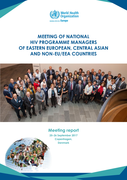
Meeting report, 25-26 September 2017 Copenhagen, Denmark
5th revised edition.
This document provides a ranking of medically important antimicrobials for risk management of antimicrobial resistance due to non-human use. The current revision took place at the seventh meeting of the AGISAR held in Raleigh, United States of America in 2016.

The seventh WHO Report on the global tobacco epidemic analyses national efforts to implement the most effective measures from the WHO Framework Convention on Tobacco Control (WHO FCTC) that are proven to reduce demand for tobacco.
The report showed that while only 23 countries have implemented ce
...
WHO working group on HIV incidence assays meeting report
10–11 December 2015
Glion, Switzerland
UNAIDS/WHO working group on global HIV/AIDS and STI surveillance
WHO/HIV/2017.03

Published:February 02, 2021DOI:https://doi.org/10.1016/S0140-6736(21)00234-8
When situations occur in which unwanted events are rightly or wrongly connected with vaccination, they may erode confidence in vaccines and the authorities delivering them. This document presents the scientific evidence behind WHO’s recommendations on building and restoring confidence in vaccines
...

The report identifies major global gaps in WASH services: one third of health care facilities do not have what is needed to clean hands where care is provided; one in four facilities have no water services, and 10% have no sanitation services. This means that 1.8 billion people use facilities that l
...
The Joint Monitoring Programme (JMP) report – Progress on household drinking water, sanitation and hygiene 2000 - 2020 – presents estimates on household access to safely managed drinking water, sanitation and hygiene services over the past five years, and assesses progress toward achieving the s
...
PlosOne May 7, 2012 https://doi.org/10.1371/journal.pone.0036735 ; Safe drinking water is critical for health. Household water treatment (HWT) has been recommended for improving access to potable water where existing sources are unsafe. Reports of low adherence to HWT may limit the usefulness of thi
...
Report of a global meeting on yaws eradication surveillance, monitoring and evaluation: Geneva, 29–30 January 2018. World Health Organization.

Driving progress towards rabies elimination: Results of Gavi’s Learning Agenda on rabies and new WHO position on rabies immunization

The WHO COVID-19 Clinical management: living guidance contains the most up-to-date recommendations for the clinical management of people with COVID-19. Providing guidance that is comprehensive and holistic for the optimal care of COVID-19 patients throughout their entire illness is important.
This action plan is intended for senior-level decision-makers in ministries of health, malaria
programme managers, entomologists, and epidemiologists working on malaria and other vectorborne diseases programmes. It is also intended for decision-makers and technical and advocacy
staff at other orga
...

The Committee discussed the implications for preparedness for smallpox-like events reflected by the ongoing COVID-19 pandemic. The Committee noted how quickly diagnostics and vaccines could be developed and deployed when resources and political will were abundant. This rapidity was also due to the f
...
WHO QualityRights is an initiative which aims to improve the quality of care in mental health and related services and to promote the human rights of people with psychosocial, intellectual and cognitive disabilities, throughout the world.

Mpox continues to affect people around the world. A new framework released today by WHO will guide health authorities, communities and other stakeholders in preventing and controlling mpox outbreaks, eliminating human-to-human transmission of the disease, and reducing spillover of the virus from ani
...
