Filter
2143
Text search:
conflict
settings
Featured
244
480
Language
2082
61
42
40
28
14
14
7
6
3
3
2
2
2
2
2
2
2
2
2
2
1
1
1
1
1
1
1
1
1
1
1
1
1
1
1
Document type
1043
450
299
156
103
36
23
20
6
2
2
1
Countries / Regions
154
64
47
46
40
38
37
34
33
32
31
30
28
28
27
25
24
23
17
15
15
14
14
14
14
13
12
12
12
11
11
11
11
10
10
9
9
9
8
8
8
8
8
7
7
7
6
6
6
6
6
5
5
5
5
5
4
4
4
4
3
3
3
3
3
3
3
2
2
2
2
2
2
2
1
1
1
1
1
1
1
1
1
1
1
1
1
1
1
1
1
1
1
1
1
1
1
1
1
1
1
1
1
1
Authors & Publishers
369
103
83
69
55
45
43
41
38
34
25
17
14
14
14
13
13
11
11
11
11
10
9
9
8
8
7
7
7
7
7
6
6
6
6
6
6
5
5
5
5
5
5
5
5
5
5
4
4
4
4
4
4
4
4
4
4
4
4
4
4
4
4
4
4
4
4
4
4
4
4
4
4
4
4
4
4
4
4
4
4
4
3
3
3
3
3
3
3
3
3
3
3
3
3
3
3
3
3
3
3
3
3
3
3
3
3
3
3
3
3
3
3
3
3
3
3
3
3
3
3
3
3
3
3
3
3
3
2
2
2
2
2
2
2
2
2
2
2
2
2
2
2
2
2
2
2
2
2
2
2
2
2
2
2
2
2
2
2
2
2
2
2
2
2
2
2
2
2
2
2
2
2
2
2
2
2
2
2
2
2
2
2
2
2
2
2
2
2
2
2
2
2
2
2
2
2
2
2
2
2
2
2
2
2
2
2
2
2
2
2
2
2
2
2
2
2
2
2
2
2
2
2
2
2
2
2
2
2
2
2
2
2
2
2
2
2
1
1
1
1
1
1
1
1
1
1
1
1
1
1
1
1
1
1
1
1
1
1
1
1
1
1
1
1
1
1
1
1
1
1
1
1
1
1
1
1
1
1
1
1
1
1
1
1
1
1
1
1
1
1
1
1
1
1
1
1
1
1
1
1
1
1
1
1
1
1
1
1
1
1
1
1
1
1
1
1
1
1
1
1
1
1
1
1
1
1
1
1
1
1
1
1
1
1
1
1
1
1
1
1
1
1
1
1
1
1
1
1
1
1
1
1
1
1
1
1
1
1
1
1
1
1
1
1
1
1
1
1
1
1
1
1
1
1
1
1
1
1
1
1
1
1
1
1
1
1
1
1
1
1
1
1
1
1
1
1
1
1
1
1
1
1
1
1
1
1
1
1
1
1
1
1
1
1
1
1
1
1
1
1
1
1
1
1
1
1
1
1
1
1
1
1
1
1
1
1
1
1
1
1
1
1
1
1
1
1
1
1
1
1
1
1
1
1
1
1
1
1
1
1
1
1
1
1
1
1
1
1
1
1
1
1
1
1
1
1
1
1
1
1
1
1
1
1
1
1
1
1
1
1
1
1
1
1
1
1
1
1
1
1
1
1
1
1
1
1
1
1
1
1
1
1
1
1
1
1
1
1
1
1
1
1
1
1
1
1
1
1
1
1
1
1
1
1
1
1
1
1
1
1
1
1
1
1
1
1
1
1
1
1
1
1
1
1
1
1
1
1
1
1
1
1
1
1
1
1
1
1
1
1
1
1
1
1
1
1
1
1
1
1
1
1
1
1
1
1
1
1
1
1
1
1
1
1
1
1
1
1
1
1
1
1
1
1
1
1
1
1
1
1
1
1
1
1
1
1
1
1
1
1
1
1
1
1
1
1
1
1
1
1
1
1
1
1
1
1
1
1
1
1
1
1
1
1
1
1
1
1
1
1
1
1
1
1
1
1
1
1
1
1
1
1
1
1
1
1
1
1
1
1
1
1
1
1
1
1
1
1
1
1
1
1
1
1
1
1
1
1
1
1
1
1
1
1
1
1
1
1
1
1
1
1
1
1
1
1
1
1
1
1
1
1
1
1
1
1
1
1
1
1
1
1
1
1
1
1
1
1
1
1
1
1
1
1
1
1
1
1
1
1
1
1
1
1
1
1
1
1
1
1
1
1
1
1
1
1
1
1
1
1
1
1
1
1
1
1
1
1
1
1
1
1
1
1
1
1
1
1
1
1
1
1
1
1
1
1
1
1
1
1
1
1
1
1
1
1
1
1
1
1
1
1
1
1
1
1
1
1
1
1
1
1
1
1
1
1
1
1
1
1
1
1
1
1
1
1
1
1
1
1
1
1
1
1
1
1
1
1
1
1
1
1
1
1
1
1
1
1
1
1
1
1
1
1
1
1
1
1
1
1
1
1
1
1
1
1
1
1
1
1
1
1
1
1
1
1
1
1
1
1
1
1
1
1
1
1
1
1
1
1
1
1
1
1
1
1
1
1
1
1
1
1
1
1
1
1
1
1
1
1
1
1
1
1
1
1
1
1
1
1
1
1
1
1
1
1
1
1
1
1
1
1
1
1
1
1
1
1
1
1
1
1
1
1
1
1
1
1
1
1
1
1
1
1
1
1
1
1
1
1
1
1
1
1
1
1
1
1
1
1
1
1
1
1
1
1
1
1
1
1
1
1
1
1
1
1
1
1
1
1
1
1
1
1
1
1
1
1
1
1
1
1
1
1
1
1
1
1
1
1
1
1
1
1
1
1
1
1
1
1
1
1
1
1
1
1
1
1
1
1
1
1
1
1
1
1
1
1
1
1
1
1
1
1
1
1
1
1
1
1
1
1
1
1
1
1
1
1
1
1
1
1
1
1
1
1
1
1
1
1
1
1
1
1
1
1
1
1
1
1
1
1
1
1
1
1
1
1
1
1
1
1
1
1
1
1
1
1
1
1
1
1
1
1
1
1
1
1
1
1
1
1
1
1
1
1
1
1
1
1
1
1
1
1
1
1
1
1
1
1
1
1
1
1
1
1
1
1
1
1
1
1
1
1
1
1
1
1
1
1
1
1
1
1
1
1
1
1
1
1
1
1
1
1
1
1
1
1
1
1
1
1
1
1
1
1
1
1
1
1
1
1
1
1
1
1
1
1
1
1
1
1
1
1
1
1
1
1
1
1
1
1
1
1
1
1
1
1
1
1
1
1
1
1
1
1
1
1
1
1
1
1
1
1
1
1
1
1
1
1
1
1
1
1
1
1
1
1
1
1
1
1
1
1
1
1
1
1
1
1
1
1
1
1
1
1
1
1
1
1
1
1
1
1
1
1
1
1
1
1
1
1
1
1
1
1
1
1
1
1
1
1
1
1
1
1
1
1
1
1
1
1
1
1
1
1
1
1
1
1
1
1
1
1
1
1
1
1
1
1
1
1
1
1
1
1
1
1
1
1
1
1
1
1
1
1
1
1
1
1
1
1
1
1
1
1
1
1
1
1
1
1
1
1
1
1
1
1
1
1
1
1
1
1
1
1
1
1
1
1
1
1
1
1
1
1
1
1
1
1
1
1
1
1
1
1
1
1
1
1
1
1
1
1
1
1
1
1
1
1
1
1
1
1
1
1
1
1
1
1
1
1
1
1
1
1
1
1
1
1
1
1
1
1
1
1
1
1
1
1
1
1
1
1
1
1
1
1
1
1
1
1
1
1
1
1
1
1
1
1
1
1
1
1
1
1
1
1
1
1
1
1
1
1
1
1
1
1
1
1
1
1
1
1
1
1
1
1
1
1
1
1
1
1
1
1
1
1
1
1
1
1
1
1
1
1
1
1
1
1
1
1
1
1
1
1
1
1
1
1
1
1
1
1
1
1
1
1
1
1
1
1
1
1
1
1
1
1
1
1
1
1
1
1
1
1
1
1
1
1
1
1
1
1
1
1
1
1
1
1
1
1
1
1
1
1
1
1
1
1
1
1
1
1
1
1
1
1
1
1
1
1
1
1
1
1
1
1
1
1
1
1
1
1
1
1
1
1
1
1
1
1
1
1
1
1
1
1
1
1
1
1
1
1
1
1
1
1
1
1
1
1
1
1
1
1
1
1
1
1
1
1
1
1
1
1
1
1
1
1
1
1
1
1
1
1
1
1
1
1
1
1
1
1
1
1
1
1
1
1
1
1
1
1
1
1
1
1
1
1
1
1
1
1
1
1
1
1
1
1
1
1
1
1
1
1
1
1
1
1
1
1
1
1
1
1
1
1
1
1
1
1
1
1
1
1
1
1
1
1
1
1
1
1
1
1
1
1
1
1
1
1
1
1
1
1
1
1
1
1
1
1
1
1
1
1
1
1
1
1
1
1
1
1
1
1
1
1
1
1
1
1
1
1
1
1
1
1
1
1
1
1
1
1
1
1
1
1
1
1
1
1
1
1
1
1
1
1
1
1
1
1
1
1
1
1
1
1
1
1
1
1
1
1
1
1
1
1
1
1
1
1
1
1
1
1
1
1
1
1
1
1
1
1
1
1
1
1
1
1
1
1
1
1
1
1
1
1
1
1
1
1
1
1
1
1
1
1
1
1
1
1
1
1
1
1
1
1
1
1
1
1
1
1
1
1
1
1
1
1
1
1
1
1
1
1
1
1
1
1
1
1
1
1
1
1
1
1
1
1
1
1
1
1
1
1
1
1
1
1
1
1
1
1
1
1
1
1
1
1
1
1
1
1
1
1
1
Publication Years
783
1202
152
6
Category
503
238
198
153
137
47
11
3
Toolboxes
311
186
157
114
112
82
81
79
78
50
43
39
39
36
34
34
30
26
21
18
17
16
11
8
2
1
Vitamin A supplementation (VAS) programs targeted at children aged 6–59 months are implemented in many countries. By improving immune function, vitamin A (VA) reduces mortality associated with measles, diarrhea, and other illnesses. There is currently a debate regarding the relevance of VAS, but a
...
midst the debate, researchers acknowledge that the majority of nationally-representative data on VA status is outdated. To address this data gap and contribute to the debate, we examined data from 82 countries implementing VAS programs, identified other VA programs, and assessed the recentness of national VA deficiency (VAD) data.
Article published in: Nutrients, 2017, 9, 190
https://doi.org/10.3390/nu9030190 more
Article published in: Nutrients, 2017, 9, 190
https://doi.org/10.3390/nu9030190 more

A new global Police Handbook aims to address some of the most difficult challenges that survivors of violence face when accessing police and justice sector services around the world.

Water, sanitation and hygiene (WASH) are critical in the prevention and care for all of the 17 neglected tropical diseases (NTDs) scheduled for intensified control or elimination by 2020.
Provision of safe water, sanitation and hygiene is one of the five key interventions within the global NTD ... roadmap. Yet to date, the WASH component of the strategy has received little attention and the potential to link efforts on WASH and NTDs has been largely untapped.
Focused efforts on WASH are urgently needed if the global NTD roadmap targets are to be met. This is especially needed for NTDs where transmission is most closely linked to poor WASH conditions such as soil-transmitted helminthiasis, schistosomiasis, trachoma and lymphatic filariasis.
This strategy aims to mobilise WASH and NTD actors to work together towards the roadmap targets. more
Provision of safe water, sanitation and hygiene is one of the five key interventions within the global NTD ... roadmap. Yet to date, the WASH component of the strategy has received little attention and the potential to link efforts on WASH and NTDs has been largely untapped.
Focused efforts on WASH are urgently needed if the global NTD roadmap targets are to be met. This is especially needed for NTDs where transmission is most closely linked to poor WASH conditions such as soil-transmitted helminthiasis, schistosomiasis, trachoma and lymphatic filariasis.
This strategy aims to mobilise WASH and NTD actors to work together towards the roadmap targets. more

The guide is designed to help disaster managers in national Governments gain basic knowledge of how to use international tools and services. It aims to support the growing disaster response and disaster response preparedness capabilities that exist at national level across Asia and the Pacific.
... The guide is for national disaster management organizations (NDMOs) and line ministries involved in disaster response and disaster response preparedness. It is also a reference document for representatives of intergovernmental organizations, civilsociety actors and disaster-affected people.
The guide concentrates on key tools and services that can be helpful to disaster managers during the response and response preparedness phases of the disaster programme cycle. more
... The guide is for national disaster management organizations (NDMOs) and line ministries involved in disaster response and disaster response preparedness. It is also a reference document for representatives of intergovernmental organizations, civilsociety actors and disaster-affected people.
The guide concentrates on key tools and services that can be helpful to disaster managers during the response and response preparedness phases of the disaster programme cycle. more

Addressing Forced Displacement through Development Planning and Co-operation: Guidance for Donor Policy Makers and Practitioners
Mwangi, Annabel; Gamez, Laura et al.
Organisation for Economic Co-operation and Development (OECD)
(2017)
C1
OECD Development Policy Tools
Recognising that donor policies and responses constantly evolve, this guidance recommends that donors operating in situations of forced displacement prioritise three broad areas of work, where they can best contribute to existing capacities at the national, regiona ... l and global levels. more
Recognising that donor policies and responses constantly evolve, this guidance recommends that donors operating in situations of forced displacement prioritise three broad areas of work, where they can best contribute to existing capacities at the national, regiona ... l and global levels. more
This external performance evaluation of the Malawi Girls’ Empowerment through Education and Health Activity (ASPIRE), conducted 2.5 years after ASPIRE began, establishes the activity’s progress against its objectives, proposes adaptations for the final year, and captures lessons for application
...
in future girls’ empowerment, health, and education programming in Malawi.
more

Journal of the International AIDS Society 2017, vol. 20:e25026
In Myanmar, men who have sex with men (MSM) experience high risk of HIV infection. However, access to HIV testing and prevention services remains a challenge among this marginalized population. The objective of this study was to est ... imate population prevalence and correlates of prior HIV testing among young MSM (YMSM) and informs the development of HIV testing and intervention programmes that respond to the specific needs of this population.
https://doi.org/10.1002/jia2.25026 more
In Myanmar, men who have sex with men (MSM) experience high risk of HIV infection. However, access to HIV testing and prevention services remains a challenge among this marginalized population. The objective of this study was to est ... imate population prevalence and correlates of prior HIV testing among young MSM (YMSM) and informs the development of HIV testing and intervention programmes that respond to the specific needs of this population.
https://doi.org/10.1002/jia2.25026 more
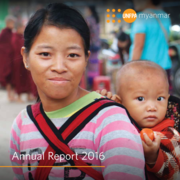
Census data shows that Myanmar can harness a double dividend – both youth and gender. This year’s annual report provides many facets of the journey to gender equality. It tells a story of widening horizons for women and girls who are capable in their own right. It is also a story of women fulfil
...
ling their reproductive rights, and of couples having access to family planning choices.
more

Disaster risk management systems analysis: A guide book
Baas, Stephan; Ramasamy, Selvaraju; Dey de Pryck, Jenny et al.
Food and Agriculture Organization of the United Nations (FAO)
(2008)
C1
The guide book provides a set of tools and methods to assess existing structures and capacities of national, district and local institutions with responsibilities for Disaster Risk Management (DRM) in order to improve their effectiveness and the integration of DRM concerns into development planning,
...
with particular reference to disaster-prone areas, vulnerable sectors and population groups.
The strategic use of the Guide is expected to enhance understanding of the strengths, weaknesses, opportunities and threats facing existing DRM institutional structures and their implications for on-going institutional change processes. It will also highlight the complex institutional linkages among various actors and sectors at different levels. more
The strategic use of the Guide is expected to enhance understanding of the strengths, weaknesses, opportunities and threats facing existing DRM institutional structures and their implications for on-going institutional change processes. It will also highlight the complex institutional linkages among various actors and sectors at different levels. more
Myanmar is prone to various natural hazards that include earthquakes, floods, cyclones, droughts, fires, tsunamis, some of whichhave the potential to impact large numbers of people. In the event that large numbers of people are affected(such as was the case in 2008 following cyclone Nargis), the gov
...
ernment may decide to request international assistance to respond to the disaster.
The overall goal of the ERPP is to mitigate the impact of disasters and save as many lives as possible from preventable causes. It aims to ensure that effective and timely assistance is provided to people in need through effective coordination and communication on emergency preparedness and humanitarian response between members of the HCTin Myanmar. The approach has been developed in collaboration with the Government, to facilitate a coordinated and effective support to people affected by humanitarian crises.
more
The ERP approach seeks to improve effectiveness by reducing both time and effort, enhancing predictability through establishing predefined roles, responsibilities and coordination mechanisms. The Emergency Response Preparedness Plan (ERPP) has four main components: i) Risk Assessment, ii) Minimum Pr
...
eparedness Actions, iii) Standard Operating Procedures (SOP), and iv) Contingency Plans for the initial emergency response. Besides these four elements, the preparedness package also includes the updated Multi-Sector Initial Rapid Assessment (MIRA) methodology, the Scenario Plan for a cyclone in Ayeyawaddy as well as the key documents for cash transfer programming in new emergencies.
more
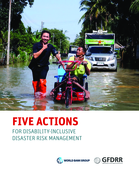
A recent survey of the literature and experience identified five broad actions that development institutions and governments, as well as their partners and stakeholders, can take to improve disability-inclusive disaster risk management. Those five actions are:
- Include persons with disabilitie ... s as valued stakeholders in disaster risk management activities
- Help remove barriers to the full participation of persons with disabilities
- Increase awareness among governments and their partners of the safety and security needs of persons with disabilities
- Collect data that is disaggregated by disability
- Ensure that new construction, rehabilitation and reconstruction are accessible to persons with disabilities more
- Include persons with disabilitie ... s as valued stakeholders in disaster risk management activities
- Help remove barriers to the full participation of persons with disabilities
- Increase awareness among governments and their partners of the safety and security needs of persons with disabilities
- Collect data that is disaggregated by disability
- Ensure that new construction, rehabilitation and reconstruction are accessible to persons with disabilities more

This assessment is the first of its kind to be conducted in the south-eastern region of Myanmar. It is an important contribution to ensuring the full inclusion of women and children in Myanmar’s political, social, and cultural systems, with a specific focus on the issue of gender-based violence (G
...
BV) and its impact on these groups in south-eastern Myanmar. The United Nations Population Fund (UNFPA) is grateful for the participation of women, men, boys and girls from Mon, Kayin and Kayah States for sharing their views and experiences during the study.
more
The Indonesian government has reformed its laws, policies, and institutions to better manage disaster risk since the significant 2004 Indian Ocean Tsunami. The Government of Indonesia now has contingency plans for every disaster-prone city which identifies its vulnerabilities, outlines the relief re
...
sponse, and builds overall preparedness. In 2007, the government introduced a disaster management bill that incorporated disaster management prevention into disaster management response. In 2008, Indonesia created the National Disaster Management Agency (Badan Nasional Penanggulangan Bencana, BNPB). The new shift led to the strengthening of the country’s disaster management agency, and the addition of district branches and representatives. Despite the progress made, more work is needed at the local level as well as integration of disaster risk reduction in government departments.11 Under Indonesia’s 2007 Disaster Management law, provincial and district administrations are mandated to head disaster management during a crisis.
more

Myanmar has made significant progress in its disaster management policies, plans, and procedures since 2008, when Cyclone Nargis impacted the country leaving devastation in its aftermath. The Government of Myanmar (GoM) has modified the government structure and created new authorities and plans to i
...
mprove the effectiveness of disaster management at all levels. While this progress is encouraging and shows the determination of the government to make necessary adjustments, the resources to implement the policy changes have been slower to develop. Myanmar has made significant progress in its disaster management policies, plans, and procedures since 2008, when Cyclone Nargis impacted the country leaving devastation in its aftermath. The Government of Myanmar (GoM) has modified the government structure and created new authorities and plans to improve the effectiveness of disaster management at all levels. While this progress is encouraging and shows the determination of the government to make necessary adjustments, the resources to implement the policy changes have been slower to develop.
more
In view of the ongoing political, peace and reconciliation, administrative and economic reforms as well as plans to establish the United Nations Development Assistance Framework (UNDAF) in 2018, WFP extended the current Protracted Relief and Recovery Operation (PRRO 200299), launched in January 2
...
013, by two years to include 2016 and 2017, with approved budget USD 343 million. To echo this extension and provide a more appropriate response to the country's rapid and multi-pronged transition, WFP adopted a transition strategy with gradually reduced emphasis on humanitarian assistance and greater focus on early recovery and development interventions. WFP's strategic engagement in-country was driven by the overarching goal to assist Myanmar to achieve the national Zero Hunger Challenge by 2025, and was guided by three priorities: emergency preparedness and response; nutrition; and provision of social safety nets.
more
International Journal of Drug Policy 24 (2013) e91-98
Singing to the Lions is a free training package (facilitator’s guide, supplement and video) by CRS, that is designed to help children and youth lessen the impact of violence and abuse in their lives. The main component is a three-day workshop where participants learn skills that can help them tran
...
sform their lives and no longer feel dominated by fear. Although the workshop is aimed at young people and includes games, art and songs, it can also be used to help adults take action on aspects of their lives that cause fear and, in so doing, become better parents and caregivers.
more