
Filter
759
Text search:
atlas
Featured
Recommendations
60
New Publications
133
Language
Document type
No document type
390
Studies & Reports
187
Guidelines
61
Manuals
43
Strategic & Response Plan
22
Fact sheets
19
Training Material
14
Situation Updates
7
Resource Platforms
6
Infographics
5
Dashboards/Maps
2
Brochures
1
Online Courses
1
Countries / Regions
Global
63
Africa
26
Latin America and the Carribbean
24
India
21
Kenya
21
Western and Central Europe
20
Myanmar / Burma
17
Tanzania
13
Liberia
12
Malawi
12
Mozambique
12
Sierra Leone
11
Uganda
11
Eastern Europe
11
Congo, Democratic Republic of
10
Ethiopia
10
Russia
10
Nigeria
9
Senegal
9
Nepal
9
Zambia
9
Asia
9
Ghana
8
Syria
8
South Africa
8
Ukraine
8
Indonesia
7
Brazil
7
Zimbabwe
6
Venezuela
6
Guinea
5
Cameroon
5
Philippines
5
Rwanda
5
Bangladesh
5
Namibia
5
Botswana
5
Middle East and North Africa
5
South–East Asia Region
5
Eastern Europe and Central Asia
5
North America
5
Haiti
4
South Sudan
4
China
4
Eswatini/ Swaziland
4
Angola
4
Lesotho
4
Burkina Faso
3
Afghanistan
3
Germany
3
Cambodia
3
Peru
3
Colombia
3
Yemen
3
Western Pacific Region
3
Guinea-Bissau
2
Chad
2
Thailand
2
Sudan
2
Benin
2
Bolivia
2
Guatemala
2
Madagascar
2
Chile
2
West and Central Africa
2
Paraguay
2
Vietnam
2
Mali
1
Côte d’Ivoire / Ivory Coast
1
Morocco
1
Niger
1
Somalia
1
Iraq
1
Gambia
1
Malaysia
1
Central African Republic
1
Switzerland
1
Serbia
1
Burundi
1
Ecuador
1
El Salvador
1
Mexico
1
East and Southern Africa
1
Palestine
1
Albania
1
Uzbekistan
1
Australia
1
Georgia
1
France
1
United Kingdom
1
South Korea
1
Authors & Publishers
Publication Years
Category
Countries
253
Clinical Guidelines
71
Public Health
58
Key Resources
23
Women & Child Health
16
Pharmacy & Technologies
10
Capacity Building
8
Toolboxes
Mental Health
149
HIV
49
Planetary Health
44
NTDs
44
Disability
41
TB
37
NCDs
37
Caregiver
18
Global Health Education
17
COVID-19
16
Health Financing Toolbox
15
Malaria
15
Conflict
11
AMR
9
Refugee
8
Natural Hazards
7
Rapid Response
7
Ebola & Marburg
6
2.0 Rapid Response
6
Pharmacy
4
Zika
3
Social Ethics
3
Cholera
1
Polio
1

The National Strategic Plan for Malaria Elimination 2021–2025 outlines Bangladesh’s roadmap to achieve zero indigenous malaria cases by 2030, with an interim goal to reduce transmission to near-zero levels by 2025. The strategy builds upon earlier successes in malaria control and shifts focus to
...

According to the WHO, there were an estimated 251 million malaria cases (95% of global cases) and 579,414 malaria deaths (97% of global deaths) in African Union Member States in 2023. 76% of these deaths were children under the age of five.
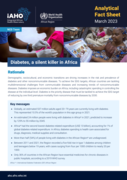
Diabetes is an increasingly prevalent yet under-recognised health crisis in Africa, driven by demographic and socioeconomic transitions. In 2021, 24 million adults in the region were living with diabetes, and this figure is expected to increase by 129% by 2045.
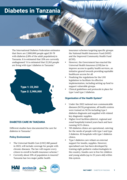
Tanzania has an estimated 2.9 million adults with diabetes, 35% of whom are undiagnosed, and over 22,000 people living with type 1 diabetes. While the 2023 Universal Health Insurance law aims to improve access to care, only 15% of people are insured. Over 700 clinics provide diabetes care and offer
...

The Ghana National Malaria Strategic Plan 2021–2025 aims to reduce malaria mortality by 90% and malaria cases by 50% (using 2019 as baseline) and to achieve pre-elimination in at least six districts by 2025. The plan focuses on scaling up prevention measures like distributing insecticide-treated n
...

The Training Toolkit for Community Early Warning Systems is an operational manual that aims to strengthen early warning systems in a developing country context. It accompanies and should put into practice the guiding strategic principles found in the Community Early Warning Systems: Guiding Principl
...

Growing emergencies and displacements across the world demand increasingly complex interventions and responses. The World Health Organization (WHO) has developed Malaria control in emergencies: a field manual to provide technical guidance to help partners respond effectively to malaria in emergency
...
2023 was another year of significant progress in the fight against HIV, tuberculosis (TB) and malaria. In countries where the Global
Fund invests, there has been a full recovery from the disruptive impact of the COVID-19 pandemic. The results we have achieved in the last year build on our extraord
...
Tobacco mythbusters: tools for debunking common myths promoted by the tobacco industry

PHSM are vital in reducing the risk and scale of infectious disease transmission and lowering hospitalization and deaths. Examples include contact tracing, quarantine and isolation, mask use, ventilation, school or workplace measures, mobility restrictions and travel requirements.
While these mea
...

Country tables & figures

Topics in Antiviral Medicine, March 4, 2025

World malaria report 2025
recommended
Addressing the threat of antimalarial drug resistance. This year’s report spotlights the growing threat of antimalarial drug resistance. Partial resistance to artemisinin derivatives – the backbone of malaria treatments after failures of chloroquine and sulfadoxine-pyrimethamine – has now b
...

HIV rapid diagnostic test market landscape
recommended
The analysis includes the three most commonly used HIV rapid diagnostic test
(RDT) categories: HIV-only professional use RDTs, dual HIV/syphilis professional use
RDTs, and HIV self-tests (HIVST).
2024 Global AIDS Update. Thematic report. Gay men and other men who have sex with men are one of the populations that are disproportionally affected by HIV

В сводном руководстве изложены меры общественного здравоохранения применительно к ВИЧ-инфекции, вирусным гепатитам и инфекциям, передаваемым половым путем (ИПП
...
2024 GLOBAL AIDS UPDATE
Thematic briefing note

Operational requirements for implementing WHO recommendations in digital systems. 2nd edition.
To ensure that countries can effectively benefit from digital health investments, “digital adaptation kits” (DAKs) are designed to facilitate the accurate reflection of WHO’s clinical, public health
...
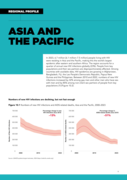
In 2023, 6.7 million [6.1 million–7.5 million] people living with HIV were residing in Asia and the Pacific, making this the world’s largest epidemic after eastern and southern Africa. The region accounts for a quarter of annual new HIV infections globally (23%). People from key populations and
...
