Filter
906
Text search:
World
Health
Organization
Eastern
Mediterranean
Featured
Recommendations
126
New Publications
179
Language
Document type
No document type
312
Studies & Reports
247
Guidelines
143
Manuals
65
Strategic & Response Plan
53
Fact sheets
25
Situation Updates
19
Training Material
16
Resource Platforms
15
Infographics
7
Brochures
1
App
1
Online Courses
1
Videos
1
Countries / Regions
Global
92
Syria
31
Africa
29
Middle East and North Africa
22
Western and Central Europe
18
Somalia
12
Yemen
11
Latin America and the Carribbean
10
Pakistan
9
Sudan
9
Nigeria
8
South–East Asia Region
8
Eastern Europe
8
Congo, Democratic Republic of
6
Afghanistan
6
Lebanon
6
Sierra Leone
5
Liberia
5
Ethiopia
5
India
5
Jordan
5
Kenya
5
Myanmar / Burma
5
West and Central Africa
5
Asia
5
Saudi Arabia
4
Nepal
4
Iraq
4
Rwanda
4
East and Southern Africa
4
Iran
4
Ghana
3
Uganda
3
South Sudan
3
Turkey
3
Egypt
3
China
3
Ukraine
3
Russia
3
Senegal
2
Cambodia
2
Thailand
2
South Africa
2
Benin
2
Greece
2
Madagascar
2
Western Pacific Region
2
Eastern Europe and Central Asia
2
Venezuela
2
Albania
2
Djibouti
2
Guinea
1
Morocco
1
USA
1
Cameroon
1
Niger
1
Philippines
1
Tanzania
1
Indonesia
1
Bangladesh
1
Malawi
1
Brazil
1
North Macedonia
1
Serbia
1
Croatia
1
Colombia
1
Ecuador
1
Libya
1
Sri Lanka
1
Palestine
1
Qatar
1
Georgia
1
Tunisia
1
Authors & Publishers
Publication Years
Category
Countries
127
Clinical Guidelines
119
Public Health
111
Women & Child Health
72
Key Resources
57
Capacity Building
26
Pharmacy & Technologies
19
Toolboxes
Mental Health
107
COVID-19
76
Planetary Health
59
TB
49
NTDs
47
NCDs
44
HIV
42
Global Health Education
38
Conflict
35
AMR
34
Refugee
30
Caregiver
30
Rapid Response
26
Malaria
26
Disability
24
Pharmacy
20
2.0 Rapid Response
19
Ebola & Marburg
17
Polio
16
Cholera
13
Natural Hazards
12
Zika
10
Health Financing Toolbox
8
Specific Hazards
4
Typhoon
1
Social Ethics
1
The report aims to capture lessons from the COVID-19 pandemic and to highlight the opportunity for more ambitious global action: expanding sustainable access to vaccines for all towards the Immunization Agenda 2030 and pandemic prevention, preparedness and response efforts. The report is organized i
...

Developmental disabilities are common. Yet, children with developmental disabilities have been neglected in health systems planning and policy provisions for health and continue to experience stigma
...

The 2023 meeting of the WHO Clinical Consortium on Healthy Ageing (CCHA) was the group’s ninth gathering and took place in Geneva 5–7 December 2023. The meeting was structured around seven panels, with a series of technical presentations, plenary discussions and group work, and a final session o
...

The WHO Global Antimicrobial Resistance and Use Surveillance System (GLASS) was launched in 2015 to foster AMR surveillance and inform strategies to contain AMR. The system started with surveillance of AMR in bacteria causing common human infections and has expanded its scope to include surveillance
...
The 2023 Country Presence Report provides an overview of what WHO does in countries to advance towards the SDGs and implement GPW13, how we do it, with whom we work, and what is needed to overcome challenges for achieving results and impact in countries.
The ninth WHO report on the global tobacco epidemic tracks the progress made by countries in tobacco control since 2008 and, marks 15 years since the introduction of the MPOWER technical package which is designed to help countries implement the demand-reduction measures of the WHO Framework Conventi
...

This report compiles data for the first time on the far-reaching consequences of uncontrolled hypertension, including heart attacks, strokes and premature death, along with substantial economic losses for communities and countries. It also contains information on the global, regional and country-lev
...

About one fourth of the world’s population is estimated to have been infected with the tuberculosis (TB) bacilli, and about 5–10% of those infected develop TB disease in their lifetime. The risk for TB disease after infection depends on several
...

Cholera is a major health risk in many parts of the world, affecting millions of people every year. Since mid-2021, the world has been facing an ac
...

National action plans on antimicrobial resistance (AMR) often overlook the critical intersection of gender, despite evidence that exposure and susceptibility to infection, health-seeking behaviours, as well as antimicrobial prescribing and use patte
...
Due to the heterogeneous distribution of malaria transmission and its determinants, subnational tailoring (SNT) provides an analytical framework to facilitate the targeting of each population with appropriate intervention packages for maximum impact to inform national strategic planning and prioriti
...

The Malaria Ministerial Conference, co-hosted by WHO and the Government of Cameroon on 6 March 2024, brought together more than 400 stakeholders, including Ministers of Health and senior representatives from the African countries hardest hit by mala
...

This toolkit is a comprehensive set of practical tools and resources designed to support country-level risk communication and community engagement (RCCE) practitioners, decision-makers, and partners to plan and implement readiness and response activities for yellow fever outbreaks. The toolkit conta
...

The key to a lasting world free of all forms of poliovirus lies in rapidly interrupting all remaining endemic transmission of WPV in the endemic areas of Pakistan and Afghanistan. This is the only way to ensure that such strains do not re-emerge glo
...
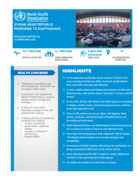
In the early morning of 6 February 2023, a magnitude 7.8 earthquake struck southern Türkiye near the northern
border of Syria. The earthquake was followed 11 minutes later by a magnitude 6.7 aftershock. Many aftershocks
continue to be felt across the region. Whilst the impact is still being ass
...
Fever Diagnostic Technology Landscape
recommended
1st edition.
Unitaid’s report describes a slate of new devices that can more efficiently identify dangerously ill children so that they can be treated immediately. These tools make it easier to recognize danger signs, and support integrated approaches to reducing childhood deaths from the three
...
The 2019 edition treating data for 2018 marks sustained international efforts dedicated to reporting on, analysing and understanding the year-to-year variations and long-term trends of a changing climate.