
Filter
118
Text search:
visually
impaired
students
Featured
2
32
Language
Document type
107
3
2
2
2
1
1
Countries
6
6
6
5
5
5
4
4
4
3
3
3
3
3
3
2
2
2
2
2
2
1
1
1
1
1
1
1
1
1
1
1
1
1
1
Authors & Publishers
Publication Years
Category
62
5
3
2
1
Toolboxes
63
4
3
2
1
1
1

A systematic literature review of education systems in low-and middle income countries commissioned by CBM

Volume 2 - 2014
A Resource Book of Inclusive Practices
Resource Kit for Field workers
Available in: English, French, Chinese, Spanish, Russian, Arabic, Thai, Korean, Tajik, Vietnamese, Uzbek
http://www.who.int/disabilities/cbr/guidelines/en/
Available in: English, French, Chinese, Spanish, Russian, Arabic, Thai, Korean, Tajik, Vietnamese, Uzbek
http://www.who.int/disabilities/cbr/guidelines/en/
The purpose of this document is to share good practices and processes concerning the inclusion of disability issues in HIV policy and programming, drawing on specific experiences in Senegal, Ethiopia, Kenya, Rwanda and Cambodia and on lessons learned at international AIDS conferences.
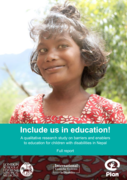
A 2013 Plan study across 30 countries found that children with disabilities were on average 10 times less likely to go to school than children without disabilities. This report presents the findings of a follow-up second phase to the research with a qualitative study on barriers and enablers to educ
...
Guidance Note A DFID practice paper
The study analyses the intersection of gender with disability issues by combining economic and social analysis across four states in India by using both quantitative and qualitative methods including gender analysis of disability budgets.
Accessed Sept. 2, 2015

PILOT SURVEY REPORT: BIRIM, HO, MANYA

Paper commissioned for the EFA Global Monitoring Report 2010, Reaching the marginalized

From Exclusion to Inclusion
