
Filter
1767
Text search:
acute
malnutrition
Featured
182
657
Language
Document type
1033
271
179
91
80
38
35
32
4
3
1
Countries
99
67
62
60
55
48
45
44
43
43
41
40
39
34
32
31
29
29
27
26
24
24
22
18
17
15
15
14
13
12
12
12
11
11
11
10
10
10
10
9
9
9
8
7
7
7
6
5
5
5
5
4
4
4
3
3
3
3
3
2
2
2
2
2
2
2
2
2
2
2
2
1
1
1
1
1
1
1
1
1
1
1
1
1
1
1
1
1
1
1
1
Authors & Publishers
Publication Years
Category
902
167
155
140
85
23
3
1
Toolboxes
112
112
67
61
53
47
42
39
37
34
29
27
23
22
21
20
20
16
13
10
10
9
3
3
1
1


Public Health Action PHA 2017; 7(2): 110–115
Level of stunting among Bangladeshi children <5years declined from 51% in 2004 to 36% and underweight from 41% in 2007 to 33% (BDHS 2014). But the decrease in wasting rate is not as expected, which is only from 17% to 14.3 % over last decade. Approximately 3.1 % (BDHS 2014) of under-5 children suffering from SAM only b
...
This summary assesses the current state of evidence on each approach in tabular form, providing: the definition and objectives; evidence of effectiveness; operational considerations (e.g., training, staffing, and logistics); cost considerations and evidence on cost-effectiveness; operational success
...
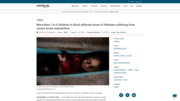
21 Oct 2022. Cases of malnutrition escalate rapidly as the lives of millions of children remain in jeopardy
Lancet Planet Health 2021; 5: e654–58
Humanitarian emergencies result in a breakdown of critical health-care services and often make vulnerable communities dependent on external agencies for care. In resource-constrained settings, this may occur against a backdrop of extreme poverty, malnutrit
...
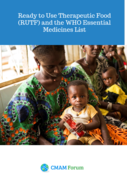
Severe Acute Malnutrition (SAM) is one of the greatest child survival challenges in the world today and
reportedly affects more than 16.2 million children each year1. High impact, proven treatment
...
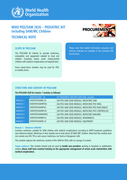
For 50 SAM children with medical complications and for a paediatric ward of 10-15 beds for 3 months
The PED/SAM kit is especially designed to provide medicines, renewables and equipment suitable for children and to treat the common childhood illness including severe
...

Malnutrition in childhood and pregnancy has many adverse consequences for child survival and long-term well-being. It
also has far-reaching consequences for human capital, economic productivity, and national development overall. The
consequences o
...
Over the period 2015 to 2019, scaling up a package of selected nutrition-specific and nutrition sensitive interventions to cover 90 per cent of Sudan would:
- Reduce the under-five mortality rate to 49/1,000 live births
- Reduce the prevalence of stunting to 25 per cent
- Reduce the ...
- Reduce the under-five mortality rate to 49/1,000 live births
- Reduce the prevalence of stunting to 25 per cent
- Reduce the ...

Humanitarian crises exacerbate nutritional risks and often lead to an increase in acute malnutrition. Emergencies include both manmade (conflict) and natural disasters (floods, drought, cyclones, ty
...
In this report a nutrition governance framework was applied to research and analyse the provincial experience with nutrition policy in Pakistan, looking both at chronic and acute malnutrition. Twent
...
The risk of communicable diseases remains a humanitarian concern with major health risks including cholera, acute watery diarrhea, bloody diarrhea, malaria and other vector borne diseases and conditions such as severe
...
Evidence for technical update of pocket book recommendations. Newborn conditions, dysentery, pneumonia, oxygen use and delivery, common causes of fever, severe acute malnutrition and supportive care
...
Disease Control Priorities –3rdEdition, Volume 2.
This book focuses on maternal conditions, childhood illness, and malnutrition. Specifically, the chapters address acute illness and undernutritio
...
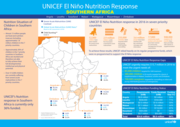
Nutrition Situation of Children in Southern Africa
• Almost 15 million people are food and nutrition insecure (including approximately 7.8 million children) in the 7 priority countries.
• Approximately 36% of children in the 7 priority countries in Southern Africa are stunted and there
...
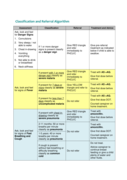
The document titled "Classification and Referral Algorithm – iCCM South Sudan", published by Malaria Consortium in 2012, provides a practical tool for community health workers to assess, classify, and manage common childhood illnesses in South Sudan. It outlines step-by-step procedures for identif
...
