
Filter
150
Text search:
Division
of
Parasitic
Diseases
and
Malaria
Featured
Recommendations
15
New Publications
47
Language
Document type
No document type
85
Studies & Reports
26
Guidelines
11
Manuals
8
Training Material
8
Strategic & Response Plan
7
Fact sheets
3
Situation Updates
2
Countries / Regions
Rwanda
13
India
8
Bangladesh
7
Global
7
Nigeria
6
Nepal
5
Namibia
5
Myanmar / Burma
4
Ethiopia
3
Kenya
3
Middle East and North Africa
3
Africa
3
Liberia
2
Uganda
2
South–East Asia Region
2
Latin America and the Carribbean
2
Western and Central Europe
2
Sierra Leone
1
Morocco
1
Saudi Arabia
1
Ghana
1
Philippines
1
Pakistan
1
South Sudan
1
Iraq
1
Jordan
1
Lebanon
1
Turkey
1
Syria
1
Chad
1
Tanzania
1
Cambodia
1
Thailand
1
China
1
Indonesia
1
South Africa
1
Mozambique
1
Sudan
1
Botswana
1
Greece
1
East and Southern Africa
1
West and Central Africa
1
Western Pacific Region
1
Eastern Europe and Central Asia
1
Other region
1
Asia
1
Eastern Europe
1
Albania
1
Laos
1
Bulgaria
1
Iran
1
Georgia
1
Vietnam
1
Tunisia
1
Authors & Publishers
Publication Years
Category
Countries
71
Clinical Guidelines
13
Public Health
9
Women & Child Health
8
Capacity Building
7
Key Resources
6
Pharmacy & Technologies
3
Toolboxes
NTDs
14
Planetary Health
10
Malaria
10
Mental Health
5
TB
5
Global Health Education
5
AMR
5
HIV
4
Rapid Response
3
Conflict
2
Caregiver
2
2.0 Rapid Response
2
Disability
1
Ebola & Marburg
1
Pharmacy
1
Health Financing Toolbox
1

In Kenya, the bacterial infections that contribute most to human disease are often those in which re-‐sistance is most evident. Examples are multidrug-‐resistant enteric bacterial pathogens such as typhoid,
...
Lymphatic Filariasis and Podoconiosis morbidity management and disability prevention guidelines
recommended
National Guideline

Dracunculiasis (Guinea worm disease), caused by the parasite Dracunculus medinensis, is traditionally acquired by drinking water containing copepods (water fleas) infected with D. medinensis larvae, but in recent years also appears increasingly to be transmitted by eating fish or other aquatic anima
...

In response to the recent publication “Is onchocerciasis elimination in Africa feasible by 2025: a perspective based on lessons learnt from the African control programmes” by Dadzie et al., it is important to clarify and highlight the positive
...
The internationally recognized criteria for diagnosis of neurocysticercosis include a requirement for neuroimaging techniques, such as computerized tomography (CT) and/or magnetic resonance imaging
...

An interregional meeting on leishmaniasis among neighbouring endemic
countries in the Eastern Mediterranean, African and European regions was organized by the World Health Organization (WHO) Regional Office for the Eastern
Mediterranean in Amman,
...

WHO Technical Series 971
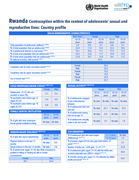
Country profile: Rwanda

In this version of the compendium, each guidance is coded using the International Classification of Health Interventions (ICHI).
The compendium provides a systematic compilation
...
Almost 25% of deaths worldwide could be prevented if the actions in the compendium were fully implemented
This compendium provides a systematic compilation of published guidance from WHO
...
A MANUAL FOR WASH IMPLEMENTERS, BOTSWANA
Sightsavers | Department for International Development | The International Trachoma Initiative | Children Without Worms | WaterAid | WASH Advocates | Center for Global Safe Water, Emory University | CARE USA
The report summarizes the estimates of the burden of disease attributable to unsafe drinking water, sanitation, and hygiene for the year 2019 for f
...
