Filter
514
Text search:
Department
of
Labour,
Republic
of
South
Africa
Featured
43
144
Language
Document type
291
113
54
24
23
4
2
2
1
Countries / Regions
50
31
23
21
17
17
14
11
10
10
10
9
9
9
8
8
7
6
6
6
6
6
5
5
5
4
4
4
4
3
3
3
3
3
3
3
3
3
3
2
2
2
2
2
2
2
2
2
1
1
1
1
1
1
1
1
1
1
1
1
1
1
1
1
1
1
1
1
1
1
1
1
1
1
1
Authors & Publishers
Publication Years
Category
199
45
37
26
25
6
3
Toolboxes
45
42
35
32
22
21
20
17
14
13
12
11
10
8
6
5
5
4
3
3
2
2
1
1
1
DHS Working Papers No. 120

This policy paper underscores that, although children do not represent a high-risk group for direct COVID-19 fatality, the pandemic posts far-reaching secondary impacts that heighten risks to African children’s rights and wellbeing.
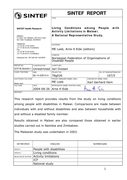
Living Conditions among People with Activity Limitations in Malawi. A National Representative Study.
This research report provides results from the study on living conditions
among people with disabilities in Malawi. Comparisons are made between
individuals with and without disabilities and also between households with and without a disabled family member. Results obtained in Malawi are also comp
...

DEPRESSION AND ANXIETY 27 : 390–403 (2010
Research Article
PLOS ONE | DOI:10.1371/journal.pone.0169530 February 16, 2017
Systematic Review Summary 4
Framework for Action

This report summarizes the World Health Organization’s (WHO) global work on water, sanitation and hygiene (WASH) during 2022. It describes how the Organization continued to deliver its essential WASH programming as elaborated in its 2018–2025 strategy.
World Drug Report 2017
-5-
Accessed: 14.03.2019
WHO Technical Series 971

The Lancet Infectious Disease Volume 25, Issue 2e77-e85February 2025
Background paper 10
The Independent Panel for Pandemic Preparedness and Response
May 2021
Protecting children on the move from violence, abuse and exploitation
Living Conditions among People with Activity Limitations in Zambia: A National Representative Study.
This research report provides results from the study on living conditions among people with disabilities in Zambia. Comparisons are made between individuals with and without disabilities and also between households with and without a disabled family member. Results obtained in Zambia are also compar
...