
Filter
3207
Text search:
WHO,
Regional
Office
Africa
Featured
Recommendations
313
New Publications
833
Language
Document type
No document type
1688
Studies & Reports
638
Guidelines
393
Manuals
180
Strategic & Response Plan
145
Training Material
57
Fact sheets
47
Situation Updates
39
Resource Platforms
9
Infographics
5
Brochures
2
Videos
2
App
1
Online Courses
1
Countries / Regions
Global
163
Ethiopia
119
Kenya
103
Sierra Leone
100
Africa
97
Liberia
87
Uganda
78
Zambia
68
Nigeria
63
South Africa
63
Tanzania
59
Ghana
54
Malawi
53
Namibia
45
Rwanda
42
Congo, Democratic Republic of
41
Guinea
40
India
40
South Sudan
39
Mozambique
37
East and Southern Africa
37
West and Central Africa
37
Western and Central Europe
37
Syria
33
Senegal
29
Nepal
29
Middle East and North Africa
29
Lesotho
27
Asia
25
Zimbabwe
22
Yemen
20
South–East Asia Region
20
Bangladesh
19
Central African Republic
19
Ukraine
19
Latin America and the Carribbean
18
Cameroon
15
Eswatini/ Swaziland
15
Eastern Europe
15
Somalia
14
Angola
14
Myanmar / Burma
14
Botswana
13
Madagascar
12
Burkina Faso
11
Mali
11
Pakistan
11
Sudan
11
Guinea-Bissau
9
Cambodia
9
China
9
Brazil
9
Russia
9
Côte d’Ivoire / Ivory Coast
8
Afghanistan
8
Thailand
8
Venezuela
8
Haiti
7
Philippines
7
Lebanon
7
Benin
7
Burundi
7
Colombia
7
Eastern Europe and Central Asia
7
Togo
6
Chad
6
Gambia
6
Indonesia
6
Jordan
5
Sri Lanka
5
Western Pacific Region
4
Southern Africa
4
Iran
4
Niger
3
Germany
3
Peru
3
North Macedonia
3
Libya
3
Mexico
3
Laos
3
Georgia
3
Vietnam
3
Mauritius
3
Morocco
2
Saudi Arabia
2
Iraq
2
Papua New Guinea
2
Greece
2
Palestine
2
Albania
2
Djibouti
2
Moldova
2
Kyrgyzstan
2
Kazakhstan
2
Portugal
2
Bosnia and Herzegovina
2
USA
1
Turkey
1
Mauritania
1
Argentina
1
Serbia
1
Hungary
1
Ecuador
1
Armenia
1
Timor Leste/ East Timor
1
Tajikistan
1
Qatar
1
Bulgaria
1
Estonia
1
North America
1
Gabon
1
Turkmenistan
1
Jamaica
1
Japan
1
Belgium
1
Tunisia
1
United Kingdom
1
Norway
1
Spain
1
Belarus
1
Israel
1
Authors & Publishers
Publication Years
Category
Countries
1094
Clinical Guidelines
228
Key Resources
219
Women & Child Health
177
Public Health
174
Capacity Building
58
Pharmacy & Technologies
34
Toolboxes
HIV
284
COVID-19
247
Mental Health
195
Ebola & Marburg
160
Planetary Health
149
TB
147
Disability
143
Rapid Response
98
NTDs
92
AMR
89
Conflict
88
Global Health Education
80
Refugee
76
Caregiver
73
2.0 Rapid Response
61
Pharmacy
51
Health Financing Toolbox
48
NCDs
44
Malaria
41
Natural Hazards
40
Zika
22
Cholera
18
Polio
14
Social Ethics
9
Specific Hazards
8
Typhoon
3
South Sudan
1
21 January 2022
The overall threat posed by Omicron largely depends on four key questions: (i) how transmissible the variant is; (ii) how well vaccines and prior infection protect against infection, transmission, clinical disease and death; (iii) how virulent the variant is compared to other varian
...

Uganda hosts approximately 1.1 million refugees making it Africa’s largest refugee hosting country and one of the five largest refugee hosting countries in the world. Most recently, throughout 2016- 2018, Uganda was impacted by three parallel emer
...
The World Health Organization (WHO) defines mental health as ‘a state of well-being in which the individual realizes his or her own abilities, can cope with the normal stresses of life, can work productively and fruitfully, and is able to make a c
...
The purpose of this manual is to provide a resource for training to increase understanding of Health in All Policies (HiAP) by health and other professionals. It is anticipated that the material in this manual will form the basis of two- or three-day workshops, which will:
• Bu
...

The Country Cooperation Strategy is the World Health Organization (WHO)’s reference for country work guiding planning and resource allocation through alignment with national health priorities and harmonization with other development partners. It c
...

Emergency medical teams (EMT) are first response health care providers – doctors, nurses, paramedics, and others – during outbreaks and emergencies or disasters, working with governments, charities such as nongovernmental organizations (NGOs), armies, and international organizations such as the
...

Since 2000, concerted efforts by national programmes, supported by public–private partnerships, nongovernmental organizations, donors and academia under the auspices and coordination of the World Health Organization (WHO), have produced important
...

Over the past decade, countries in the African region experienced slow progress in mobilizing resources for health while facing continued challenges. In their revised estimates published in 2017, Stenberg et al., developed two costs scenarios, termed progress and ambitious, aimed at strengthening co
...

In 2022, Namibia had an estimated population of 2.6 million people, where 51 per cent per cent are females and 52.5 per cent of households in urban areas, with fast-growing urban informal settlements which lack access to basic services. Namibia has a young population; 42 per cent are children (0-17
...
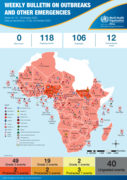
The WHO Health Emergencies Programme is currently monitoring 118 events in the region. This week’s main articles cover the following events:
Coronavirus disease 2019 (COVID-19) in Togo
Measles in Chad
Ebola virus disease (EVD) in É
...
