Filter
139
Text search:
West
Nile
fever
Featured
20
58
Language
Document type
71
29
17
7
7
3
3
2
Countries
9
9
6
5
4
3
3
2
2
2
2
2
2
1
1
1
1
1
1
1
1
1
1
1
1
1
1
1
1
1
1
Authors & Publishers
Publication Years
Category
31
17
12
10
5
2
Toolboxes
23
19
17
7
7
7
5
4
3
2
2
2
2
1
1
1
1
1
1

There is a broad consensus nowadays that the Earth is warming up as a result of greenhouse gas emissions caused by anthropogenic activities. It is also clear that current trends in the fields of energy, development and population growth will lead to continuous and ever more dramatic climate change.
...
Canadian Journal of Microbiology 25 June 2021 https://doi.org/10.1139/cjm-2020-0572
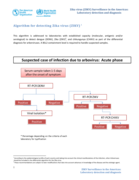
This algorithm is addressed to laboratories
with established capacity(molecular, antigenic and/orserological) to detect dengue (DENV), Zika (ZIKV), and chikungunya(CHIKV) as part of the differential diagnosis for arborviruses. A BSL2 containment level is required to handle suspected samples.

Parasites & Vectors volume 11, Article number: 264 (2018)
Dengue creates a staggering epidemiological and economic burden for endemic countries. Without a specific therapy and with a commercial vaccine that presents some problems relative to its full effectiveness, initiatives to improve vector
...
It is Zika virus (ZIKV) that most often causes these neurological effects it appears to be the only arbovirus than can cause congenital malformations such as microcephaly. In any case, more scientific tests are needed to establish the causal relationship between the virus and this malformation (7-10
...

The Pharmaceutical Forum of the Americas (PFA) has previously published guidelines and organised campaigns for community pharmacists on the prevention, detection and control of arbovirus infections in 2018 with a grant from the FIP Foundation for Pharmacy Education and Research. Building on that exp
...
Inerim Guidance. These guidelines have been developed in recognition that infection with Zika virus may present a risk to blood safety, and in consideration of the declaration on 1 February 2016 by the WHO Director-General of a Public Health Emergency of International Concern with regard to clusters
...
As the nation’s public health leader, the Centers for Disease Control and Prevention (CDC) is actively engaged in a national effort to protect the public’s health from the harmful effects of climate change. Scientists from CDC’s National Center for Emerging and Zoonotic Infectious Diseases (NC
...
The primary audience for this guidance is persons
working directly in vector-borne disease prevention
and control, including programme managers,
researchers and field workers. A brief technical
background is provided for the benefit of persons
without expertise in vector-borne diseases; readers
...

A summary of health effects, resources, and adaptation examples from health departments funded by CDC’s Climate and Health Program

Managing epidemics
recommended
Key facts about major deadly diseases.This manual provides concise and up-to-date knowledge on 15 infectious diseases that have the potential to become international threats, and tips on how to respond to each of them.
You can download an interactive version directly at the website
http://www.who.
...
updated 05 April 2016
Accessed: 11.03.2019
The 2013 RMIS is a nationally representative, household-based survey that provides data on malaria indicators, which are used to assess the progress of a malaria control program. The primary objective of the 2013 Rwanda Malaria Indicator Survey (2013 RMIS) was to provide up-to date information on th
...
Bulletin of the World Health Organization; http://dx.doi.org/10.2471/BLT.16.176677
Infectious diseases continue to impose unpredictable burdens on global health and economies, a subject that requires constant research and updates. In this sense, the objective of the present article was to review studies on the role of wild animals as reservoirs and/or dispersers of etiological age
...