
Filter
44
Text search:
HIV
Response
Coordination
Communication
Community
Capacity
Eswatini
Featured
4
5
Language
Document type
12
9
9
8
3
2
1
Countries / Regions
6
6
3
2
2
2
2
2
1
1
1
1
1
1
1
1
Authors & Publishers
Publication Years
Category
15
5
3
2
1
Toolboxes
17
6
5
1
1
1
1
1
1
1
The African Region has been experiencing unprecedented health challenges due to the Coronavirus disease 2019 (COVID-19) pandemic, which have compounded the already difficult task the Region was facing in moving towards universal health coverage (UHC) attainment.

This ToR outlines the background, purpose,
audience, and use of the evaluation, objective and key evaluation questions,
methodological considerations, timeline and deliverables, and the technical
requirements the prospective evaluation team should meet

Men lag behind women regarding use of HIV services and represent the majority of individuals living with uncontrolled HIV, advanced HIV, and who ex
...
WHO operational handbook on tuberculosis Module 5: Management of tuberculosis in children and adolescents
recommended
The practical guidance in the operational handbook aims to inform the development or revision of national policies and related implementation guidance on the management of TB in children and adolescents under programmatic circumstances and at different levels of the health system. The operational ha
...
State of Health in the WHO African Region
recommended
This report is not a country scorecard. Rather, its purpose is to act as a compass to guide progress towards health in the SDGs.
There has been a significant improvement in the state of health in the region with healthy life expectancy - time spent in full health - in the region increasing from 50
...

This report is one of the first major products of the newly established Precision Public Health Metrics unit of the UCN cluster of the WHO Regional Office for Africa. The report presents national trends in communicable and non-communicable disease burden and control in the WHO African region. It tra
...


Background Note: Briefing to the Executive Board, First Regular Session 2025
The Leonard Cheshire Disability and Inclusive Development Centre | University College London | 4 Taviton Street | London WC1H OBT | United Kingdom| Principal Investigator: Dr Raymond Lang | Email: r.lang@ucl.ac.uk | Tel: +44 (0)207 679 1519 | Research Commissioned by the Southern African Federation
...
The GHS Index is intended to be a key resource in the face of increasing risks of high-consequence and globally catastrophic biological events and in light of major gaps in international financing for preparedness. These risks are magnified by a rapidly changing and interconnected world; increasing
...

Antimicrobials are medicines, including antibiotics, antivirals, antifungals, and antiparasitics, that are used to prevent and treat infections in humans, animals, and plants. Antimicrobial Resistance (AMR) arises when bacteria, viruses, fungi, and parasites no longer respond to these medicines, ren
...
A study conducted by the World Health Organisation Regional Office for Africa. The COVID-19 pandemic has had a significant impact on older persons both globally and in the African region. Although overall the region’s population is younger relative to many other world regions, the WHO AFRO region
...
Tuberculosis cases, TB deaths

In 2022, Namibia had an estimated population of 2.6 million people, where 51 per cent per cent are females and 52.5 per cent of households in urban areas, with fast-growing urban informal settlements which lack access to basic services. Namibia has a young population; 42 per cent are children (0-17
...
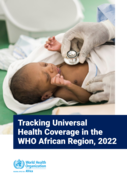
n 2015, Member States of the United Nations adopted the 2030 Agenda for Sustainable Development and its accompanying Sustainable Development Goals (SDGs), with the third goal of the agenda focusing on health – good health and well-being. This has the attainment of universal health coverage (UHC) a
...

This publication is a compendium of 49 country examples highlighting efforts in improving refugees’ and migrants’ health following the adoption of the WHO Global Action Plan on Promoting the health of refugees and migrants at the seventy-second World Health Assembly, in May 2019.
