
Filter
391
Text search:
Uganda
Aids
Commission
Featured
Recommendations
23
New Publications
92
Language
Document type
No document type
275
Studies & Reports
71
Guidelines
20
Strategic & Response Plan
13
Manuals
9
Training Material
2
Situation Updates
1
Countries / Regions
Uganda
50
Africa
23
Kenya
16
Tanzania
12
Malawi
12
Ethiopia
11
Rwanda
11
South Africa
10
Global
10
Zambia
9
Nigeria
8
Ghana
8
India
7
East and Southern Africa
6
Liberia
5
Nepal
5
South Sudan
5
Germany
5
Namibia
5
Lesotho
5
Sierra Leone
4
Bangladesh
4
West and Central Africa
4
Congo, Democratic Republic of
3
Zimbabwe
3
Syria
3
Thailand
3
Mozambique
3
Burkina Faso
2
Philippines
2
Pakistan
2
Indonesia
2
Middle East and North Africa
2
Guinea
1
Senegal
1
Mali
1
Morocco
1
Cameroon
1
Haiti
1
Lebanon
1
Chad
1
Cambodia
1
Sudan
1
Argentina
1
Eswatini/ Swaziland
1
Brazil
1
North Macedonia
1
Hungary
1
Ukraine
1
Colombia
1
Botswana
1
Angola
1
Mexico
1
Myanmar / Burma
1
Yemen
1
Latin America and the Carribbean
1
Western and Central Europe
1
Asia
1
Russia
1
Kyrgyzstan
1
Georgia
1
Jamaica
1
Norway
1
Portugal
1
Authors & Publishers
Publication Years
Category
Countries
129
Public Health
30
Clinical Guidelines
16
Women & Child Health
14
Key Resources
7
Capacity Building
3
Pharmacy & Technologies
2
Toolboxes
HIV
79
Disability
43
Mental Health
28
TB
18
Global Health Education
14
Health Financing Toolbox
12
COVID-19
10
NTDs
9
Ebola & Marburg
8
Caregiver
8
Planetary Health
8
NCDs
6
Conflict
5
Rapid Response
5
Pharmacy
5
Refugee
4
AMR
2
Social Ethics
1
Malaria
1
2.0 Rapid Response
1
Globally, approximately 56.8 million people are in need of palliative care
services; 78% of them living in low and middle-income country yet only
about 12% have their needs being met causing great suffering for many.

While there has been real progress in addressing the burden of disease in the WHO African region, the COVID-19 pandemic has highlighted the link between health, economics and security, as the region saw decades of progress threatened, including positive trends in decreasing inequality. In the Africa
...
Rapport sur les populations clés.

Self-care interventions are among the most promising and exciting new approaches to improve health and well-being, both from a health systems perspective and for people who use these interventions. The World Health Organization (WHO) uses the following working definition of self-care: Self-care is t
...
The Guidelines for the Diagnosis, Treatment and Prevention of Leprosy provide state-of-the-art knowledge and evidence on leprosy diagnosis, treatment and prevention based on a public health approach in endemic countries. The target audience of this document includes policy-makers in leprosy or infec
...

Every year, an estimated 15 million babies are born preterm – before 37 weeks of pregnancy. That is more than 1 in 10 live births. Approximately 1 million children die each year worldwide due to complications from their early birth. Those that survive often face a lifetime of ill-health including
...
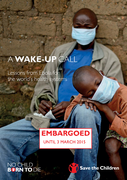
Almost 30 countries vulnerable to a new Ebola-style Epidemic, jeopardising the future of millions of Children. The report ranks the world’s poorest countries on the state of their public health systems, finding that 28 have weaker defences in place than Liberia where, alongside Sierra Leone and Gu
...
Addressing comorbidities and risk factors for tuberculosis (TB) is a crucial component of the World Health Organization (WHO)’s End TB Strategy. This WHO operational handbook on tuberculosis. Module 6: tuberculosis and comorbidities aims to support countries in scaling up people-centred care,
...
Interim Guidance.
A number of medical problems have been reported in survivors, including mental health issues. Ebola virus may persist in some body fluids, including semen. Ebola survivors need comprehensive support for the medical and psychosocial challenges they face and also to minimize the ...
A number of medical problems have been reported in survivors, including mental health issues. Ebola virus may persist in some body fluids, including semen. Ebola survivors need comprehensive support for the medical and psychosocial challenges they face and also to minimize the ...

A lot has happened this year. While we continued to tackle the COVID-19 pandemic, we were hit by disease outbreaks and
humanitarian crises. Yet, despite these challenges, we marched on, resolute in resolving critical health systems issues to increase
access to quality healthcare services. To furth
...
Cancer
recommended
This volume presents the complex patterns of cancer incidence and death around the world and evidence on effective and cost-effective ways to control cancers. The Disease Control Priorities Volume 3 evaluation of cancer will indicate where cancer treatment is ineffective and wasteful, and offer alte
...

Findings on maternal and child health in Nepal, Mozambique and
Rwanda, and neglected tropical diseases in Cambodia and Sierra Leone | This report synthesises findings from five country case studies from the health dimension of this project, which focus on maternal and child health (MCH) (Mozambique
...
War Child put forward a specific request for comparative study, addressing the following questions: •What are the key types of intervention for psychosocial assistance that are being applied to children in war-affected areas? •What are the results of (scientific) research into the effects of th
...
Oxfam Briefing Paper
Disabled people in developing countries are the poorest of the poor: if we are serious about tackling extreme poverty, our development work has to target them. The post-2015 development framework offers hope that disabled people will finally get the prominence they deserve on the global development
...

Early Childhood Matters is a journal about early childhood. It looks at specific issues regarding the development of young children, in particular from a psychosocial perspective. It is published twice per year by the Bernard van Leer Foundation.
On Page 54 of this issue the article titled: "Par
...
