
Filter
838
Text search:
National
Institute
for
Occupational
Safety
and
Health
Featured
Recommendations
103
New Publications
192
Language
Document type
No document type
431
Guidelines
156
Studies & Reports
119
Manuals
65
Strategic & Response Plan
30
Training Material
25
Fact sheets
5
Situation Updates
3
Infographics
2
Brochures
1
Resource Platforms
1
Countries / Regions
Global
37
South Africa
31
India
30
Kenya
25
Liberia
23
Western and Central Europe
21
Ghana
16
Namibia
15
Uganda
14
Nigeria
13
Africa
13
Ethiopia
12
Philippines
12
Rwanda
12
Myanmar / Burma
11
Sierra Leone
10
Bangladesh
10
Zambia
8
Syria
8
Latin America and the Carribbean
8
USA
7
Nepal
7
Cambodia
7
Asia
7
Ukraine
6
West and Central Africa
6
Guinea
5
Germany
5
Tanzania
5
Eastern Europe
5
Russia
5
Indonesia
4
Malawi
4
Mozambique
4
Brazil
4
Congo, Democratic Republic of
3
Pakistan
3
Thailand
3
Peru
3
East and Southern Africa
3
Middle East and North Africa
3
Western Pacific Region
3
Eastern Europe and Central Asia
3
Laos
3
Vietnam
3
South Sudan
2
Lebanon
2
China
2
Eswatini/ Swaziland
2
Colombia
2
Botswana
2
Lesotho
2
Yemen
2
South–East Asia Region
2
Tajikistan
2
Burkina Faso
1
Cameroon
1
Togo
1
Haiti
1
Iraq
1
Jordan
1
Afghanistan
1
Egypt
1
Malaysia
1
Sudan
1
Benin
1
Ecuador
1
Bolivia
1
Angola
1
Chile
1
Paraguay
1
Albania
1
Southern Africa
1
Bulgaria
1
Estonia
1
Lithuania
1
Iran
1
Japan
1
United Kingdom
1
Spain
1
Authors & Publishers
Publication Years
Category
Countries
286
Public Health
75
Clinical Guidelines
58
Key Resources
46
Women & Child Health
15
Pharmacy & Technologies
12
Capacity Building
9
Toolboxes
Mental Health
109
COVID-19
86
TB
47
Planetary Health
44
Disability
38
Rapid Response
38
Caregiver
36
Ebola & Marburg
33
HIV
33
NCDs
25
Specific Hazards
22
2.0 Rapid Response
22
Global Health Education
21
AMR
17
NTDs
15
Pharmacy
13
Conflict
11
Refugee
10
Polio
4
Natural Hazards
4
Zika
3
Malaria
3
Social Ethics
2
Health Financing Toolbox
2
Cholera
1

The Government recognizes the critical role of the built environment in addressing climate change and environmental degradation. To this end, it has identified and empowered the Kenya Building Resea
...
New and updated information.
Adverse health effects of hot weather and heat-waves are largely preventable. Prevention requires a portfolio of acti
...

The primary audience for this guidance is persons
working directly in vector-borne disease prevention
and control, including programme managers,
researchers
...
There is a substantial and ever-increasing unmet need for rehabilitation worldwide, which is particularly profound in low- and middle
-income coun
...
SCOPING QUESTION:Which psychosocial interventions are effective in the treatment of psychostimulant dependence for adults and young people?

Mental disorders impose an enormous burden on society, accounting for almost one in three years lived with disability globally. •In addition to their health impact, mental disorders cause a signif
...

J HEALTH POPUL NUTR 2010 Aug;28(4):327-332
ISSN 1606-0997

N95 or equivalent respirators are single-use personal protective equipment (PPE) designed for use by health workers that provide direct care to patients with diseases transmitted by aerosols or duri
...
Food environments are usually defined as the settings with all the different types of
food made available and accessible to people as they go about their daily lives.
That is, the range of food in supermarkets, small retail outlets, wet markets
...
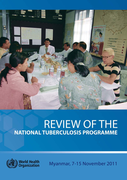
Myanmar is one of the world’s 22 high tuberculosis (TB) burden countries, and supporting TB control in Myanmar is a global priority. This report reflects the findings, discussions, conclusions and
...

Objective of this document: Present a summary of the administrative measures that serve as the basis for implementation of infection prevention and control (IPC)measures in the context of COVID-19
The ASEAN Mental Health Systems Report
catalogues the situation of mental health in ASEAN
Member States. This report provides comprehensive
information on the progress made so far by AMS in
inte
...
Drinking-water quality regulations and standards developed or revised in accordance with this guidance will reflect the best practices identified in the WHO Guidelines for Drinking-water Quality to
...

Addressing comorbidities and risk factors for tuberculosis (TB) is a crucial component of the World Health Organization (WHO)’s End TB Strategy.
...
Addressing comorbidities and risk factors for tuberculosis (TB) is a crucial component of the World Health Organization (WHO)’s End TB Strategy.
...
Disinfection of drinking-water supplies has been one of the most significant public health advancements of the last century with respect to reducing waterborne disease.
Although chlorine has been used as the disinfectant of choice ...
Although chlorine has been used as the disinfectant of choice ...
The Manual for Indoor Residual Spraying in Urban Areas for Aedes aegypti Control is intended not only for operational personnel
...
Recent systematic reviews and meta-analysis of the impact of chemical-based mollusciciding (King et al., 2015, Sokolow et al., 2016) have concluded that regular mollusciciding is likely to contribute significantly towards elimination of schistosomia
...
