
Filter
516
Text search:
respiratory
communicable
diseases
control
Featured
Recommendations
57
New Publications
123
Language
Document type
No document type
236
Studies & Reports
106
Guidelines
87
Strategic & Response Plan
30
Manuals
25
Training Material
11
Situation Updates
8
Fact sheets
6
Dashboards/Maps
5
Brochures
1
Resource Platforms
1
Countries / Regions
Global
44
India
24
Kenya
22
Africa
16
South Africa
14
Rwanda
13
Ghana
12
Nigeria
11
Ethiopia
11
Liberia
10
Myanmar / Burma
10
Sierra Leone
9
Philippines
9
Zambia
9
Bangladesh
9
Namibia
9
Western and Central Europe
9
Uganda
8
Syria
8
Latin America and the Carribbean
8
Malawi
7
Nepal
6
Tanzania
5
West and Central Africa
4
Eastern Europe
4
Indonesia
3
Mozambique
3
Yemen
3
Guinea
2
Congo, Democratic Republic of
2
Zimbabwe
2
Haiti
2
Pakistan
2
Thailand
2
Sudan
2
Brazil
2
Ukraine
2
Colombia
2
Lesotho
2
East and Southern Africa
2
South–East Asia Region
2
Western Pacific Region
2
Bhutan
2
Tajikistan
2
Cameroon
1
South Sudan
1
Jordan
1
Afghanistan
1
Turkey
1
Papua New Guinea
1
Benin
1
Argentina
1
Peru
1
North Macedonia
1
Botswana
1
Sri Lanka
1
Middle East and North Africa
1
Other region
1
Asia
1
Venezuela
1
Palestine
1
Timor Leste/ East Timor
1
Iran
1
Kazakhstan
1
Maldives
1
Mauritius
1
Azerbaijan
1
Authors & Publishers
Publication Years
Category
Countries
229
Public Health
77
Clinical Guidelines
50
Key Resources
27
Women & Child Health
17
Capacity Building
7
Pharmacy & Technologies
5
Toolboxes
COVID-19
53
NCDs
53
TB
43
Planetary Health
27
AMR
21
Caregiver
17
HIV
16
Rapid Response
15
Conflict
14
Mental Health
12
Ebola & Marburg
9
Global Health Education
9
Natural Hazards
8
Refugee
7
NTDs
7
2.0 Rapid Response
7
Pharmacy
5
Polio
4
Cholera
2
Zika
2
Specific Hazards
2
Disability
1
Typhoon
1
Health Financing Toolbox
1
Reliable cause specic mortality statistics are the cornerstone of national health information
systems. They are essential for evidence-based decision making for monitoring health of
populations, health services planning and delivery, programme implementation, policy development
and epidemiolog
...

Every year, around 830 000 children die from unintentional or "accidental" injuries. The vast majority of these injuries occur in low-income and middle-income countries. However, dozens of prevention strategies and programmes exist. If they were integrated into other child survival programmes and im
...

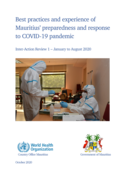
his Inter Action Review report for the COVID-19 outbreak in Mauritius documents and assesses the country’s capacity to respond to the outbreak and identifies the best practices, strengths, gaps and challenges of the national response. Areas requiring improvements or sustained actions have been ide
...
2nd edition


The annual Development Co-operation Report brings new evidence, analysis and ideas on
sustainable development to members of the OECD Development Assistance Committee (DAC) and the international community more broadly. The objectives are to promote best practices and innovation in development co-ope
...
This report explores community-focused change initiatives in the financing, organization, and delivery of mental health services in Peru from 2013 to 2016. It examines the national dimension of reforms but focuses above all on implementation and results in the economically fragile district of Caraba
...

Thailand is exposed to flooding, landslides, drought, earthquakes, tsunamis, heat waves, forest fires, and epidemics. Thailand is also exposed to technological hazards such as chemical accidents. Flooding is the natural hazard with the most significant impact on human life, livelihoods, and the econ
...
The infectious disease burden in India is among the highest in the world. A large amount of antibiot-ics are consumed in fighting infections, some of them saving lives, but every use adding to antibiotic resistance in bacteria. Antibiotic use is increasing steadily (table 1), particularly
...
7 June 2020 Version 1
Women in Myanmar have traditionally been underrepresented in public decision-making processes, a trend which is continuing in structures established to respond to COVID-19. This means that even as women are disproportionately affected by the crisis, they have less say in how t
...
Produced by Training and Research Support Centre for the Regional Network for Equity in Health in east and southern Africa (EQUINET), March 20, 2020.
This brief summarises and provides links to official, scientific and other resources to support an understanding of and individual to regional level
...
Statistical Agency under the President of the Republic of Tajikistan Dushanbe, Republic of Tajikistan
Ministry of Health and Social Protection of Population of the Republic of Tajikistan
Dushanbe, Republic of Tajikistan
The DHS Program ICF
Rockville, Maryland, USA

The availability, prices and affordability of essential medicines in Malawi: A cross-sectional study
The Malawian government recently introduced cost-covering consultation fees for self-referral patients in tertiary public hospitals. Previously, patients received medicines free of charge in government-owned health facilities, but must pay elsewhere. Before the government implements a payment policy
...
This brief considers the rationale for shielding individuals at high risk of severe disease or death from COVID-19 in low- and middleincome countries. It provides an overview of proposed approaches to shielding, discusses the categories of individuals who may be identified for shielding, and outline
...

1 June 2020
Countries around the world are facing the challenge of increased demand for care of people with COVID-19, compounded by fear, misinformation and limitations on movement that disrupt the delivery of health care for all conditions. Maintaining essential health services: operational guidan
...
