
Filter
2160
Text search:
community
event
based
surveillance
Featured
267
543
Language
Document type
878
418
413
182
177
34
28
23
4
1
1
1
Countries
142
63
57
56
55
41
41
40
36
35
30
29
27
26
26
25
25
25
24
21
21
21
21
21
20
20
18
17
16
15
11
11
11
11
10
10
10
9
9
8
7
7
7
7
6
6
6
6
6
5
5
5
5
4
4
4
4
3
3
3
3
3
3
2
2
2
2
2
2
2
2
2
2
2
2
2
2
2
2
1
1
1
1
1
1
1
1
1
1
1
1
1
1
1
1
1
1
1
1
1
1
1
1
1
1
1
1
1
1
1
1
1
Authors & Publishers
Publication Years
Category
625
221
184
174
98
38
29
Toolboxes
236
139
124
115
104
97
94
86
72
70
55
52
50
45
39
38
33
32
31
29
29
21
14
13
4
1
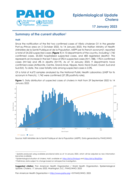
The report provides an epidemiological update on cholera outbreaks in Haiti as of January 17, 2023. Since the first confirmed cases in October 2022, Haiti has reported 24,232 suspected cases, including 1,742 confirmed cases and 483 deaths. The most affected areas are in the Ouest Department, particu
...

The Quadripartite organizations have developed the One Health Priority Research Agenda for AMR report, this is a joint initiative to assist in directing and catalysing scientific interest and financial investments for the priority research agenda across sectors for countries and funding bodies. The
...

The active participation and engagement of health and care workers (HCWs) in health emergency preparedness, readiness and response is crucial to support risk communication, community engagement and infodemic management (RCCE-IM) interven
...

The South African WHO Country Cooperation Strategy (CCS) 2023–2027 focuses on four key strategic priorities based on the country’s health needs and disease epidemiology, while also considering the need for building resilient health systems for U
...

These guidelines promote the delivery of people-centred health services for STIs by providing evidence-based recommendations related to decentralization, integration, task sharing and digital health. These recommendations complement existing WHO gui
...
The document provides a standardized protocol for evaluating the Early Warning Alert and Response Network (EWARN), a surveillance system used during humanitarian emergencies when regular national health su
...
This handbook follows a comprehensive approach to health system strengthening at borders in order to support IHR national focal points and other national agencies in developing and implementing evidence-based action plans for IHR capacity developmen
...

Integrated Outbreak Analytics (IOA) applies a multidisciplinary approach to understanding outbreak dynamics and to inform outbreak response. It aims to drive comprehensive, accountable, and effective public health and clinical strategies by enabling communities, and national and subnational health a
...

The document “Guide to revision of national pandemic influenza preparedness plans – Lessons learned from the 2009 A(H1N1) pandemic” provides guidance for countries on how to improve and update their national pandemic preparedness plans. It is based
...
The Gulf CDC Technical Guide for Rapid Risk Assessments of Acute Public Health Events provides a structured, multi-sectoral approach to evaluate and manage public health threats in Gulf Cooperation Council (GCC) countries. It focuses on rapid, evidence-bas
...
A survey was conducted in countries in all six WHO regions and focused on the building blocks that are considered prerequisites to combat antimicrobial resistance: a comprehensive national plan, laboratory capacity to undertake surveillance for resi
...
The Lancet DOI: 10.1016/S2468-2667(20)30101-8
WHO declared COVID-19 to be a pandemic on March 11, 2020. The pandemic eventually reached Yemen, with the first laboratory confirmed case announced on April 10. emen has structural vulnerabilities that have developed over a protracted period of conflic
...
Many critical questions remain about the effectiveness of COVID-19 vaccines in real-world settings. These questions can only be answered in post-introduction vaccine effectiveness studies.This guidance document outlines an approach to leverage existing sur
...

This template dossier complements and should be used after fulfilling the criteria and preconditions specified in the Process of validation of elimination of kala-azar as a public health problem in South-East Asia. The national kala-azar programme should be in the consolidation phase of elimination;
...
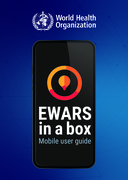
This Mobile user guidance is aimed at supporting implementation of EWARS in a box, WHO’s electronic early warning, alert and response system in emergencies. This guidance fulfills a long felt need to have an easy to use resource with step-by-step instructions in establishing EWARS in a box, facili
...
In this document, recommendations are provided on designing and implementing
a cross-sectional serosurvey using school-based sampling to estimate age-specific
DENV seroprevalence to inform a country’s national dengue vaccination program.
The
...
The Pandemic Influenza Preparedness (PIP) Framework is a World Health Assembly resolution adopted unanimously by all Member States in 2011. It brings together Member States, industry, other stakeholders and WHO to implement a global approach to pandemic influenza preparedness and response. The Frame
...

Developed through broad and inclusive consultation, and aligned with the WHO Global Health Sector Strategies and the Sustainable Development Goals, the framework promotes a people-centred approach and antimicrobial stewardship across 5 key domains: prevention and response,
...
As a public good, antimicrobial medicines require rational use if their effectiveness is to be preserved. However, up to 50% of antibiotic use is inappropriate, adding considerable costs to patient care, and increasing morbidity and mortality. In addition, there is compelling evidence that antimicro
...
The aim of the people-centred framework is to help countries to develop fully prioritized and budgeted NSPs based on a culture of making full use of the available data, which are aligned with national planning cycles and which provide the basis for
...
