Filter
1908
Text search:
foreign
countries
Featured
163
533
Language
1857
46
34
29
25
20
14
10
10
9
8
6
6
6
5
4
4
4
4
4
4
4
4
4
4
4
3
3
3
3
3
3
3
2
2
2
2
2
2
2
2
2
2
2
1
1
1
1
1
1
1
1
1
1
1
1
1
1
1
Document type
1030
424
175
126
64
28
27
18
9
5
1
1
Countries
132
55
55
53
46
44
44
43
38
36
36
34
28
27
25
25
24
23
21
21
21
20
20
19
19
18
18
18
16
15
14
14
13
13
12
10
10
9
9
9
9
8
8
8
7
7
7
7
7
7
7
7
7
6
6
6
5
5
5
5
5
4
4
4
4
3
3
3
3
3
3
3
3
3
2
2
2
2
2
2
2
2
2
2
2
2
1
1
1
1
1
1
1
1
1
1
1
1
1
1
1
1
1
1
1
1
1
1
1
1
1
1
1
1
1
1
1
1
1
1
1
Authors & Publishers
171
58
53
51
38
24
23
21
20
18
12
10
10
10
10
9
9
8
8
7
7
7
7
7
7
7
7
7
7
6
6
6
6
6
6
6
6
5
5
5
5
5
5
5
5
5
5
5
5
5
4
4
4
4
4
4
4
4
4
4
4
4
4
4
4
4
4
4
4
4
4
4
4
4
4
3
3
3
3
3
3
3
3
3
3
3
3
3
3
3
3
3
3
3
3
3
3
3
3
3
3
3
3
3
3
3
3
3
3
3
3
3
3
3
3
3
3
3
3
3
2
2
2
2
2
2
2
2
2
2
2
2
2
2
2
2
2
2
2
2
2
2
2
2
2
2
2
2
2
2
2
2
2
2
2
2
2
2
2
2
2
2
2
2
2
2
2
2
2
2
2
2
2
2
2
2
2
2
2
2
2
2
2
2
2
2
2
2
2
2
2
2
2
2
2
2
2
2
2
2
2
2
2
2
2
2
2
2
2
2
2
2
2
2
2
2
2
2
2
2
2
2
2
2
2
2
2
2
2
2
2
2
2
2
2
2
2
2
2
2
2
2
2
2
1
1
1
1
1
1
1
1
1
1
1
1
1
1
1
1
1
1
1
1
1
1
1
1
1
1
1
1
1
1
1
1
1
1
1
1
1
1
1
1
1
1
1
1
1
1
1
1
1
1
1
1
1
1
1
1
1
1
1
1
1
1
1
1
1
1
1
1
1
1
1
1
1
1
1
1
1
1
1
1
1
1
1
1
1
1
1
1
1
1
1
1
1
1
1
1
1
1
1
1
1
1
1
1
1
1
1
1
1
1
1
1
1
1
1
1
1
1
1
1
1
1
1
1
1
1
1
1
1
1
1
1
1
1
1
1
1
1
1
1
1
1
1
1
1
1
1
1
1
1
1
1
1
1
1
1
1
1
1
1
1
1
1
1
1
1
1
1
1
1
1
1
1
1
1
1
1
1
1
1
1
1
1
1
1
1
1
1
1
1
1
1
1
1
1
1
1
1
1
1
1
1
1
1
1
1
1
1
1
1
1
1
1
1
1
1
1
1
1
1
1
1
1
1
1
1
1
1
1
1
1
1
1
1
1
1
1
1
1
1
1
1
1
1
1
1
1
1
1
1
1
1
1
1
1
1
1
1
1
1
1
1
1
1
1
1
1
1
1
1
1
1
1
1
1
1
1
1
1
1
1
1
1
1
1
1
1
1
1
1
1
1
1
1
1
1
1
1
1
1
1
1
1
1
1
1
1
1
1
1
1
1
1
1
1
1
1
1
1
1
1
1
1
1
1
1
1
1
1
1
1
1
1
1
1
1
1
1
1
1
1
1
1
1
1
1
1
1
1
1
1
1
1
1
1
1
1
1
1
1
1
1
1
1
1
1
1
1
1
1
1
1
1
1
1
1
1
1
1
1
1
1
1
1
1
1
1
1
1
1
1
1
1
1
1
1
1
1
1
1
1
1
1
1
1
1
1
1
1
1
1
1
1
1
1
1
1
1
1
1
1
1
1
1
1
1
1
1
1
1
1
1
1
1
1
1
1
1
1
1
1
1
1
1
1
1
1
1
1
1
1
1
1
1
1
1
1
1
1
1
1
1
1
1
1
1
1
1
1
1
1
1
1
1
1
1
1
1
1
1
1
1
1
1
1
1
1
1
1
1
1
1
1
1
1
1
1
1
1
1
1
1
1
1
1
1
1
1
1
1
1
1
1
1
1
1
1
1
1
1
1
1
1
1
1
1
1
1
1
1
1
1
1
1
1
1
1
1
1
1
1
1
1
1
1
1
1
1
1
1
1
1
1
1
1
1
1
1
1
1
1
1
1
1
1
1
1
1
1
1
1
1
1
1
1
1
1
1
1
1
1
1
1
1
1
1
1
1
1
1
1
1
1
1
1
1
1
1
1
1
1
1
1
1
1
1
1
1
1
1
1
1
1
1
1
1
1
1
1
1
1
1
1
1
1
1
1
1
1
1
1
1
1
1
1
1
1
1
1
1
1
1
1
1
1
1
1
1
1
1
1
1
1
1
1
1
1
1
1
1
1
1
1
1
1
1
1
1
1
1
1
1
1
1
1
1
1
1
1
1
1
1
1
1
1
1
1
1
1
1
1
1
1
1
1
1
1
1
1
1
1
1
1
1
1
1
1
1
1
1
1
1
1
1
1
1
1
1
1
1
1
1
1
1
1
1
1
1
1
1
1
1
1
1
1
1
1
1
1
1
1
1
1
1
1
1
1
1
1
1
1
1
1
1
1
1
1
1
1
1
1
1
1
1
1
1
1
1
1
1
1
1
1
1
1
1
1
1
1
1
1
1
1
1
1
1
1
1
1
1
1
1
1
1
1
1
1
1
1
1
1
1
1
1
1
1
1
1
1
1
1
1
1
1
1
1
1
1
1
1
1
1
1
1
1
1
1
1
1
1
1
1
1
1
1
1
1
1
1
1
1
1
1
1
1
1
1
1
1
1
1
1
1
1
1
1
1
1
1
1
1
1
1
1
1
1
1
1
1
1
1
1
1
1
1
1
1
1
1
1
1
1
1
1
1
1
1
1
1
1
1
1
1
1
1
1
1
1
1
1
1
1
1
1
1
1
1
1
1
1
1
1
1
1
1
1
1
1
1
1
1
1
1
1
1
1
1
1
1
1
1
1
1
1
1
1
1
1
1
1
1
1
1
1
1
1
1
1
1
1
1
1
1
1
1
1
1
1
1
1
1
1
1
1
1
1
1
1
1
1
1
1
1
1
1
1
1
1
1
1
1
1
1
1
1
1
1
1
1
1
1
1
1
1
1
1
1
1
1
1
1
1
1
1
1
1
1
1
1
1
1
1
1
1
1
1
1
1
1
1
1
1
1
1
1
1
1
1
1
1
1
1
1
1
1
1
1
1
1
1
1
1
1
1
1
1
1
1
1
1
1
1
1
1
1
1
1
1
1
1
1
1
1
1
1
1
1
1
1
1
1
1
1
1
1
1
1
1
1
1
1
1
1
1
1
1
1
1
1
1
1
1
1
1
1
1
1
1
1
1
1
1
1
1
1
1
1
1
1
1
1
1
1
1
1
1
1
1
1
1
1
1
1
1
1
1
1
1
1
1
1
1
1
1
1
1
1
1
1
1
1
1
1
1
1
1
1
1
1
1
1
1
1
1
1
1
1
1
1
1
1
1
1
1
1
1
1
1
1
1
1
1
1
1
1
1
1
1
1
1
1
1
1
1
1
1
1
1
1
1
1
1
1
1
1
1
1
1
1
1
1
1
1
1
1
1
1
1
1
1
1
1
1
1
1
1
1
1
1
1
1
1
1
1
1
1
1
1
1
1
1
1
1
1
1
1
1
1
1
1
1
1
1
1
1
1
1
1
1
1
1
1
1
1
1
1
1
1
1
1
1
1
1
1
1
1
1
1
1
1
1
1
1
1
1
1
1
1
1
1
1
1
1
1
1
1
1
1
1
1
1
1
1
1
1
1
1
1
1
1
1
1
1
1
1
1
1
1
1
1
1
1
1
1
1
1
1
1
1
1
1
1
1
1
1
1
1
1
1
1
1
1
1
1
1
1
1
1
1
1
1
1
1
1
1
1
1
1
1
1
1
1
1
1
1
1
1
1
1
1
1
1
1
1
1
1
1
1
1
1
1
1
1
1
1
1
1
1
1
1
1
1
1
1
1
1
1
1
1
1
1
1
1
1
1
1
1
1
1
1
1
1
1
1
1
1
1
1
1
1
1
1
1
1
1
1
1
1
1
1
1
1
1
1
1
1
1
1
1
1
1
1
1
1
1
1
1
1
1
1
1
1
1
1
1
1
1
1
1
1
1
1
1
1
1
1
1
1
1
1
1
1
1
1
1
1
1
1
1
1
1
1
1
1
1
1
1
1
1
1
1
1
1
1
1
1
1
1
1
1
1
1
1
1
1
1
1
1
1
1
1
1
1
1
1
1
1
1
1
1
1
1
1
1
1
1
1
1
1
1
1
1
1
1
1
1
1
1
1
1
1
1
1
1
1
1
1
1
1
1
1
1
1
1
1
1
1
1
1
1
1
1
1
1
1
1
1
1
1
1
1
1
1
1
1
1
1
1
1
1
1
1
1
1
1
1
1
1
1
1
1
1
1
1
1
1
1
1
1
1
1
1
1
1
1
1
1
1
1
1
1
1
1
1
1
1
1
1
1
1
1
1
1
1
1
1
1
1
1
1
1
1
1
1
1
1
1
1
1
1
1
1
1
1
Publication Years
1
586
1112
184
21
1
2
1
Category
698
179
104
81
81
28
15
Toolboxes
138
119
107
102
95
82
80
72
71
64
42
39
39
39
35
27
26
22
20
18
15
11
4
4
4
2
The Leprosy Programme and Transmission Assessment (LPTA) is an activity that is carried out by internal teams towards the end of Phase 1 (see Leprosy Elimination Framework in the Annex) when a subnational jurisdiction (typically second-tier) reaches the milestone for interruption of transmission, i.
...
e., zero autochthonous child cases for a consecutive period of five years. It also needs to be done at the end of Phase 2, when the second milestone of elimination of leprosy disease has been reached. An LPTA will be carried out to document that all relevant programme criteria have been met and examine trends of epidemiological indicators in such jurisdiction to confirm that the milestone has been achieved. The LPTA includes assessment of health facilities that provide leprosy services. LPTA comprises of review of epidemiological data, health facility assessment and data validation and verification of the programme criteria through observation during a field visit. The evidence collected in this way in subnational health administrative units is compiled in a Leprosy Elimination Dossier to be submitted to WHO when the country reaches the milestone for elimination of disease in the country as whole. Countries that have not detected any new leprosy cases in the past three years or more can use the LPTA at national level prior to or as part of the verification process. Countries likely to be among the first to apply for verification may have had no new cases detected for more than 10 years.
more
Lao People’s Democratic Republic (Lao PDR), also referred to as Laos, or Lao, is exposed to natural disasters such as flooding, typhoons, cyclones, drought, and earthquakes. The country is vulnerable to recurrent, sudden-onset and slow onset natural disasters with flooding, storms and typhoons hav
...
ing a large effect on the population. The country remains highly vulnerable to agricultural shocks and natural disasters.
Lao has established Community Based Disaster Risk Reduction (CBDRR) practices as a result of the many natural disasters the country faces. CBDRR is implemented at the village level to enhance community preparedness and to decrease village vulnerabilities to disasters.
Lao established the National Disaster Management Committee (NDMC) as its national disaster management platform and the National Disaster Management Office (NDMO) to be responsible for DRM (Disaster Risk Management) and DRR activities in the country. more
Lao has established Community Based Disaster Risk Reduction (CBDRR) practices as a result of the many natural disasters the country faces. CBDRR is implemented at the village level to enhance community preparedness and to decrease village vulnerabilities to disasters.
Lao established the National Disaster Management Committee (NDMC) as its national disaster management platform and the National Disaster Management Office (NDMO) to be responsible for DRM (Disaster Risk Management) and DRR activities in the country. more

The 2012 NDRMP lays out the Disaster Risk Management (DRM) architecture of the country and provides guidance for DRM intervention at all levels. However, implementation has been slow and resource challenges exist throughout the government.
The PNG government’s policy and institutional framework ... for DRM still faces numerous obstacles. The main challenges in moving towards a more proactive and systematic approach to manage risks and build resilience include 1.) the limited coordination between DRM and Climate Change Adaptation agencies; 2.) the slow migration from emphasis on response to risk reduction and management; 3.) the limited institutional capacity for planning and design of risk informed investments; and 4.) the lack of available historic natural hazard data, which hinders the assessment of risks. more
The PNG government’s policy and institutional framework ... for DRM still faces numerous obstacles. The main challenges in moving towards a more proactive and systematic approach to manage risks and build resilience include 1.) the limited coordination between DRM and Climate Change Adaptation agencies; 2.) the slow migration from emphasis on response to risk reduction and management; 3.) the limited institutional capacity for planning and design of risk informed investments; and 4.) the lack of available historic natural hazard data, which hinders the assessment of risks. more
Harmonising proven strategies beyond the emergency phase. Zero Hunger Phase 2
The CBDRR Manual is a practical ‘how-to’ guide on community-based disaster risk reduction for government and non-government agencies in Lao PDR. It is a commonly agreed document to be referred to by agencies working on CBDRR in Lao PDR. It provides guidance and support for systematic implementat
...
ion of CBDRR programs by explaining each of the steps as well as tools used.
The manual will also support the Government of Lao PDR (GoL) to monitor CBDRR activities, oversee progress of activities implemented by different actors and locations, provide necessary support on CBDRR technical knowledge as well as provide a reference point for replication of initiatives for local government and implementing agencies. more
The manual will also support the Government of Lao PDR (GoL) to monitor CBDRR activities, oversee progress of activities implemented by different actors and locations, provide necessary support on CBDRR technical knowledge as well as provide a reference point for replication of initiatives for local government and implementing agencies. more
Timor-Leste’s vulnerability to natural hazards means if particular care is not taken in the development of the country’s infrastructure, it will remain at risk to disruption.
Timor-Leste developed the 2008 National Disaster Risk Management Policy, which lays out the government’s vison of ... its disaster management process from the national to the village level. Additionally, through the United Nations Development Program (UNDP), they have conducted national hazards, vulnerability and risk assessments. Through Plan International they have initiated the integration of disaster management education into public schools. Although the Government of Timor-Leste considers DRM as a priority and supports the dissemination of DRM policy to the district levels, the current Strategic Development Plan 2011-2030 of Timor-Leste has not explicitly reflected nor integrated DRM as one of its development priorities. Disaster Management is included in the Strategic Plan Document of MSS 2009-2012. more
Timor-Leste developed the 2008 National Disaster Risk Management Policy, which lays out the government’s vison of ... its disaster management process from the national to the village level. Additionally, through the United Nations Development Program (UNDP), they have conducted national hazards, vulnerability and risk assessments. Through Plan International they have initiated the integration of disaster management education into public schools. Although the Government of Timor-Leste considers DRM as a priority and supports the dissemination of DRM policy to the district levels, the current Strategic Development Plan 2011-2030 of Timor-Leste has not explicitly reflected nor integrated DRM as one of its development priorities. Disaster Management is included in the Strategic Plan Document of MSS 2009-2012. more
COVID-19 epidemic in Yemen
COVID-19 is thought to be widespread although the actual situation is unclear due to limited reporting and a fear, in Houthi-controlled areas, of seeking medical help. At least 50 people displaying COVID-like symptoms are dying each day. The probability of a high number
...
of cases, on top of a seasonal rise in endemic diseases, overwhelming the struggling health services, and high mortality has increased to high/very high. Only around three hospitals in each governorate are accepting COVID-19 cases.
more
The purpose of Volume 2 is to provide a full set of reference data showing performance over the period of the previous National Health Plan 2001–2010, to provide a baseline against which performance over the next ten years can be measured, and to highlight in greater detail some of the contex
...
t against which the policies and strategies described in Volume 1 can be understood.
This Part A of Volume 2 provides data and context from a whole-of-country perspective. The data will be useful for provinces and national-level program staff within the National Department of Health to establish benchmarks and targets in the Five-year Strategic Implementation Plans to be developed to support implementation of this Plan. Additionally, this Volume will serve as a reference manual for all health sector stakeholders.
Original file: 77 MB more
This Part A of Volume 2 provides data and context from a whole-of-country perspective. The data will be useful for provinces and national-level program staff within the National Department of Health to establish benchmarks and targets in the Five-year Strategic Implementation Plans to be developed to support implementation of this Plan. Additionally, this Volume will serve as a reference manual for all health sector stakeholders.
Original file: 77 MB more
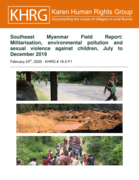
Over the reporting period, economic actors continued to carry out their activities with little regard for their impacts on the livelihoods of the communities living in the surrounding areas. In Doo Tha Htoo (Thaton) District, cold dust from a Tatmadaw-run cement factory contaminated nearby waterways
...
during the rainy season. As a result, civilians from at least 15 villages faced water shortages. In Mu Traw (Hpapun) and Kler Lwee Htoo districts, gold mining activities damaged forests and polluted water and soils in several village tracts. In both cases, the economic actors involved failed to secure the free, prior and informed consent (FPIC) of the local population, and did not compensate the affected communities for the damage caused.
more

The Western Pacific Regional Action Plan for the Prevention and Control of Noncommunicable Diseases (2014–2020) was developed in response to a resolution adopted at the sixty-second session of the WHO Regional Committee for the Western Pacific. The regional plan is fully harmonized with
...
the Global Action Plan for the Prevention and Control of Noncommunicable Diseases (2013–2020) while adding the value of actions that build on regional achievements, contexts, opportunities and perspective
more
COVID-19, a disease caused by a novel corona virus (SARS CoV-2), is currently a pandemic, which produces high morbidity in the elderly and in patients with associated comorbidities. Chronic kidney disease stage-5 (CKD-5) patients on dialysis [maintenance hemodialysis (MHD)or continuous ambulatory pe
...
ritoneal dialysis (CAPD)] are also vulnerable group because of their existing comorbidities, repeated unavoidable exposure to hospital environment and immunosuppressed state due to CKD-5. These patients are therefore not only more prone to acquire infection but also develop severe diseases as compared to general population.
more
COVID-19: Guidelines for case-finding, diagnosis, management and public health response in South Africa
recommended
Bham A., J. Bhiman, F. Bongweni et al.
Centre for Respiratory Diseases and Meningitis and Outbreak Response
(2020)
C2
The information contained in this document, be it guidelines, recommendations, diagnostic algorithms or treatment regimens, are offered in this document in the public interest. To the best of the knowledge of the guideline writing team, the information contained in these guidelines is correct. Imple
...
mentation of any aspect of these guidelines remains the responsibility of the implementing agency in so far as public health liability resides, or the responsibility of the individual clinician in the case of diagnosis or treatment.
more
This ten year global plan for measles and rubella outlines the strategy that needs to be fully implemented to achieve the measles and rubella goals endorsed by the World Health Assembly. The plan sets out the: vision, goals and targets for the 2011-2020 period, recommended strategies, guiding princi
...
ples, priorities, costing of reaching the targets, and the challenges as well as ways to overcome them.
more
Country overview: Kazakhstan
European Monitoring Centre for Drugs and Drug Addiction
(2015)
C2
Country overview: Kyrgyzstan
European Monitoring Centre for Drugs and Drug Addiction
(2015)
C2
Accessed: 28.03.2019
The object of this bill is to provide for a legal framework to promote the existence of Community Health Workers (CHWs) and to provide for clarity in the role and responsibilities assigned to CHWs in the Health sector and to promote and strengthen service delivery at the Community level.
...
The law will regulate training, certification and registration and set minimum qualifications and standards and working conditions for the CHWs.
more