
Filter
2153
Text search:
property
rights
Featured
280
492
Language
Document type
756
479
409
248
137
65
38
15
4
1
1
Countries
175
48
41
36
32
31
31
31
28
28
28
24
21
21
19
19
18
18
15
15
14
14
14
14
14
13
12
12
12
12
11
11
10
10
10
10
10
9
7
7
6
6
6
6
6
6
6
6
5
5
5
5
5
5
4
4
4
4
4
4
4
4
3
3
3
3
3
3
3
3
3
2
2
2
2
2
2
2
2
2
2
2
2
2
2
1
1
1
1
1
1
1
1
1
1
1
1
1
1
1
1
1
1
1
1
1
1
1
1
1
1
1
1
1
1
Authors & Publishers
Publication Years
Category
521
215
200
181
145
59
47
Toolboxes
189
162
121
98
96
94
92
88
87
86
62
61
56
51
49
44
42
41
37
32
19
14
8
8
4
3
2
The objective of this guideline is to present the complete set of all WHO recommendations and best practice statements relating to abortion. While legal, regulatory, policy and service-delivery contexts may vary from country to country, the recommendations and best practices described in this docume
...
These country reports provide information on the legal situation for displaced populations, namely asylum seekers, refugees, and returnees, where relevant, regarding access to mobile services, in each country covered
Essential medicines are those that satisfy the priority health care needs of a population. They are selected with due regard to disease prevalence and public health relevance, evidence of efficacy and safety and comparative cost-effectiveness. They are intended to be available in functioning health
...
The WHO Model List of Essential Medicines and Model List of Essential Medicines for Children are updated and published every two years, intended as a guide for countries or regional authorities to adopt or adapt in accordance with local priorities and treatment guidelines for the development and upd
...
Global Health Estimates
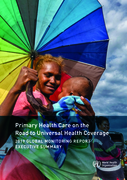
Countries must invest at least 1% more of GDP on primary health care to eliminate glaring coverage gaps
At current rates of progress up to 5 billion people will miss out on health care in 2030
Countries must increase spending on primary healthcare by at least 1% of their gross domestic product (
...

At present at least 2.2 billion people around the world have a vision impairment, of whom at least 1 billion have a vision impairment that could have been prevented or is yet to be addressed. The world faces considerable challenges in terms of eye care, including inequalities in the coverage and qua
...
The guidelines fill a gap in providing tools for surveying HIV prevalence in key populations, and the included questionnaires may also inform general population surveys. These guidelines standardize the conduct of biobehavioural surveys to permit comparisons between as well as within countries over
...
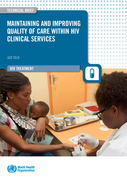
The objective of this brief is to consolidate WHO guidance to support the implementation of high-quality HIV services through approaches to policy, strategy and service delivery, to suggest considerations for selecting measures of high-quality services and to provide case examples of quality managem
...
HEARTS provides a set of locally adaptable tools for strengthening the
management of CVD in primary health care.
HEARTS is designed to enhance implementation of WHO PEN by providing:
• operational guidance on further integrating CVD management
• technical guidance on evaluating the impact of
...
Global HIV Strategic Information Working Group
For Populations At Risk For HIV
The pre-clinical pipeline shows more innovation and diversity, with 252 agents being developed to treat WHO priority pathogens.
However, these products are in the very early stages of development and still need to be proven effective and safe. The optimistic scenario, the report indicates, is for
...

This working paper was conceived to offer practical tips and suggestions on how to establish and sustain the multisectoral coordination needed to develop and implement National Action Plans on AMR (NAPs). It is intended for anyone with responsibility for addressing AMR at country level. Drawing on b
...
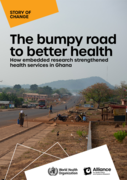
This is the story of how an experiment in the north of Ghana changed the health of a nation. How health staff in remote and rural areas are working tirelessly to prevent the deaths of mothers and children. How a radical approach to health research, known as embedded research, has revolutionized how
...

1 June 2020
Countries around the world are facing the challenge of increased demand for care of people with COVID-19, compounded by fear, misinformation and limitations on movement that disrupt the delivery of health care for all conditions. Maintaining essential health services: operational guidan
...

This primer aims to guide health professionals on engaging with WASH-related issues. It gives an overview of WASH interventions and the status of WASH services globally and outlines key linkages with health. It provides examples of key actions that health actors can take to ensure WASH efforts effec
...
The present Community Empowerment Manual draws upon the lessons learned of the Community Protection Approach implementation in Lebanon, the occupied Palestinian territory and Central America during the period 2015-2020 by WeWorld – GVC and its partners.
The Manual means to accompany Field Staff i
...
В настоящем документе представлен первоначальный обзор поступающей информации
(по состоянию на 2 июля 2020 г.) о взаимосвязи между COVID-19, НИЗ и факторами
риска НИЗ. Ре
...
A focus on Cambodia and Ethiopia
o date, little evidence is available on how such integration occurs at country level. To address this knowledge gap, WHO has conducted several in-depth situational analysis in countries that are undertaking actions to improve WASH in Health Care Facilities as part o
...
