
Filter
469
Text search:
MERS
Featured
73
40
Language
Document type
204
80
56
41
39
23
8
6
5
2
2
2
1
Countries
25
22
21
16
14
14
10
10
10
9
9
8
7
7
7
7
6
6
5
5
5
5
5
5
4
3
3
3
3
3
3
3
3
3
3
3
3
3
2
2
2
2
2
2
2
2
1
1
1
1
1
1
1
1
1
1
1
1
1
1
1
1
1
1
1
1
1
1
Authors & Publishers
Publication Years
Category
187
38
21
17
13
10
2
1
Toolboxes
317
28
20
10
8
8
7
7
6
5
5
4
4
3
3
3
2
2
2
2
1
1
1
1
1
6a edición clínica. Nuevo: 4. Vacunas (26 de abril); Nuevo: 5. Pruebas y procedimientos de diagnóstico (7 de abril); Nuevo: 7. COVID-19 persistente (7 de abril)
Il nuovo mini-textbook
Nei prossimi mesi, COVID Reference presenterà aggiornamenti regolari e racconterà i dati scientifici nel modo più completo possibile.
La 3ieme édition du nouveau mini-manuel.
Au cours des mois à venir COVID Reference publiera des mises à jour régulières.

WHO Guidance for Climate Resilient and Environmentally Sustainable Health Care Facilities
recommended
The aim of this guidance is to enhance the capacity of health care facilities to protect and improve the health of their target communities in an unstable and changing climate; and to empower health care facilities to be environmentally sustainable, by optimizing the use of resources and minimizing
...

Les données COVID-19 anonymisées reçues des États Parties par l’intermédiaire de la plateforme de données COVID-19 resteront la propriété de l’État Partie contributeur et seront utilisées par l’OMS à des fins de vérification, d’évaluation et d’assistance conformément au RSI (
...
Orientations provisoires
6 avril 2020
Le présent document résume les recommandations de l’OMS sur l’utilisation rationnelle de l’équipement de protection individuelle (EPI) dans les établissements de santé et lors des soins à domicile, ainsi que lors de la manipulation des cargaison
...

Lignes directrices provisoires, 13 août 2020
L’OMS a établi cette brève note d’information pour répondre au besoin de recommandations sur la prestation sûre de soins à domicile aux patients présumés atteints de l’infection par le nouveau coronavirus (2019-nCoV) présentant des symptô
...
COVID Reference 2020.3 DEU
recommended
Accessed: 02.05.2020
These consolidated guidelines provide recommendations for comprehensive prevention and case management strategies in Kenya
Scope of the Guidelines: Infection prevention and control Patient triage Emergency Medical Services Case management Laboratory testing algorithm
Target
...

Accessed: 02.05.2020
These interim IPC recommendations for health settings have been developed through the contributions of many individuals and institutions, such as the Centers for Disease Control-Kenya; ITECH; US Agency for International Development (USAID) Medicines, Technologies, and Pharmaceu
...

Uso racional de equipamentos de proteção individual para a doença causada pelo coronavírus 2019 (COVID-19)
recommended
Orientação provisória, 6 de abril de 2020
Este documento resume as recomendações da OMS para o uso racional de equipamentos de proteção individual (EPIs) em unidades de saúde e na assistência domiciliar, bem como no manuseio de cargas; avalia também a situação atual da cadeia de abastec
...

Este documento apresenta uma orientação provisória sobre a gestão do fornecimento de sangue em resposta à pandemia da doença causada pelo novo coronavírus (COVID-19). É dirigido a serviços de hemoterapia, autoridades nacionais de saúde, e outros responsáveis pelo fornecimento de sangue e
...
Presently, there is no evidence that the virus responsible for the current COVID-19 pandemic is carried by domestic food-producing animals, such as chickens, ducks, other poultry, pigs, cattle, camels, horses, sheep, goats, rabbits, guinea pigs or fish. While live animals can be a source of pathogen
...
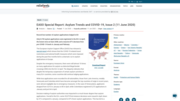
Only 8,730 asylum applications were registered in the EU+ in April, the lowest since at least 2008, and a massive 87% decrease from pre-COVID-19 levels in January and February.
The European Asylum Support Office (EASO) has released a special report which shows that the COVID-19 related travel restr
...
orientaciones provisionales, 23 de diciembre de 2020
En este documento se resumen las recomendaciones de la OMS para utilizar de forma racional los equipos de protección personal (EPP) tanto en los centros sanitarioscomo en los domicilios, así como durante la manipulación
...
Der Artikel "Händedesinfektion unter den Bedingungen der SARS-CoV-2-Pandemie" war am 4.5.2020 online vorab erschienen und ist nun in der regulären Ausgabe des Epidemiologischen Bulletins 19/2020 zu finden.
Mund-Nasen-Bedeckung im öffentlichen Raum als weitere Komponente zur Reduktion der Übertragungen von COVID-19. Strategieergänzungen zu empfohlenen Schutzmaßnahmen und Zielen (3. Update) Das RKI empfiehlt ein generelles Tragen einer Mund-Nasen-Bedeckung (MNB) in bestimmten Situationen im öffentl
...

How should humanitarian organisations prepare and respond to COVID-19 in humanitarian settings in low- and middle-income countries?
This Rapid Learning Review outlines 14 actions, insights and ideas for humanitarian actors to consider in their COVID-19 responses. It summarises and synthesises the
...
As information about COVID-19 is rapidly evolving, it can be challenging to navigate and synthesize all of the information. The purpose of this document is to provide a synthesized, indexed reference of accurate, standardized COVID-19 information from trustworthy sources. Information is presented in
...
