
Filter
2628
Text search:
Procurement
Featured
300
840
Language
Document type
1294
446
399
190
158
61
35
27
8
5
2
2
1
Countries
134
118
93
85
80
71
68
66
63
52
49
47
45
44
44
43
41
41
35
33
32
30
28
26
24
21
21
20
19
18
18
17
17
17
15
15
14
12
12
11
10
9
9
9
8
8
7
7
7
6
6
6
6
6
6
5
5
5
5
5
4
4
4
4
4
3
3
3
3
3
3
3
3
3
3
3
3
3
3
3
3
3
2
2
2
2
2
2
2
2
2
2
2
2
2
2
2
2
2
2
2
1
1
1
1
1
1
1
1
1
1
1
1
1
1
1
1
1
1
1
1
1
1
1
1
1
1
1
1
1
1
1
1
1
1
Authors & Publishers
Publication Years
Category
1227
189
184
137
97
56
24
1
Toolboxes
261
165
113
113
85
84
80
72
69
69
68
58
51
50
46
42
41
30
30
20
15
13
11
5
3
1

This multi-hazard Health Emergency Alert and Response Framework provides guidance for coordinating emergency response in countries, under the global Health Emergency Preparedness, Resilience and Response (HEPR) framework. It outlines the public health functions, coordination systems and actions need
...

This tool enables a rapid, systematic review of pharmacy curricula at the national or institutional level to evaluate their robustness in delivering the expected content and competencies. It can also assist institutions in designing strategies to strengthen AMR curricular content, and to facilitate
...

This guidance addresses one type of generative AI, large multi-modal models (LMMs), which can accept one or more type of data input and generate diverse outputs that are not limited to the type of data fed into the algorithm. It has been predicted that LMMs will have wide use and application in heal
...

TArtificial intelligence (AI) is transforming health systems, reshaping how care is planned, delivered and governed. This report presents the first assessment of AI integration into health systems across the whole of the WHO European Region, based on findings from the 2024–2025 survey on AI for he
...

A Global Access Framework for Country-Led.
ResponsesThis 2030 Prevention access framework focuses on one of those top-line targets, which covers primary prevention and requires that 90% of people in need of HIV prevention are using effective prevention options by 2030. This target is disaggregated
...

Indicators and questions to monitor progress towards the Global AIDS Strategy 2026-2031 targets

Global consultation report Lyon, France 12-15 December 2023

Western Pacific surveillance and response journal: WPSAR Vol.14 No. 6, Special Edition, pp.1-17
Hand hygiene is a simple yet powerful tool in interrupting the transmission of the monkeypox virus (MPXV) and other infectious disease both in healthcare facilities and communities. However millions still lack access to basic hygiene services particularly in vulnerable and resource limited settings.
...

The ultimate aim of the framework is to assist the user to thoughtfully, deliberately, ethically, and rationally determine whether or not the delivery of one or more vaccines to specific target populations during the acute phase of an emergency would result in an overall saving of lives, a reduction
...

Key resources include the Manual for Disaster Response Teams, which helps experts plan public communication, exchange information, and manage media, ensuring crucial data reaches humanitarian actors

It provides comprehensive guidance for logistics planners in humanitarian responses to pandemics, covering preparedness, response strategies, assessment methodologies, and operational planning.
This guidance document, titled 'Preparedness Enabler's Guide (PEG)', published in May 2023, aims to promote effective and sustainable localization in humanitarian preparedness through insights and practical tools derived from the Global Logistics Cluster's experience.

Community-led responses (CLRs) are a vital pillar of the HIV response and central to achieving national and global targets, including the 30-80-60 commitments outlined in the 2021 Political Declaration on HIV and AIDS. These guidelines provide practical, step-by-step methods for costing and budgetin
...
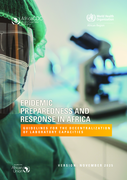
Epidemic Preparedness and Response in Africa | Guidelines for the Decentralization of Laboratory Capacity
recommended
New
The decentralization of laboratory capacities is a critical strategy for improving epidemic preparedness and response in Africa. Centralized systems often delay case confirmation, hinder timely interventions, and exacerbate the impact of outbreaks, especially in rural and hard-to-reach areas.
Thi
...
Préparatiom et la riposte aux Épidémies er Afrique guide de Décentralisation des capacités de Laboratoire
recommended
New
L’augmentation en fréquence et en ampleur des urgences de santé publique en Afrique met en évidence
l’importance cruciale d’un dépistage précoce, d’une intervention rapide et d’un accès équitable aux
capacités de laboratoire. Les systèmes centralisés se sont souvent révélés
...

The Marburg Virus Disease (MVD) Response Plan outlines Tanzania’s national strategy for responding to a Marburg virus outbreak declared in the Kagera Region in January 2025. The document describes the current epidemiological situation, assesses the risks posed by the outbreak, and sets strategic o
...
French version of "Developing Pharmacy Practice" - WHO/FIP Joint handbook - Ce manuel expose un nouveau paradigme de pratique pharmaceutique. Il a pour but de guider les enseignants en pharmacie pour qu’ils intègrent cette nouvelle pratique pharmaceutique, de former les étudiants
...
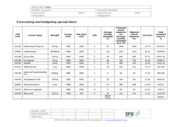
Last revised 2015.
Original Word document on: http://www.epnetwork.org/Resources/Standard%20Operating%20Procedure/Forecasting%20and%20budgeting%20spread%20sheet_Form.doc
