
Filter
2281
Text search:
stock
levels
Featured
Recommendations
209
New Publications
761
Language
Document type
No document type
1308
Studies & Reports
379
Guidelines
269
Manuals
119
Strategic & Response Plan
115
Situation Updates
29
Training Material
26
Fact sheets
25
Brochures
4
Infographics
3
Resource Platforms
2
Online Courses
1
Videos
1
Countries / Regions
India
115
Uganda
100
Kenya
99
Global
96
Ethiopia
72
Malawi
66
Liberia
65
Nigeria
62
Sierra Leone
60
South Africa
53
Tanzania
50
Myanmar / Burma
47
Nepal
46
Zambia
44
Ghana
42
Rwanda
41
Namibia
34
Bangladesh
33
Africa
31
Western and Central Europe
29
Ukraine
28
Congo, Democratic Republic of
27
Syria
25
Lesotho
25
Zimbabwe
24
Haiti
20
Senegal
19
South Sudan
18
Philippines
15
Botswana
15
Guinea
14
Cambodia
14
Indonesia
14
Mozambique
14
West and Central Africa
14
South–East Asia Region
14
Latin America and the Carribbean
14
Asia
13
East and Southern Africa
12
Eastern Europe
12
Cameroon
11
Pakistan
11
Eswatini/ Swaziland
11
Venezuela
11
Burkina Faso
10
Yemen
9
Middle East and North Africa
8
Afghanistan
7
Central African Republic
7
Sudan
6
Benin
6
Albania
6
Lebanon
5
Russia
5
Côte d’Ivoire / Ivory Coast
4
Somalia
4
Jordan
4
Gambia
4
Colombia
4
Sri Lanka
4
Western Pacific Region
4
Eastern Europe and Central Asia
4
Palestine
4
Moldova
4
Georgia
4
Togo
3
Iraq
3
Germany
3
Chad
3
Papua New Guinea
3
Burundi
3
Mexico
3
Timor Leste/ East Timor
3
Tajikistan
3
Iran
3
Vietnam
3
Jamaica
3
Mali
2
Guinea-Bissau
2
Morocco
2
Thailand
2
China
2
Argentina
2
Peru
2
Brazil
2
Greece
2
Angola
2
Laos
2
Kyrgyzstan
2
Kazakhstan
2
Turkmenistan
2
USA
1
Saudi Arabia
1
Niger
1
Turkey
1
Mauritania
1
Singapore
1
North Macedonia
1
Hungary
1
Croatia
1
El Salvador
1
Bolivia
1
Madagascar
1
Chile
1
Bhutan
1
Djibouti
1
Lithuania
1
Uzbekistan
1
North America
1
Gabon
1
Denmark
1
Maldives
1
Mauritius
1
Tunisia
1
Norway
1
Portugal
1
Guyana
1
Authors & Publishers
Publication Years
Category
Countries
1127
Key Resources
149
Clinical Guidelines
134
Women & Child Health
100
Public Health
98
Pharmacy & Technologies
33
Capacity Building
20
Toolboxes
COVID-19
165
HIV
163
TB
124
Planetary Health
78
Ebola & Marburg
71
Conflict
68
Pharmacy
67
AMR
63
NTDs
55
Malaria
51
Natural Hazards
50
Mental Health
43
Rapid Response
41
Health Financing Toolbox
41
Caregiver
40
Disability
38
Refugee
34
Global Health Education
34
Cholera
32
2.0 Rapid Response
25
NCDs
20
Polio
14
Specific Hazards
8
Zika
5
Social Ethics
5
Typhoon
3
South Sudan
1

This global guidance was developed to support malaria-free countries and those that are close to malaria elimination to prevent re-establishment. The document outlines key concepts and principles for preventing re-establishment and provides guidance on strategies, interventions, planning and managem
...

The Ghana National Malaria Strategic Plan 2021–2025 aims to reduce malaria mortality by 90% and malaria cases by 50% (using 2019 as baseline) and to achieve pre-elimination in at least six districts by 2025. The plan focuses on scaling up prevention measures like distributing insecticide-treated n
...

The National Strategic Plan on Malaria Prevention and Elimination Period 2021 – 2025 seeks to build on the previous national successes of the National Institute of Malariology, Parasitology, and Entomology (NIMPE) while addressing current challenges to reduce the overall burden of malaria in the S
...

This guidance covers different options for banning or phasing out a pesticide and suggests related risk reduction measures to be taken during the phase-out period. A key focus of this guidance is how to take action to manage, prevent, minimize, and communicate about identified risks during the imple
...

This publication provides guidance for planning country-specific programming to achieve the triple elimination of mother-to-child (or vertical) transmission of HIV, syphilis and hepatitis B virus. It is based on the WHO Triple Elimination Framework, which promotes an integrated, person-centred appro
...
This operational guidance provides a structured approach to support countries in sustaining priority services for HIV, viral hepatitis and sexually transmitted infections in the context of reduced external funding. The guidance is intended for national governments, public health programmes, communit
...

Growing emergencies and displacements across the world demand increasingly complex interventions and responses. The World Health Organization (WHO) has developed Malaria control in emergencies: a field manual to provide technical guidance to help partners respond effectively to malaria in emergency
...

This publication provides an overview of evidence and guidance on the growing challenge of workplace heat stress in the context of climate change. It highlights the health and productivity risks faced by billions of workers, especially in manual labor sectors. The report details the physiological, s
...

The 2022 report reviews the global malaria diagnostics market and technological landscape to support Unitaid’s 2023–2027 strategy for quality malaria case management. The report highlights the stalled progress of malaria control efforts, the gaps in access to diagnostics and the public health im
...

Malaria remains a significant public health concern in the SADC region, accounting for 20% of childhood deaths, as well as prompting numerous outpatient visits and hospitalisations. Around three-quarters of the population, including 35 million children under the age of five and 8.5 million pregnant
...

Non-Communicable Diseases (NCDs) have emerged as conditions of great public health concern in Kenya accounting for 39% of deaths annually. The Ministry of Health through the Department of Non-Communicable Diseases has adopted the vision of achieving a nation free from preventable burden of NCDs. Fur
...
These guidelines have been developed in simple, user-friendly language and they explain the procedures for patients’ access to and the safe management of Schedule I and II drugs that are necessary for the treatment and relief of moderate to severe pain. They provide both procedures for acquisition
...

This document outlines the plan for a continental cholera prevention and control with the implementation framework for the Cholera IMST, detailing its governance structure, strategic priorities, and operational modalities

PHSM are vital in reducing the risk and scale of infectious disease transmission and lowering hospitalization and deaths. Examples include contact tracing, quarantine and isolation, mask use, ventilation, school or workplace measures, mobility restrictions and travel requirements.
While these mea
...

This brief report summarizes recent information on HIV drug resistance (HIVDR) in the era of integrase-strand transfer inhibitors (INSTI) for HIV prevention and treatment.

In an era of constrained resources and tightening budgets, strategic prioritization in tuberculosis (TB) programming is more critical than ever. Countries must make informed decisions to allocate limited resources effectively - maximizing impact, preventing avoidable deaths, and sustaining progress
...

The findings of the report are both urgent and devastating. At the current rate of progress, by 2040 we would still have 1.9 million new HIV infections and 990,000 AIDS-related deaths in children. But if funding for HIV prevention and treatment continues to fall as current trends suggest, the world
...

Operational Guidance. This operational guidance provides a structured approach to support countries in sustaining priority services for HIV, viral hepatitis and sexually transmitted infections in the context of reduced external funding. The guidance is intended for national governments, public healt
...
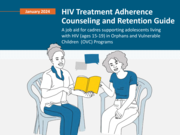
A job aid for cadres supporting adolescents living with HIV (ages 15-19) in Orphans and Vulnerable
Children (OVC) Programs

These guidelines update earlier WHO recommendations to maximize the HIV prevention impact of safe VMMC services and aim to guide the transition to the sustained provision of interventions with a focus on the health and well-being of both adolescent boys and men.
