
Filter
387
Text search:
Revised
National
TB
Control
Programme,
India
Featured
Recommendations
43
New Publications
141
Language
Document type
No document type
271
Guidelines
44
Studies & Reports
37
Manuals
17
Strategic & Response Plan
11
Training Material
3
Situation Updates
3
Resource Platforms
1
Countries / Regions
India
100
Nepal
19
Myanmar / Burma
16
Global
10
South Africa
9
Nigeria
7
Bangladesh
7
South–East Asia Region
7
Malawi
6
Sierra Leone
4
Uganda
4
Pakistan
4
Indonesia
4
Asia
4
Kenya
3
Western and Central Europe
3
Africa
3
Congo, Democratic Republic of
2
Zambia
2
Tanzania
2
Mozambique
2
Namibia
2
Botswana
2
Sri Lanka
2
East and Southern Africa
2
Latin America and the Carribbean
2
Bhutan
2
Guinea
1
Senegal
1
Ethiopia
1
Zimbabwe
1
Philippines
1
Afghanistan
1
Syria
1
Cambodia
1
Thailand
1
Rwanda
1
Papua New Guinea
1
Central African Republic
1
Lesotho
1
Yemen
1
West and Central Africa
1
Middle East and North Africa
1
Eastern Europe and Central Asia
1
Eastern Europe
1
North Korea
1
Laos
1
Timor Leste/ East Timor
1
Russia
1
Vietnam
1
North America
1
Maldives
1
Authors & Publishers
Publication Years
Category
Countries
165
Clinical Guidelines
52
Women & Child Health
17
Public Health
12
Pharmacy & Technologies
6
Key Resources
5
Capacity Building
2
Toolboxes
TB
82
HIV
57
AMR
13
Global Health Education
11
NTDs
9
Caregiver
8
Disability
7
Refugee
7
COVID-19
7
Polio
6
Mental Health
5
Ebola & Marburg
4
Malaria
3
Planetary Health
2
Pharmacy
2
Health Financing Toolbox
2
Cholera
1
Conflict
1
Natural Hazards
1
Rapid Response
1
Specific Hazards
1
NCDs
1
Practical Guideline for collaborative interventions

Participant Manual September 2009
Guidance on TB and TB/HIV prevention, diagnosis, treatment and care in the workplace
One important application of digital health in TB patient care is the support that it can lend to medication adherence. TB programmes have already been using short message
...

Despite being a preventable and curable infectious disease, tuberculosis (TB) has continued to elude global controll efforts. In 2023, 8.2 milion people with TB were diagnosed and notified to the WH
...

The National Strategic Plan is based on the following guiding principles:
1) Life-course approach: adolescence is a key decade in the course of life that influences the health outcomes later in life.
2) Comprehensive approach: It recogniz ...
1) Life-course approach: adolescence is a key decade in the course of life that influences the health outcomes later in life.
2) Comprehensive approach: It recogniz ...

Addressing comorbidities and risk factors for TB is a crucial component of Pillar one of the End TB Strategy, which focuses on integrated patient-centred care and prevention, including action on
...
Undernutrition increases the risk of tuberculosis (TB) and in turn TB can lead to malnutrition. Undernutrition is therefore highly prevalent among people with
...

Meeting Report 27-29 October 2020
The overall goal of the meeting was to discuss recent changes in treatment regimens and diagnostics for drug-resistant TB and to determine how these impact on the definition of XDR-
...

Antimicrobial resistance (AMR) is an important public health concern shared by developed and developing countries. In developing countries the burden of infectious diseases is greater and exacerbated by limited access to, and availability and affordability of, antimicrobials required to treat infect
...
These guidelines – an update to the World Health Organization’s 2015 publication Consolidated strategic information guidelines – present a set of essential aggregate indicators and guidance on choosing, collecting and systematically analysing strategic information to manage and monitor the
...

WHO consolidated guidelines on tuberculosis: Module 6: tuberculosis and comorbidities, 2nd ed
recommended
Addressing TB comorbidities and risk factors is central to the World Health Organization (WHO) End TB Strategy. These guidelines consolidate the latest WHO recommendations on
...

About one fourth of the world’s population is estimated to have been infected with the tuberculosis (TB) bacilli, and about 5–10% of those infected develop TB disease in their lifetime. The risk
...

Addressing comorbidities and risk factors for tuberculosis (TB) is a crucial component of the World Health Organization (WHO)’s End TB Strategy. This WHO operational handbook on tuberculosis. Modu
...
Addressing comorbidities and risk factors for tuberculosis (TB) is a crucial component of the World Health Organization (WHO)’s End TB Strategy. This WHO operational handbook on tuberculosis. Mo
...
A community-based approach.
These guidelines focus on manmade rather than natural disasters, but our experiences in India, El Salvador and Pakistan (earthquake interventions), and following the 2004 tsunami, cyclone Nargis in 2008 and the Haiti ear
...
This document is intended for a wide audience including national and local policymakers, implementers and managers of national and local maternal and child health programmes, non-governmental and ot
...
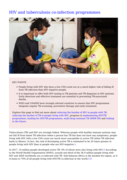
People living with HIV who have a low CD4 count are at a much higher risk of falling ill from TB infection than HIV negative people.
It is important to offer both HIV testing to TB patients an
...
This handbook builds on lessons learned from surveys implemented 2015-2017 and advice provided by the Global task force on TB patient cost surveys. It provides a standardized methodology for conducting health facility-based cross-sectional surveys t
...
