
Filter
1921
Text search:
substance
use
management
Featured
247
439
Language
Document type
1110
298
215
156
63
43
23
8
2
2
1
Countries
87
61
57
57
53
38
38
37
31
31
30
26
23
23
22
21
21
20
18
16
16
15
14
14
14
14
14
12
11
11
9
9
8
7
7
6
6
6
6
5
5
5
5
5
4
4
4
4
4
4
3
3
3
3
3
3
3
3
3
2
2
2
2
2
2
2
2
2
2
2
2
2
2
2
2
2
2
1
1
1
1
1
1
1
1
1
1
1
1
1
1
1
1
1
1
1
1
1
1
1
1
1
1
1
1
Authors & Publishers
Publication Years
Category
634
139
99
94
88
40
27
1
Toolboxes
540
98
92
90
64
49
49
47
33
32
30
29
27
25
21
20
17
15
12
12
10
9
5
4
The document is a summary report by the World Health Organization (WHO) Regional Office for the Eastern Mediterranean, focusing on a capacity-building workshop held in Abu Dhabi in 2019. The workshop addressed the management and care of
...
The new guide provides practical, first-line management recommendations for mental, neurological and substance use conditions. Contents include mod
...
As part of the Mental Health Gap Action Programme, WHO has developed training manuals (Training of trainers and supervisors training manual and Training of health-care providers training manual) to support implementation of the mhGAP Intervention Guide for mental, neurological and
...
This module should always be used together with the
mhGAP Intervention Guide for Mental, Neurological
and Substance Use Disorders in Non-specialized Health
Settings (WHO, 2010), which outlines re
...
The manual is written for clinicians working at the district hospital (first-level referral care) who diagnose and manage sick adolescents and adults in resource constrained settings. It aims to support clinical reasoning, and to provide an effective clinical approach and protocols for the
...
املعالجة الرسيرية
لالضطرابات النفسية والعصبية واستخدام مواد اإلدمان
يف حاالت الطوارئ اإلنسانية
Mhgap Humanitarian Intervention Guide (mhGAP-HIG): Clinical management
...
Лечение психических и неврологических расстройств
и расстройств, связанных с употреблением наркотиков
и других веществ, в чрезвычайных гуманитарных ситуациях
...

WHO guideline on balanced national controlled medicines policies to ensure medical access and safety
Access to medicines is essential for attainment of universal health coverage, which is central to achievement of the health-related Sustainable Development Goals. Controlled medicines include those such as opioids, benzodiazepines, barbiturates, amphetamines and others with identified or emergent cl
...
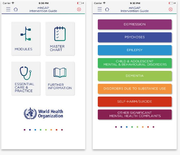
WHO’s mhGAP Intervention Guide 2.0 app, launched in October, is now available in both iOS and Android. The app provides non-specialized health-care providers with access to comprehensive information to help them diagnose and treat a range of mental, neurological and
...
The world is facing an unprecedented range of emergencies. In reaction to these complex adversities, many people experience considerable distress and impairment, and a minority may even go on to develop mental health conditions. Meanwhile, those with pre-existing mental health conditions may experie
...

Addressing comorbidities and risk factors for tuberculosis (TB) is a crucial component of the World Health Organization (WHO)’s End TB Strategy. This WHO operational handbook on tuberculosis. Module 6: tuberculosis and comorbidities aims to support countries in scaling up people-centred care, base
...
Accessed: 21.03.2019
Substance use disorders
Chapter G.3
Manual for use in primary care.
This manual explains the theoretical basis and evidence for the effectiveness of brief interventions and assists primary health care workers in conducting a simple brief intervention for clients whose
...
Perspectives on drugs
